Lesson 04 — My Body's Feeling Map
Learners make a personal "body feeling map," writing or drawing the feeling that shows up in each part of their body, and use it as a check-in tool they can keep.
Objectives
Objectives
- D03.S1.02.02 Notice where a feeling shows up in the body, such as a fast heartbeat when excited, and name the feeling.
Essential question
How do I name the feeling my body is showing me?
Key vocabulary
Materials
Standard materials
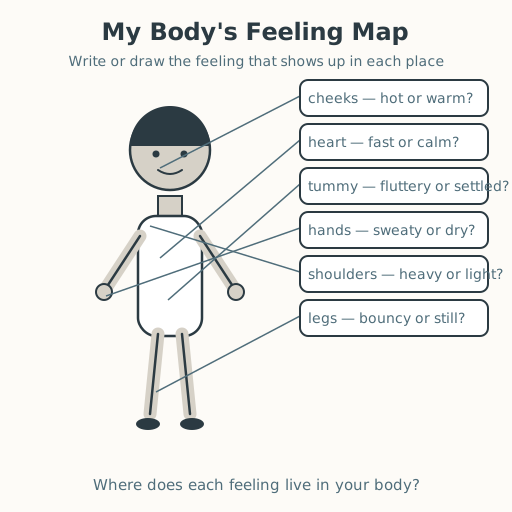
- Body-map worksheet or a drawn body outline · per learner A simple body outline with blank boxes beside the cheeks, chest, tummy, hands, shoulders, and legs
- Crayons or markers · per learner For drawing and writing the feeling in each spot
- Feeling word cards · 1 set Excited, nervous, sad, mad, calm, happy — to help learners choose words
Low-tech / no-cost
- A chalk body outline or traced own-body outline Draw around a friend on paper or in chalk, then mark the feeling spots on it
- Voice and pointing Point to each body spot and say the feeling that lives there; no paper needed
Enriched / lab & device
- Laminated body-map sheets and dry-erase markers · per learner Reusable maps for repeated feeling check-ins all year
- A "feelings check-in" corner with a mirror and feeling word cards · 1 set A quiet spot where learners can look at their own face and map a feeling privately
Works in different contexts
- large-group Make one big body outline together on a board, and fill in each spot as a class before learners do their own
- self-directed A learner fills in their own body map alone, choosing from the feeling word cards, and keeps it as a private check-in
- outdoor-only Draw a big body outline in the dirt or sand and place a stone or leaf on each feeling spot while naming it
- level-grouped Learners who read and write easily write the feeling words; others draw a face in each spot or point and say it aloud
Materials
Lesson 4 — My Body’s Feeling Map
Summary
Learners turn what they learned about feeling spots into a personal tool: a body map. They write or draw the feeling that shows up in their cheeks, chest, tummy, hands, shoulders, and legs, then keep the map as a private check-in they can use any day.
Objectives
- Notice where a feeling shows up in the body and name the feeling. (D03.S1.02.02)
Connection
A map helps you find your way. Your body has a map too: excitement lives in a fast heart, worry in a fluttery tummy, sadness in heavy shoulders. When you draw your own body’s feeling map, you build a tool for finding your way back to calm — because once you can name a feeling, you can take care of it.
Materials
- Body-map worksheet or a drawn body outline
- Crayons or markers
- Feeling word cards (excited, nervous, sad, mad, calm, happy)
Preparation
- Print or draw a body-map worksheet: a simple body outline with a blank box beside the cheeks, chest, tummy, hands, shoulders, and legs.
- Set out crayons and feeling word cards.
- Prepare a place for learners to keep their finished maps.
Facilitator note
This lesson is written to the learner (“you”) so it works in a classroom and for a self-directed learner. Prepare the worksheets and word cards, then guide the mapping and the closing check-in. This is a private, personal artifact — a learner may keep it to themselves and share only what they choose. Never grade or rank a body map, and never correct a learner’s answer: where a feeling shows up is different for every person, and every answer is honest. Honor every body — the map is the learner’s own body, not a “standard” one. Learners who cannot write may draw a face in each box or point and say the feeling; those are equal ways to make the artifact. The map becomes a quiet tool the learner can return to all year.
Procedure
- Gather (5 min). You have learned that feelings show up in the body. Today you will draw a map of your own body’s feelings — a tool you can keep.
- Look at the map (10 min). Look at the body outline. Find the six spots: cheeks, chest (heart), tummy, hands, shoulders, and legs. Point to each one on your own body.
- Fill in your map (15 min). In each box, draw or write the feeling that shows up there for you. Maybe your cheeks get warm when you are mad, your heart beats fast when you are excited, your tummy flutters when you are nervous, your shoulders feel heavy when you are sad. Use the feeling word cards if they help. Your map is yours — every body is different.
- Check in (10 min). Look at your finished map. Which spot is your body feeling right now? Name it quietly to yourself. If you want, show a partner one spot and the feeling that lives there.
- Close (5 min). Keep your map somewhere safe. Naming a feeling is the first step to caring for it.
Differentiation
- Support: Fill in one spot together first, with the learner choosing the feeling and the facilitator or partner writing it.
- Extension: Ask learners to add a seventh spot of their own — a place only they know a feeling shows up — and name it.
Assessment
- Formative (observation): Can the learner point to a body spot and name the feeling that shows up there for them?
- Artifact (portfolio): The completed body feeling map, kept in the learner’s portfolio as a private check-in tool.
Resources
- CASEL — Fundamentals of Social and Emotional Learning: https://casel.org/fundamentals-of-sel/
Home connection
Keep your body map where you can see it at home, and use it to check in with yourself each day.