Lesson 05 — Combining Movements
Learners join two movements into one sequence — hopping then turning, running then catching — and practice performing the order with control, with adapted versions for every body.
Objectives
Objectives
- D03.S2.02.01 Combine movements in a sequence, such as running and catching or hopping and turning.
Essential question
How do I combine two movements into one sequence?
Key vocabulary
Materials
Standard materials
- Cones, chalk, or rope · 1 set To mark a clear space and a path for the movement practice
- Soft scarves or beanbags · per learner To catch while running, or to toss and catch in place
- A beat source (clapping or drum) · 1 Optional, to keep a steady rhythm while moving
Low-tech / no-cost
- Your own body and open space Combine two movements with nothing but your body — hop and turn, run and catch your own tossed scarf
- Voice and clapping Call out the order ("hop, then turn!") and clap a beat; no props needed
Enriched / lab & device
- A music player with a steady-beat song · 1 For moving a sequence in time to music
- Hula hoops or floor markers · 1 set To mark where to hop, turn, run, and catch in a clear order
Works in different contexts
- large-group Move in one direction around a marked loop so everyone has space and a clear path, and call the order aloud together
- self-directed A learner chooses two movements, puts them in order, and practices the sequence at their own pace, checking each part for control
- outdoor-only Combine movements along a clear outdoor path — hop then turn, or run then catch a tossed leaf or scarf — using the ground as the boundary
- multi-age Older learners demonstrate a two-movement sequence while younger learners copy, then take turns leading
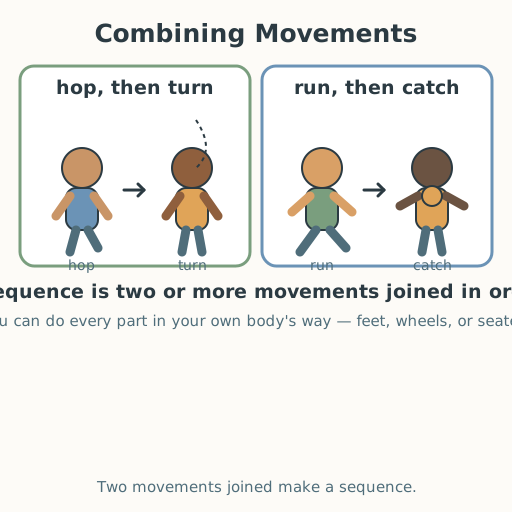
Lesson 5 — Combining Movements
Summary
Learners move from single movements to sequences. They learn that a sequence is two or more movements joined in an order, then practice combining movements — hopping then turning, running then catching — with control, in their own body’s way.
Objectives
- Combine movements in a sequence, such as running and catching or hopping and turning. (D03.S2.02.01)
Connection
Think of the things your body already does in an order without you even planning it: you run, then catch a ball; you hop, then turn to go back; you climb, then slide. A sequence is just movements joined in order, like the steps of a dance. Today you will put two movements together on purpose.
Materials
- Cones, chalk, or rope to mark a path
- Soft scarves or beanbags
- A beat source (clapping or drum, optional)
Preparation
- Mark a clear space and a simple path with cones, chalk, or rope.
- Set out soft scarves or beanbags for the catch part.
- Clear enough room for everyone to move without bumping.
Facilitator note
This lesson is written to the learner (“you”) so it works in a classroom and for a self-directed learner. Prepare the space, then model each two-movement sequence slowly before learners try. This spirals up from Grade 1’s single movements (skip, gallop, hop, jump) — now two movements join into a sequence. This is movement, not a race: celebrate control and order, never speed or distance. Honor every body: a learner who uses a wheelchair can run with their wheels and catch with a lap tray; a learner who needs support can do the sequence seated or with a partner’s help. Model adapted versions as real choices, never second choices. Call the order out loud and keep a visual beat going (a bouncing hand) so learners who are deaf or hard of hearing can follow. Invite everyone to rest and go at their own pace.
Procedure
- Warm up (5 min). March in place, then shake out your arms and legs. Your body is awake and ready.
- Learn the first sequence: hop, then turn (10 min). Try each part alone first. Hop on one foot. Then stand and turn all the way around. Now put them in order: hop, then turn. Do it slowly at first, arms out for balance.
- Learn the second sequence: run, then catch (10 min). Run a few steps in place or to a mark. Then catch a scarf or beanbag you toss to yourself. Now put them in order: run, then catch. Eyes on the scarf, hands ready.
- Put it together (15 min). From the starting mark, do your first sequence — hop, then turn. Then your second — run, then catch. Say the order out loud as you move: “hop, turn. Run, catch.” Do every part in your own body’s way — with wheels or seated springs if that is you.
- Close (5 min). Slow down and catch your breath. You just joined movements into a sequence — a movement story with a beginning and an end.
Differentiation
- Support: Practice each movement alone first, then join only two parts; clap or count the order slowly.
- Extension: Ask learners to reverse the order (turn, then hop) or add a third movement to the sequence.
Assessment
- Formative (observation): Can the learner combine two movements in an order with control, in their own body’s way?
Home connection
Show someone at home a two-movement sequence — hop then turn, or run then catch — and teach them the order.