Lesson 06 — A Movement Sequence of My Own
Learners plan their own three-movement sequence — first, then, last — rehearse it, and perform it with control, then share it with the group.
Objectives
Objectives
- D03.S2.02.01 Combine movements in a sequence, such as running and catching or hopping and turning.
Essential question
How do I build and perform a movement sequence of my own?
Key vocabulary
Materials
Standard materials
- Sequence cards or a drawing sheet · per learner Three numbered boxes — first, then, last — to plan the sequence
- Cones, chalk, or rope · 1 set To mark a performance space
- A beat source (clapping or drum, optional) · 1 To keep a steady rhythm while performing
Low-tech / no-cost
- Your own body and voice Plan and perform the sequence with nothing but your body, saying "first, then, last" aloud
- The ground or sand Draw your sequence in the dirt or sand — a hop mark, a turn arrow, a balance spot
Enriched / lab & device
- A music player with a steady-beat song · 1 To perform the sequence in time to music
- Movement picture cards · 1 set Cards showing hop, turn, balance, jump, skip, and spin to choose from when planning
Works in different contexts
- large-group Plan sequences in pairs, then have small groups perform in a clear space while the class watches and cheers
- self-directed A learner plans their own three-step sequence, practices it, and performs it for a mirror, a recording, or no audience at all
- outdoor-only Plan and perform the sequence across a clear outdoor space, using natural marks — a rock to hop to, a tree to turn around, a line to balance on
- multi-age Older learners help younger learners plan and rehearse a sequence, then everyone performs together
Materials
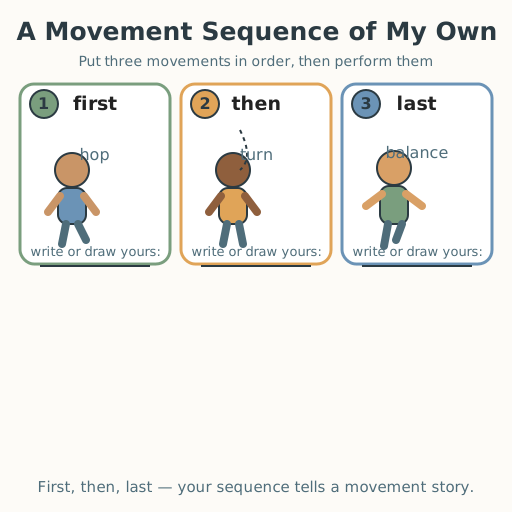
Lesson 6 — A Movement Sequence of My Own
Summary
Learners become authors of their own movement. They plan a three-part sequence — first, then, last — choose three movements, rehearse them in order, and perform the sequence with control for the group. Every sequence is the learner’s own, in their own body’s way.
Objectives
- Combine movements in a sequence, such as running and catching or hopping and turning. (D03.S2.02.01)
Connection
Every day you already do little sequences — you wake, then wash, then eat; you pick up a ball, then run, then throw. A sequence is just “first, then, last.” Today you get to choose the order yourself and make a movement story that is all yours.
Materials
- Sequence cards or a drawing sheet with three numbered boxes
- Cones, chalk, or rope
- A beat source (optional)
Preparation
- Prepare a sequence sheet with three numbered boxes labeled first, then, last.
- Mark a performance space.
- Optional: prepare movement picture cards (hop, turn, balance, jump, skip, spin).
Facilitator note
This lesson is written to the learner (“you”) so it works in a classroom and for a self-directed learner. Prepare the sequence sheets and space, then guide planning, rehearsal, and performance. The goal is authorship and control, not a flawless show — praise order and effort, never compare performances. Honor every body: a sequence can be done seated, with wheels, with a partner, or with arms only, and it counts fully. Learners who do not want to perform for the group may perform for a partner, a mirror, or a recording, or narrate their sequence aloud. Keep the audience kind — watching and cheering is part of the skill.
Procedure
- Gather (5 min). Last time you joined two movements into a sequence. Today you will build one of your own, with three parts.
- Plan (10 min). Look at your sequence sheet — three boxes: first, then, last. Choose three movements. Maybe first you hop, then you turn, last you balance. Or first you skip, then you jump, last you spin. Draw or write your plan in the three boxes.
- Rehearse (15 min). Practice your sequence in order, slowly at first. Say the words as you move: “first hop, then turn, last balance.” Check each part for control. If a part is hard, swap it or do it in your own body’s way — that is your choice.
- Perform (10 min). Perform your sequence for the group, a partner, or a mirror. Watch your friends and cheer them on. Every sequence is different, and every one is good.
- Close (5 min). You are the author of your own movement story. How did it feel to plan and perform your own sequence?
Differentiation
- Support: Plan just two movements (first, then) and rehearse with a partner calling the order aloud.
- Extension: Ask learners to add a fourth movement, or to perform the sequence once fast and once slow, keeping the order.
Assessment
- Formative (performance/observation): Can the learner plan and perform a three-movement sequence in order with control, in their own body’s way?
- Artifact (portfolio): The completed sequence plan, kept in the learner’s portfolio.
Home connection
Teach your sequence to someone at home and perform it together, then let them make one up too.