Lesson 07 — Throwing and Catching with Both Hands
Learners practice throwing and catching a soft ball with both hands, aiming at a target and catching with ready hands, building control step by step in their own body's way.
Objectives
Objectives
- D03.S2.02.02 Throw, catch, and kick a ball with developing control using both hands and both feet.
Essential question
How do I throw and catch with both hands and growing control?
Key vocabulary
Materials
Standard materials
- Soft balls or beanbags · 1 per learner or pair Light and easy to catch, in a range of sizes
- A target (a hoop, bucket, or chalk circle) · 1 set For aiming practice
- Floor markers (cones, chalk, or rope) · 1 set To mark a throwing line
Low-tech / no-cost
- Rolled-up socks or crumpled paper balls A safe, no-cost ball that is easy to throw and catch
- A basket, box, or chalk circle A simple target made from what is around
Enriched / lab & device
- Balls of several sizes and softnesses · 1 set So each learner can choose the size and softness that fits their hands
- A velcro catch mitt set or large scoop · 1 set To help learners build catch success before catching with bare hands
Works in different contexts
- large-group Throw in one direction toward a wall or a row of targets so balls travel the same way and no one is in the line of throw
- self-directed A learner throws at a target and tosses to themselves to catch, checking their own control and trying both hands
- outdoor-only Throw and catch outside toward a wall, a tree target, or a partner, using a soft ball or rolled-up socks
- level-grouped Learners who catch easily use a smaller ball and stand farther back, while others use a larger, softer ball and a closer line
Lesson 7 — Throwing and Catching with Both Hands
Summary
Learners build ball control with their hands. They learn to throw with both hands toward a target and to catch with both hands ready and eyes on the ball, practicing at their own distance with the ball size that fits them.
Objectives
- Throw and catch a ball with developing control using both hands. (D03.S2.02.02)
Connection
Think of a game you have played with a ball, or a time you tossed something to a friend. Throwing and catching are how people play together all over the world — in a courtyard, a field, a beach, or a schoolyard. Using both hands, and practicing over and over, is how your hands learn to be ready and sure.
Materials
- Soft balls or beanbags
- A target (hoop, bucket, or chalk circle)
- Floor markers to mark a throwing line
Preparation
- Set up a throwing line and one or more targets at a reachable distance.
- Set out a range of soft balls and beanbags so each learner can choose what fits.
- Clear the throwing lane so no one is in the path of a throw.
Facilitator note
This lesson is written to the learner (“you”) so it works in a classroom and for a self-directed learner. Prepare the targets and line, then model a two-hand throw and a ready-hands catch slowly before learners try. This is skill-building, not competition: celebrate control and growing accuracy, never distance or speed. Honor every body: a learner who uses a wheelchair throws and catches seated, and that counts fully; a learner who needs a larger, softer ball or a scoop catches with a tool, and that counts too. Offer adapted versions as real choices. Supervise throws so everyone faces the same direction and no one is hit. Pair learners so a more confident catcher can toss gently to a partner still learning.
Procedure
- Warm up (5 min). Wiggle your fingers and roll a ball between your hands. Your hands are ready to work.
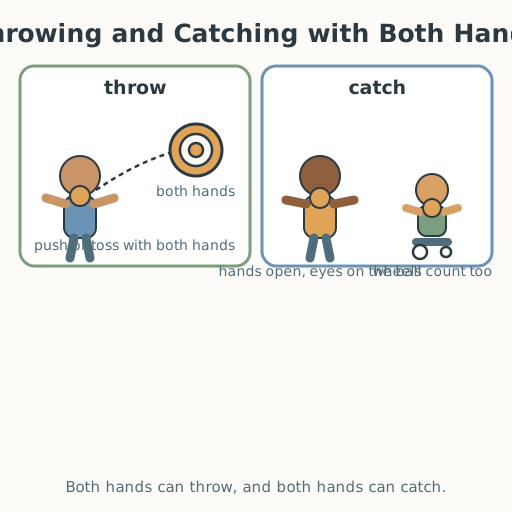
- Learn to throw (10 min). Hold the ball with both hands. Look at the target. Push or toss the ball toward it, releasing with both hands together. Try it slowly first. Then step back a little and try again — small steps build control.
- Learn to catch (10 min). Toss the ball a little up in the air and catch it with both hands. Keep your hands open and ready, and watch the ball all the way in. Catch it softly, like you are hugging it with your hands. If a friend tosses to you, keep your eyes on the ball.
- Practice both (15 min). Take turns with a partner: one throws with both hands, the other catches with both hands, then switch. Or throw at the target and catch your own rebound. Try the throw with your left hand forward, then with your right — both hands learn.
- Close (5 min). Shake out your hands. You threw and caught with both hands, and with every try your hands get a little surer.
Differentiation
- Support: Stand close to the target and use a large, soft ball or beanbag; catch with a scoop or mitt before bare hands.
- Extension: Ask learners to throw at a smaller target or from farther back, or to catch a ball tossed from the side instead of straight ahead.
Assessment
- Formative (observation): Can the learner throw toward a target and catch a soft ball with both hands, with growing control, in their own body’s way?
Home connection
At home, throw and catch a rolled-up pair of socks or a soft ball with someone, using both hands.