Lesson 05 — A Welcoming Group
Learners name what makes a group feel welcoming and inclusive — say hi, learn my name, make room, invite me in — and build a class welcome picture that shows everyone belongs.
Objectives
Objectives
- D02.S3.02.01 Explain what makes a group feel welcoming and inclusive to everyone in it.
Essential question
What makes a group feel welcoming and inclusive to everyone in it?
Key vocabulary
Materials
Standard materials
- Chart paper and markers · 1 sheet per group For a class "welcome picture" poster
- Welcome-steps cards · 1 set Cards reading "say hi", "learn my name", "make room", "invite me in"
Low-tech / no-cost
- Voices and bodies Act out each welcoming step with words and gestures; no cards or paper needed
- A real empty space Practice making physical room for a newcomer in the circle
Enriched / lab & device
- A map or photo set of welcomes around the world · 1 set Pictures of how people welcome newcomers in different places — a bow, a handshake, sharing tea, a song
- Camera or tablet · 1 per group Photograph the class welcome poster or a welcoming act for a class book
Works in different contexts
- large-group Build one big class welcome poster, with each learner adding one welcoming word or picture
- self-directed A learner draws a "welcome picture" of a group that includes everyone, then writes or says one way to make a newcomer feel welcome
- outdoor-only Form a circle outside and practice making room for a newcomer; then draw the welcome picture with a stick in the dirt or on paper
- multi-age Older learners share how they were welcomed into a new group; younger learners draw what welcome looks like
- level-grouped Pair a confident speaker with a quieter learner so every voice is heard in the sharing
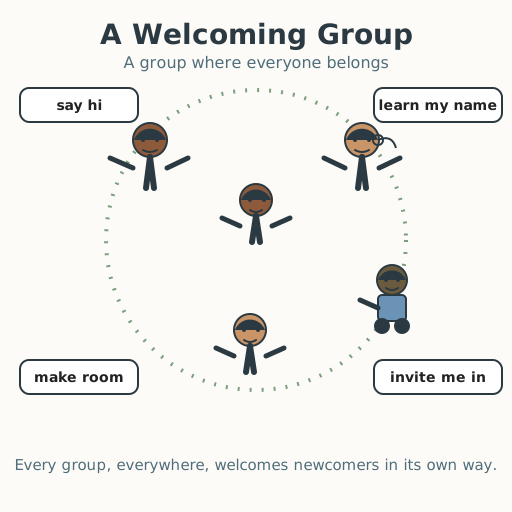
Lesson 5 — A Welcoming Group
Summary
Learners explore what makes a group feel welcoming and inclusive — saying hi, learning a name, making room, inviting someone in — and build a class welcome picture that shows everyone belongs. Welcoming is seen as something every group, everywhere, does in its own way.
Objectives
- Explain what makes a group feel welcoming and inclusive to everyone in it. (D02.S3.02.01)
Connection
Remember your first day in a new place — a new class, a new neighborhood, a new team. What made you feel like you belonged? Probably someone said hello, learned your name, made a space for you, and invited you into what they were doing. That is what a welcoming group does. In every part of the world, people welcome newcomers in their own way — a bow, a handshake, sharing tea, a song of welcome. Today you will name what welcome looks like and build a picture of a group where everyone belongs.
Materials
- Chart paper and markers
- Welcome-steps cards (“say hi”, “learn my name”, “make room”, “invite me in”)
Preparation
- Arrange a circle for gathering.
- Set out chart paper and markers for the welcome picture.
Facilitator note
Belonging is a deep human need, and inclusion is a practice, not a slogan (CASEL’s social-awareness competency). Teach the four welcome steps explicitly, with a worked example, then let learners build the picture together (Kirschner, Sweller & Clark, 2006). Keep two commitments in view: inclusion means everyone, not most — name language, ability, family shape, and body differences as reasons to adapt our welcome, never as reasons to exclude; and welcoming is mutual — the group welcomes the newcomer, and the newcomer’s own way of greeting is honored too. A newcomer should never be pressed to tell their story or name their difference; being welcomed is enough. A non-speaking learner contributes a welcome with a sign, a wave, or a picture; a learner with low vision describes what welcome sounds and feels like. Read the procedure aloud; model each step with voice and body.
Procedure
- Gather (5 min). Sit in a circle. Think: when did you feel truly welcome somewhere? What did people do?
- Meet the welcome steps (10 min). Learn and act out the steps: say hi (a wave or a smile); learn my name (say it, and try to say theirs); make room (open the circle and let someone in); invite me in (“Come join us!”). Wonder: how do people welcome others in different places and languages?
- Practice a welcome (10 min). Pretend one of you is new. The rest of the group practices all four steps — say hi, learn the name, make room, invite in. Swap so a different person is new each time.
- Build the welcome picture (15 min). Together, draw a picture of a welcoming group. Add everyone — every skin tone, every way of moving, every way of speaking. Label the welcome steps on your picture.
- Close (5 min). Remember: a welcoming group is one where everyone belongs — and you are a part of making that true.
Differentiation
- Support: Model each step one at a time with a gesture; a non-speaking learner contributes a wave, a sign, or a drawn welcome. Offer sentence starters (“Hi, I’m… What’s your name?”).
- Extension: Invite learners to learn and share one way a different culture or language says welcome, and add it to the picture.
Assessment
- Formative (observation): Can the learner name and show at least two things that make a group welcoming?
- Artifact (portfolio): The class welcome picture, with the learner’s contribution visible.
Home connection
At home, notice a time someone new is around — a visitor, a new neighbor — and try the welcome steps: say hi, learn their name, make room, invite them in.