Lesson 06 — Our Traditions
Learners share a tradition or celebration their family or community keeps, and discover that traditions everywhere give a group the same gifts — sharing, remembering, and belonging.
Objectives
Objectives
- D02.S3.02.02 Describe a community tradition or celebration and what it means to the group.
Essential question
What is a tradition our community shares, and what does it mean to us?
Key vocabulary
Materials
Standard materials
- Paper and crayons · per learner For drawing a tradition and what it means
- A talking stick or turn marker · 1 Passed around so each learner shares in turn
Low-tech / no-cost
- Voices and bodies Tell and act out a tradition with words and movement; no paper needed
- A found object as a turn marker A stick, a stone, or a seed pod to pass around the sharing circle
Enriched / lab & device
- Photos or objects from different celebrations · 1 set Images or small items from harvests, new years, and naming days around the world to spark sharing
- A voice recorder · 1 per group Record a family or community tradition in a home language to build a class traditions album
Works in different contexts
- large-group Share traditions in small circles, then gather one or two from each circle to the whole group; keep sharing by choice, never requirement
- self-directed A learner draws one tradition their family or community shares and writes or says what it means to the group
- outdoor-only Share traditions seated outside in a circle, and use the season — a harvest, a planting, a rainy season — as a living example
- multi-age Older learners share a tradition they remember from when they were younger; younger learners share one they love now
- level-grouped Pair a learner new to a language with one who shares it, so a tradition can be told in a home language and then re-told together
Lesson 6 — Our Traditions
Summary
Learners share a tradition or celebration their family or community keeps, and discover that traditions everywhere — harvests, new years, naming days, weekly meals, songs — give a group the same gifts: sharing, remembering, and belonging.
Objectives
- Describe a community tradition or celebration and what it means to the group. (D02.S3.02.02)
Connection
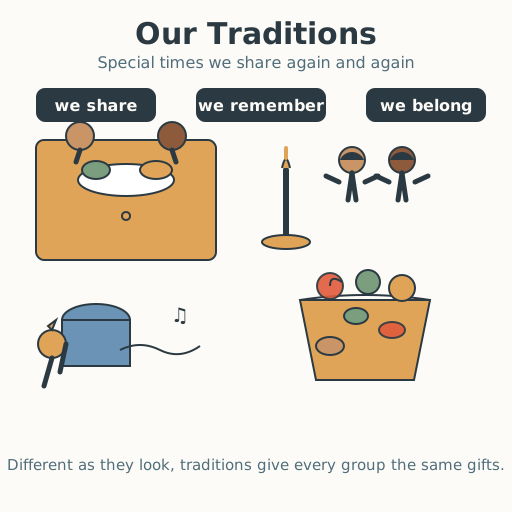
Think of a special time your family or neighborhood shares — a birthday, a harvest feast, a new year, a weekly meal, a song or a dance, a moment of quiet together. These are traditions: things a group does again and again, because they mean something. Traditions are everywhere. A harvest festival thanks the earth for food. A new year brings people together to start again. A naming day welcomes a new person. Different as they look, traditions give every group the same gifts: they help us share, remember, and belong. Today you will share one of yours and hear the traditions of others.
Materials
- Paper and crayons
- A talking stick or turn marker
Preparation
- Arrange a circle for gathering.
- Set out paper and crayons for drawing.
Facilitator note
Traditions are one of the places the global and anthropological lens lives most naturally: celebrate the variety without ranking any tradition above another. The commitments to hold: every family and community shape is honored — a learner may have one parent, two, many, or a chosen family of neighbors and friends; a tradition belongs to whatever community the learner names, and no one is asked to defend or explain it. Sharing is always by choice, never requirement: a learner may pass, or draw instead of speak, or tell a tradition quietly to a partner rather than the whole group. Some traditions are private or sacred; a learner may share only what they wish. A non-speaking learner shares by drawing or pointing to a picture; a learner whose tradition is not well known here is a teacher today, not a curiosity. Read the procedure aloud and share a tradition of your own to open the circle.
Procedure
- Gather (5 min). Sit in a circle. Think: what special time does my family or community share? What do we do together?
- Meet the idea (10 min). Wonder together: what is a tradition? Look at examples from around the world — a harvest feast, a new year, a naming day, a weekly meal, a song. Ask: what does each one give the group? Discover the three gifts: share, remember, belong.
- Draw your tradition (15 min). Draw one tradition your family or community shares. Add the people, the food, the songs, the season. If you like, add a word for what it means.
- Sharing circle (10 min). Pass the turn marker. When it comes to you, share your tradition if you want to — with words, with your drawing, or by acting a part of it. Listen to the traditions of others and find what is the same and what is different.
- Close (5 min). Remember: traditions may look different, but they give every group the same gifts — sharing, remembering, and belonging.
Differentiation
- Support: Offer picture prompts (food, music, lights, gathering) and let a learner point to what their tradition includes. Sharing may be by drawing only.
- Extension: Invite learners to learn one tradition from a different culture and tell what gift it gives its group — share, remember, or belong.
Assessment
- Formative (observation): Can the learner describe a tradition and say what it means to the group?
- Artifact (portfolio): The learner’s tradition drawing, kept as a record of their community.
Home connection
At home, ask a grown-up to tell you the story of one family tradition — where it came from and why it matters — and share what you learned with the class next time.