Lesson 07 — Together We Can
Learners do a real task that no one could do alone — carrying, lifting, or building together — and discover that cooperation means each person does a part and the group finishes together.
Objectives
Objectives
- D02.S4.02.01 Cooperate with others to finish a task that no one could do alone.
Essential question
How do we finish a task that no one could do alone?
Key vocabulary
Materials
Standard materials
- A large, heavy-but-safe shared item · 1 A mat, a bench, a full basket, or a big sheet to carry together
- Blocks or cups for a group tower · 1 set per group Enough for each learner to add one piece in turn
Low-tech / no-cost
- Bodies and voices Carry a heavy item together, or do a task no one can do alone — lift, pass, row, hold — with bodies only
- A found heavy or wide object A big branch, a full basket, or a wide cloth that needs many hands
Enriched / lab & device
- A parachute or large tarp · 1 To lift and move together, everyone holding an edge
- Camera or tablet · 1 per group Photograph the group finishing the task to show "each does a part"
Works in different contexts
- large-group Split into teams; each team does a cooperative task, then reflects on how every part mattered
- self-directed A learner tries a task alone, notices it is too hard, then does it with a helper and names each person's part
- outdoor-only Carry a heavy branch, roll a log, or move a pile of stones together; name each person's part
- multi-age A mixed-age team does a task together, and each learner names the part they carried
- level-grouped Pair learners so each task needs different strengths — one steadies, one lifts, one guides
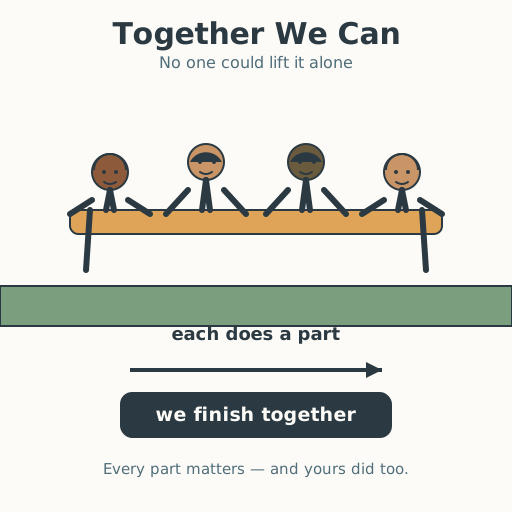
Lesson 7 — Together We Can
Summary
Learners experience cooperation directly: they try a task alone, find it too hard, and finish it together, discovering that cooperating means each person does a part — and no part is too small to matter.
Objectives
- Cooperate with others to finish a task that no one could do alone. (D02.S4.02.01)
Connection
Some things are simply too big for one pair of hands — a heavy bench, a full basket, a wide cloth, a pile of stones. One person cannot lift the bench; two or three can. One person cannot hold the sheet for the tent; four can. This is true everywhere: a boat crew rows together, a harvest is gathered by many hands, builders raise a house side by side. When each person does a part, the group can do what no one could do alone. Today you will feel this with your own hands.
Materials
- A large, heavy-but-safe shared item (a mat, a bench, a full basket, a big sheet)
- Blocks or cups for a group tower
Preparation
- Choose a safe cooperative task — carrying a heavy item, or a group tower where each learner adds one piece in turn.
- Set out the materials and clear a safe space.
Facilitator note
Cooperation is the heart of mutual aid, and the lesson to protect is that every part matters and no part ranks above another (philosophy §8: mastery is individual, success is collective). Do not crown a “leader” and do not sort children into “strong” and “weak” helpers — name each contribution as real: the one who steadies, the one who lifts, the one who guides, the one who calls the rhythm. Let learners feel the “too hard alone” moment first; that concrete experience carries the concept. Keep tasks safe and age-appropriate; no one is forced to lift beyond their ability. A learner with a motor difference contributes by directing, steadying, or holding an edge, and their part counts fully; a non-speaking learner contributes with gestures and rhythm. Read the procedure aloud; model counting or calling a rhythm together.
Procedure
- Gather (5 min). Sit in a circle. Think: what is something too heavy or too big for one person to do alone?
- Try it alone (10 min). Try the task by yourself — lift the bench, carry the basket, hold the whole sheet. Notice: it is too hard. Now try it with one helper, then with three or four. Feel the difference: more hands, easier work.
- Each does a part (15 min). Do the task together. Talk it over first: who will steady, who will lift, who will guide, who will call the rhythm? Then do it, and name each person’s part as you go.
- Group tower (15 min). In your team, build a tower where each person adds one block in turn — no one skips, no one takes over. When it stands, notice: every piece had a part.
- Close (5 min). Remember: alone it was too hard; together it was done. Each part mattered, and yours did too.
Differentiation
- Support: Offer a lighter or seated cooperative task; a learner who cannot lift steadies or guides. Keep groups small so every learner has a clear part.
- Extension: Invite teams to plan a second task that needs everyone, and name each person’s part before they begin.
Assessment
- Formative (observation): Does the learner contribute a part and finish the task with the group?
- Performance: The task completed together, with each learner able to name their own part.
Home connection
At home, find one job that needs more than one person — carrying, folding, tidying — and do it together, each taking a part, then tell how it went.