Lesson 03 — Sight Words Everywhere
Learners build a personal set of common "sight words" — words they know by heart just by seeing them — and practice reading them quickly and accurately in their own writing system.
Objectives
Objectives
- D04.S2.02.01 Read common sight words and regularly spelled words accurately and with growing fluency.
Essential question
How do I read the common words I see every day, quickly and by heart?
Key vocabulary
Materials
Standard materials
- A set of common sight-word cards · 1 set Words the learner sees often, written in the home writing system
- A short text with many sight words · 1 A simple sentence set or little book in the home language
Low-tech / no-cost
- Sight words written in the air or in sand Trace each word with a finger so the eye and hand learn it together
- Found print around the learner Labels, signs, or packaging with common words to hunt and read
Enriched / lab & device
- Word cards on sturdy cardstock · 1 set per learner Durable cards for daily flash-practice all year
- A screen that reveals one word at a time · 1 Quick recognition practice, one word per flash
Works in different contexts
- large-group Flash a word to the whole group, then have everyone read it aloud together before one volunteer uses it in a sentence
- self-directed A learner times how many sight words they can read by heart in one minute, then tries again the next day to beat their own score
- multi-age Older learners make new sight-word cards for younger ones; younger learners read them back as fast as they can
- level-grouped Give each small group a stack of words at just their level, so each learner practices words that are slightly new but reachable
- outdoor-only Hunt for common words on signs and labels outdoors, then read each one found; write new words in sand or soil
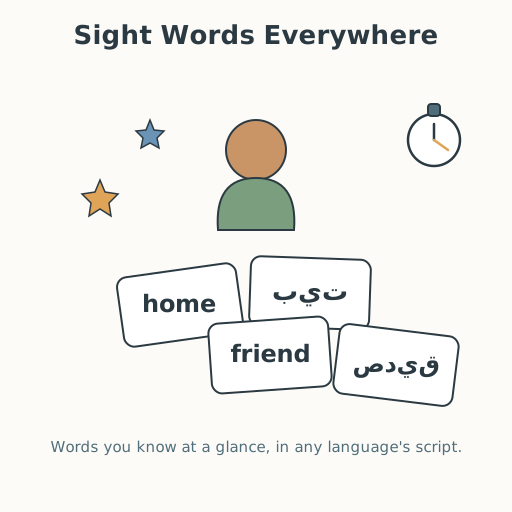
Lesson 3 — Sight Words Everywhere
Summary
Learners collect the common words they see every day and learn to read them “by heart” — quickly and accurately, without sounding them out. Every language has its own common words, and every writing system has its own set; the learner works in their own.
Objectives
- Read common sight words accurately and with growing fluency. (D04.S2.02.01)
Connection
Some words you meet so often that your eyes and brain learn to know them the way you know a friend’s face — at a glance. The words on a shop sign, the words in a favorite book, the words on a food packet: after you see them many times, you read them instantly. Knowing these words by heart makes reading smoother and faster, so you can spend your energy on the words that are new.
Materials
- A set of common sight-word cards (in the home writing system)
- A short text with many sight words (a sentence set or little book)
Preparation
- Choose 8–10 common words the learner sees often, written clearly in the home writing system.
- Prepare the word cards and a short text that uses several of them.
Facilitator note
This lesson is written to the learner (“you”) so it works in a classroom and for a self-directed learner. The goal is recognition that is fast and automatic, not memorized in a fixed order — shuffle the cards so the learner reads the word itself, not the position. Work in the learner’s home writing system; never assume the Latin alphabet or English. A sight word in one script is a sight word in any script, and recognizing whole words quickly is a skill that transfers to any language the learner reads. Reading is taught with explicit instruction and guided practice (Kirschner, Sweller & Clark, 2006), so model first, then guide, then let the learner practice independently. For a learner who reads braille or uses large print, prepare the same common words in their medium — the words are the same.
Procedure
- Gather (5 min). Think of a word you have seen so many times you know it the instant you see it — on a sign, in a book, on a packet. That is a sight word.
- Meet your words (5 min). Look at your set of common words. Say each one. These are words you will learn to know by heart, without sounding them out.
- Read together (10 min). Read each word aloud as it is shown. Then read them again, faster. Let your eyes take in the whole word at once.
- Practice on your own (15 min). Shuffle the cards and read them one by one, as quickly and accurately as you can. If a word slows you down, set it aside and come back to it — that word is your “next” word to grow.
- Read the words in a text (5 min). Find your sight words inside a short text. Reading them inside a sentence is how they become truly yours.
- Close (5 min). Words you know by heart free your mind for words you do not. Every language has its own set of common words — and now you know some of yours.
Differentiation
- Support: Begin with 3–4 words; read them as a whole (look, cover, say, check) before adding more.
- Support (braille/large print): Prepare the same words in the learner’s medium; reading by touch is reading by heart too.
- Extension: Collect new sight words from the learner’s own world and add them to the personal set; read them inside new sentences.
Assessment
- Formative (observation/self): Can the learner read the common words quickly and accurately, by heart, without sounding them out?
Home connection
Hunt for three sight words around home or the street today, and read them aloud to someone.
Resources
- Kirschner, Sweller & Clark (2006), “Why Minimal Guidance During Instruction Does Not Work” — rationale for explicit instruction in foundational reading skills.
- UNESCO, multilingual and mother-tongue-based education: https://www.unesco.org/en/days/mother-language