Lesson 04 — Words I Can Read Myself
Learners sound out regularly spelled words in their own writing system — breaking a word into its sounds and blending them back into a word they can read on their own.
Objectives
Objectives
- D04.S2.02.01 Read common sight words and regularly spelled words accurately and with growing fluency.
Essential question
How do I sound out regularly spelled words and read them on my own?
Key vocabulary
Materials
Standard materials
- A list of regularly spelled words · 1 Words that follow the sound rules of the home writing system
- Sound-tap counters · 10 Small objects to tap one per sound while reading a word
Low-tech / no-cost
- Words written in sand or soil Trace and sound out each word with a finger as it is read
- Found objects for counting sounds Stones or seeds tapped one per sound
Enriched / lab & device
- Sound boxes · 1 set A frame of empty boxes to fill one per sound in a word
- An audio model of each word · 1 Learners listen, then read, then check their own reading
Works in different contexts
- large-group Sound out a word together, the whole group tapping one counter per sound, before one learner reads the whole word
- self-directed A learner sounds out each word, taps the sounds, blends them, then checks against an audio or written model
- multi-age Older learners build a list of regular words for younger ones to sound out; younger learners tap the sounds as they read
- level-grouped Give each group words with the sound patterns they are ready for, so every learner meets a reachable challenge
- outdoor-only Write words in sand or soil with a stick, tap one stone per sound, then blend the sounds aloud into the word
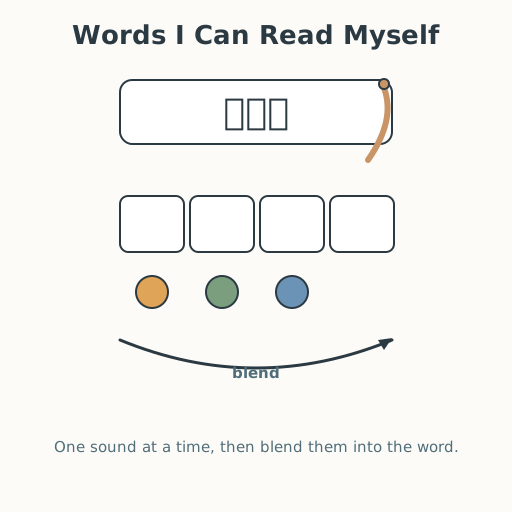
Lesson 4 — Words I Can Read Myself
Summary
Learners read regularly spelled words by sounding them out: breaking a word into its sounds, then blending the sounds back into a word. They work in their own writing system, whatever script that is.
Objectives
- Read regularly spelled words accurately and with growing fluency. (D04.S2.02.01)
Connection
A word is like a line of beads: each bead is a sound, and when you run your finger along the line, the sounds join into a word. Sounding out is how readers unlock a word they have never seen before — no grown-up needed. Once you know your language’s sound rules, you can read many new words all by yourself, the way a key opens many locks.
Materials
- A list of regularly spelled words (following the home writing system’s sound rules)
- Sound-tap counters (one per sound)
Preparation
- Choose 6–8 words that follow the regular sound rules of the learner’s writing system.
- Prepare counters and, if available, sound boxes.
Facilitator note
This lesson is written to the learner (“you”) so it works in a classroom and for a self-directed learner. “Regularly spelled” means the word follows the sound rules of the learner’s own language and script — the rules differ across writing systems, so choose words that are regular in the learner’s system, and never assume an alphabet. Sounding out is a foundational skill taught with explicit instruction and guided practice (Kirschner, Sweller & Clark, 2006): model one word fully, guide a second together, then release learners to practice. The point is independence — the learner reads a new word without being told it. A learner who is Deaf or hard of hearing can map the written word to a signed word and to mouth shapes; a learner who reads braille sounds out by touch. Every path to the word is honored.
Procedure
- Gather (5 min). Remember the last new word you read all by yourself. How did you do it? You probably broke it into its sounds and joined them again.
- Meet sounding out (5 min). A regularly spelled word follows your language’s sound rules. You can sound it out: say each sound, then blend the sounds into the word.
- Watch and listen (5 min). Watch one word sounded out slowly: each sound tapped with a counter, then the sounds joined into the whole word.
- Sound out together (10 min). Take a second word. Tap one counter for each sound as you say it. Then blend the sounds — run them together — into the word. Read the whole word aloud.
- Practice on your own (15 min). Sound out each word in your list: tap the sounds, blend them, read the word. If a word is tricky, try it again slowly.
- Close (5 min). Sounding out is your own key. With it, you can open new words yourself — in your language, in your script, every day.
Differentiation
- Support: Begin with two-sound words, then three; model blending with a slow finger-sweep under the word.
- Support (Deaf/Hard of Hearing): Pair each written word with a sign and a mouth-shape; sounding out can be signing out the parts.
- Extension: Sound out a longer, unfamiliar regular word and use it in a sentence of the learner’s own.
Assessment
- Formative (observation): Can the learner break a regularly spelled word into its sounds and blend them back into a correctly read word, without help?
Home connection
Find one new regularly spelled word around home, sound it out, and read it to someone.
Resources
- Kirschner, Sweller & Clark (2006), “Why Minimal Guidance During Instruction Does Not Work” — explicit instruction in decoding.
- UNESCO, multilingual and mother-tongue-based education: https://www.unesco.org/en/days/mother-language