Lesson 08 — Why
Learners read a short text and answer the deepest of the five questions — why — finding the reason something happened and saying it with "because."
Objectives
Objectives
- D04.S2.02.02 Answer who, what, where, when, and why questions about a text read independently or with support.
Essential question
How do I find why something happened in a text?
Key vocabulary
Materials
Standard materials
- A short text with a clear cause · 1 A story or account where one thing happens because of another, in the home writing system
- A why question card · 1 A card reading "why" with a small picture
Low-tech / no-cost
- A told story with a reason Listen for why something happened, then say the reason back
- Why written in the air Trace the question word while saying it
Enriched / lab & device
- A recorded story to re-listen · 1 Pause and rewind to hear the reason again
- A because answer frame · 1 A sentence starter such as "It happened because…" in the home language
Works in different contexts
- large-group After reading, the whole group echoes the answer together — "it happened because…" — then one volunteer finds the words that show it
- self-directed A learner reads a text, writes or draws the reason something happened, and checks it against the text before checking with a grown-up
- multi-age Older learners model a "why" answer with "because"; younger learners point to the cause in a picture or retell it simply
- level-grouped Each group reads a text at its own level and finds one why, then shares its because-sentence with the class
- outdoor-only Observe something outdoors — a puddle, a fallen leaf, a bird flying off — and wonder together why it happened, then check your reasons
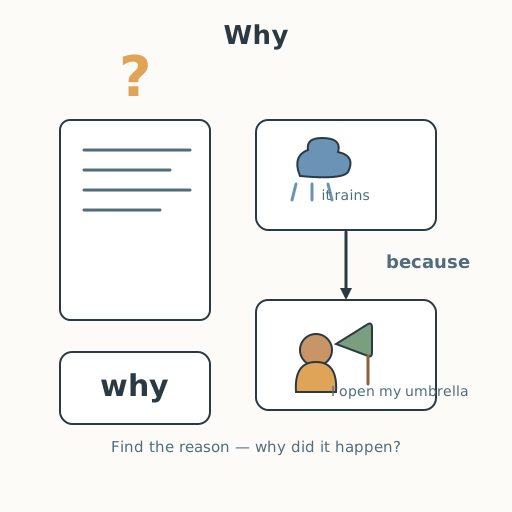
Lesson 8 — Why
Summary
Learners read a short text and answer why something happened — the question that asks for a reason. They learn to answer with “because” and to find the words in the text that show the cause.
Objectives
- Answer why questions about a text. (D04.S2.02.02)
Connection
“Why” is the question that turns a list of facts into understanding. A pot boils over because the fire is too hot; a friend runs because it is starting to rain. Finding the reason is how you make sense of things, not just notice them. Of the five reading questions, “why” asks you to think — and it is the one that never runs out of answers to wonder about.
Materials
- A short text with a clear cause (in the home writing system)
- A “why” question card
Preparation
- Choose a short text where one thing clearly happens because of another.
- Prepare the “why” card and, if available, a “because” answer frame.
Facilitator note
This lesson is written to the learner (“you”) so it works in a classroom and for a self-directed learner. “Why” is the question of cause, and the answer is a reason — often the hardest of the five because it asks for inference, not just location. Model one because-answer fully, showing where the text hints at the reason, then guide and release. Some why-questions have more than one honest answer; honor a reason the text supports, and keep genuinely open whys open — “I wonder too” is a fine answer. Work in the home language; every language has its own word for “why” and for “because.” A learner answers by speaking, signing, drawing, or writing.
Procedure
- Gather (5 min). Quick recall: name the four reading questions we have met. (Who, what, where, when.) Today comes the deepest: why.
- Meet why (5 min). Why? — what is the reason it happened? The answer often begins with because. Say both words in your home language.
- Read the text (10 min). Read the short text once, all the way through.
- Hunt for the reason (15 min). Read again. Ask: why did that happen? Find the words that hint at the reason, then say the answer with “because.” If there is more than one good reason, share both.
- Ask each other (5 min). Trade why-questions with a partner about the text, and answer with “because” and evidence.
- Close (5 min). You now hold all five keys: who, what, where, when, why. Next, we will use all five at once.
Differentiation
- Support: Answer with a two-word reason first (“the rain”), then grow it into a because-sentence.
- Support (non-speaking): Draw the cause and its effect and point from one to the other — showing the reason is answering why.
- Extension: Wonder a why the text does not answer, and guess two possible reasons, telling which the text supports better.
Assessment
- Formative (observation): Can the learner answer why something happened in a text, using “because” and pointing to evidence in the text?
Home connection
Ask someone at home “why” about one small thing today, and listen for their reason.
Resources
- National Reading Panel (2000), reading comprehension — questioning and inferring. (Cited as a widely used evidence base.)