Lesson 09 — Asking All Five Questions
Learners use all five questions — who, what, where, when, and why — together to understand and retell a whole text, completing the comprehension set for this unit.
Objectives
Objectives
- D04.S2.02.02 Answer who, what, where, when, and why questions about a text read independently or with support.
Essential question
How do I use who, what, where, when, and why together to understand a whole text?
Key vocabulary
Materials
Standard materials
- A short, rich text · 1 A story or account with people, happenings, a place, a time, and a reason, in the home writing system
- A five-question frame · 1 Five labeled spaces to answer who, what, where, when, and why
Low-tech / no-cost
- Five fingers Touch one finger per question as each is answered
- A told story Answer all five questions about a story told aloud
Enriched / lab & device
- A recorded text · 1 Learners re-listen and pause to fill each of the five answers
- Five-question cards on cardstock · 1 set per pair Durable cards for repeated five-question practice
Works in different contexts
- large-group Answer the five questions together, the whole group holding up one finger for each question as it is answered
- self-directed A learner reads a text, fills a five-question frame, then retells the whole text using the five answers
- multi-age Older learners fill the who/what/where/when answers; younger learners answer why, then everyone checks the whole set together
- level-grouped Each group reads at its own level and completes the five-question frame, then retells the text using all five answers
- outdoor-only Answer all five questions about a short happening observed outdoors — who, what, where, when, and why — then retell it as one whole
Lesson 9 — Asking All Five Questions
Summary
Learners bring all five reading questions together — who, what, where, when, and why — to understand a whole text and retell it completely. This is the comprehension capstone of the reading thread.
Objectives
- Answer who, what, where, when, and why questions about a text. (D04.S2.02.02)
Connection
Five questions, working together, are like five senses on a text: who and what give you the people and the happening, where and when place it in the world, and why gives it meaning. Asked together, they turn a page of words into a whole story you could tell to someone who was not there. That is what it means to truly understand what you read — in any language.
Materials
- A short, rich text (people, happenings, a place, a time, and a reason)
- A five-question frame (who, what, where, when, why)
Preparation
- Choose a short text that supports all five answers.
- Prepare the five-question frame (five labeled spaces).
Facilitator note
This lesson is written to the learner (“you”) so it works in a classroom and for a self-directed learner. This is a spaced, integrating lesson: it retrieves the four earlier lessons (who/what, where/when, why) and joins them into one skill. Model filling the whole frame once, then guide pairs, then release. The frame is a tool, not a test — a learner may answer by speaking, signing, drawing, or writing, and the five answers become the bones of a retelling. Work in the home language. A learner who struggles with one question is not “behind”; the frame shows exactly which question to practice next, and that is information for growth, never a verdict.
Procedure
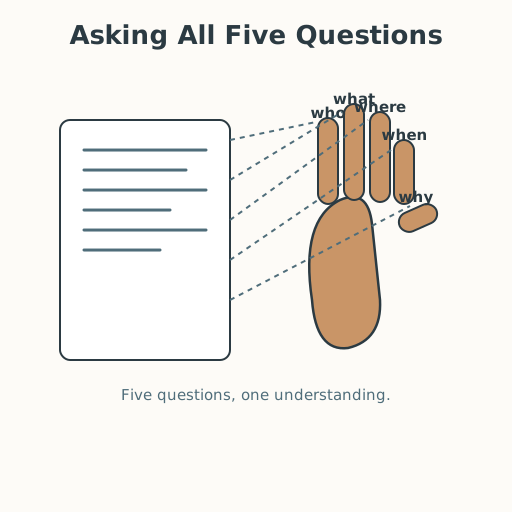
- Gather (5 min). Hold up one hand. Each finger stands for one reading question: who, what, where, when, why. Say all five.
- Meet the five-question frame (5 min). Look at your frame with five spaces. Today you will fill every space and use them to retell a whole text.
- Read the text (10 min). Read the short text once, all the way through.
- Fill the frame (15 min). Read again, and answer each question: Who is it about? What happened? Where? When? Why? Write, draw, or say each answer in the right space, and check each against the words.
- Retell the whole text (5 min). Use your five answers to retell the text to a partner as one connected story. Let them retell it back.
- Close (5 min). Five questions, one understanding. You can now unlock any text — in your language, in any script.
Differentiation
- Support: Fill the frame with drawings, one box at a time, then retell using the pictures.
- Support (non-speaking): Answer each question by signing, pointing, or drawing; the five answers together are the understanding.
- Extension: Read a second text and fill the frame again, then compare how the five answers differ between the two.
Assessment
- Formative (performance): Can the learner answer who, what, where, when, and why about a text and use the five answers to retell it completely?
Home connection
Read or hear a short story tonight and answer all five questions — who, what, where, when, why — to someone at home.
Resources
- National Reading Panel (2000), reading comprehension — question generation and answering. (Cited as a widely used evidence base.)