Lesson 03 — Comparing and Ordering Two-Digit Numbers
Learners build two numbers with tens and ones and compare them, discovering the tens-first rule: look at the tens first, and only check the ones if the tens tie. They order small sets of two-digit numbers from least to greatest.
Objectives
Objectives
- D05.S1.02.01 Use place value of tens and ones to read, write, compare, and order two-digit numbers.
Essential question
How do tens and ones help me tell which of two numbers is greater and put numbers in order?
Key vocabulary
Materials
Standard materials
- Bundles of ten and single ones (or base-ten blocks) · per learner or pair To build two numbers and compare them side by side
- Number cards · 1 set Cards with two-digit numbers to sort and order
- Paper or slate and a writing tool · per learner To record comparisons
Low-tech / no-cost
- Found objects and the ground Build two numbers with bundles and ones in the dirt and place them side by side to see which has more tens
- Voice and body Two learners each show a number with tens (fists) and ones (fingers) and the group says which is greater
Enriched / lab & device
- A number line or 0-99 chart · 1 per pair To see where numbers sit in order
- Greater-than/less-than symbol cards · 1 set Cards with >, <, and = to place between two numbers
Works in different contexts
- large-group Hold up two numbers, and the class votes with a hand signal which is greater, then checks by comparing tens
- self-directed A learner draws number cards, builds them, decides which is greater, and writes the comparison with >, <, or =
- outdoor-only Line up pebbles in rows of ten and ones on the ground and read off which number is greater
- multi-age Older learners explain the tens-first rule to younger learners, who build and check the two numbers
- level-grouped Learners who compare easily order three or four numbers from least to greatest; others compare two numbers with bundles
Lesson 3 — Comparing and Ordering Two-Digit Numbers
Summary
Learners build two numbers with tens and ones and compare them, discovering that you look at the tens first, and only check the ones if the tens are the same. They then order small sets of two-digit numbers from least to greatest, using bundles as the proof.
Objectives
- Use place value of tens and ones to read, write, compare, and order two-digit numbers. (D05.S1.02.01)
Connection
Every day we compare amounts — which pile of fruit is bigger, which jar has more, who has more steps to walk. Comparing well is not about who is better; it is about knowing amounts so we can share and plan fairly. To compare two numbers, you do not have to count every single thing — you look at the big groups first. The tens tell you most of the answer right away.
Materials
- Bundles of ten and single ones (or base-ten blocks)
- Number cards
- Paper or slate and a writing tool
Preparation
- Prepare number cards with two-digit numbers of varying tens and ones.
- Have bundles and ones ready for building two numbers at once.
- Plan to model the tens-first rule as a worked example.
Facilitator note
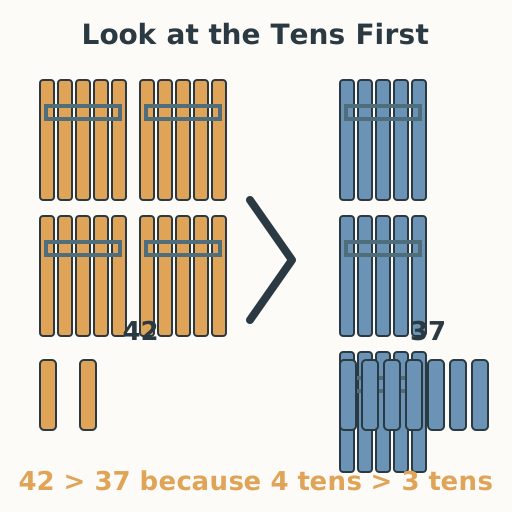
This lesson is written to the learner (“you”). It turns the tens-and-ones idea from Lessons 1–2 into comparison and order. Teach the tens-first rule as a worked example (philosophy §13): build 42 and 37, compare the tens (four tens beats three tens), and only then decide. Keep the language careful and kind: we say “greater than” and “less than” about amounts, never about people. A number being bigger is a fact about a collection, not a worth about a child — more is not better, it is just more. Comparing is a tool for fairness, not a contest. For learners who are Deaf or hard of hearing, show the comparison with bundles and signs; for learners who are blind or low-vision, let hands feel the bundles side by side. A learner who does not speak points or places the greater-than card. No ranking of learners, ever.
Procedure
- Gather — recall tens and ones (5 min). You can read a number by its tens and ones. Which is more, three tens or four tens? Say why. Today we compare and order numbers.
- Worked example — look at tens first (10 min). Build 42 (four tens, two ones) and 37 (three tens, seven ones). Which is greater? Compare the tens first: four tens is more than three tens, so 42 is greater than 37. Write 42 > 37. The ones did not matter this time, because the tens decided it.
- Guided practice — compare pairs (15 min). Draw two number cards. Build each number. Say the tens first, then the ones if you need them. Write the comparison with >, <, or =. Do several pairs. What happens when the tens are the same — like 45 and 48? Then look at the ones.
- Order a small set (8 min). Take three number cards. Put them in order from least to greatest, checking the tens first each time. Read them back in order.
- Check with a friend (5 min). Trade comparisons. A friend reads your ordered numbers and checks with bundles. Do you agree? Talk it through kindly if not.
- Close (2 min). To compare numbers, look at the tens first. It is a fast, fair way to see which amount is more — so we can share and plan well together.
Differentiation
- Support: Compare only two numbers whose tens clearly differ; use bundles every time.
- Support (motor): Use large, easy-to-move cards and have a partner build while the learner directs.
- Extension: Order four or five numbers, or explain what happens when two numbers have the same tens and the same ones.
Assessment
- Formative (observation): Can the learner build two numbers, compare the tens first, and record the comparison with >, <, or =?
- Formative (peer): Can the learner order a small set of numbers and check a friend’s order with bundles?
Home connection
At home, compare two amounts with a grown-up — two jars of beans, two piles of rice — and say which is greater and how you know by looking at the tens first.
Resources
- Clements, D. H., & Sarama, J. (2014). Learning and Teaching Early Math: The Learning Trajectories Approach (2nd ed.). Routledge. (Comparing two-digit numbers by comparing tens before ones.)