Lesson 04 — Adding Tens and Ones Within 100
Learners add two numbers within 100 by joining their tens and their ones separately: 34 + 25 becomes 3 tens + 2 tens and 4 ones + 5 ones. Models and drawings carry the meaning before written methods.
Objectives
Objectives
- D05.S1.02.02 Add and subtract within 100 using models, drawings, or written methods, and explain the strategy used.
Essential question
How do I add two numbers within 100 by adding the tens and the ones separately?
Key vocabulary
Materials
Standard materials
- Bundles of ten and single ones (or base-ten blocks) · per learner or pair To model joining two numbers
- Paper or slate and a writing tool · per learner To record the addition in parts
Low-tech / no-cost
- Found objects and the ground Join bundles and ones in the dirt and count the tens, then the ones
- Voice and body One learner shows tens, another ones; the group counts the joined total
Enriched / lab & device
- Place-value mat with tens and ones columns · 1 per pair To keep tens and ones lined up while adding
- A number line to 100 · 1 per pair To show adding as jumps of tens and ones
Works in different contexts
- large-group Model one addition together on a big chart, then learners work in pairs with their own bundles
- self-directed A learner builds two numbers, joins them, counts tens then ones, and writes the sum in parts
- outdoor-only Join two collections of sticks and stones outdoors, bundling new tens when ten ones gather
- multi-age Older learners coach younger ones in adding tens first, then ones; younger learners count the joined total aloud
- level-grouped Learners who add easily move to numbers with regrouping; others add numbers without regrouping first
Lesson 4 — Adding Tens and Ones Within 100
Summary
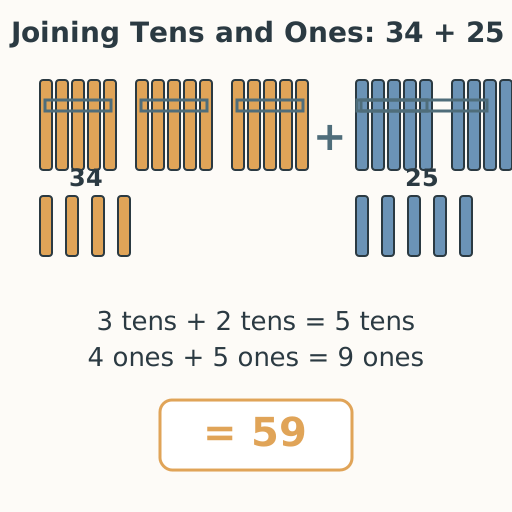
Learners add two numbers within 100 by joining the tens and the ones separately. They model with bundles, draw the join, and record the sum in parts — three tens plus two tens, and four ones plus five ones — so the written method grows out of the objects.
Objectives
- Add and subtract within 100 using models, drawings, or written methods, and explain the strategy used. (D05.S1.02.02)
Connection
Adding is a joining story you already know. A market seller has 34 mangoes and a neighbor brings 25 more; a fisher has 34 fish and catches 25 more; you have 34 seeds and find 25 more. To join them without losing count, you join the tens with the tens and the ones with the ones — big groups with big groups, little ones with little ones.
Materials
- Bundles of ten and single ones (or base-ten blocks)
- Paper or slate and a writing tool
Preparation
- Give each learner or pair bundles and ones enough to model two numbers at once.
- Prepare a few addition examples whose sum stays within 100 (start without regrouping).
- Plan to model joining tens and ones as a worked example.
Facilitator note
This lesson is written to the learner (“you”). It introduces adding within 100 by place value. Teach with a worked example (philosophy §13): build 34 and 25, join them, count tens then ones. Keep numbers without regrouping at first, so the strategy is clear before the extra step of regrouping (which comes in a later lesson). The point is sense-making, not speed: a learner may count every object today and use a written method tomorrow — both are correct, and explaining one’s own way is the real goal. There is no single “right” strategy; every clear strategy is honored. For learners who are Deaf or hard of hearing, model with bundles and write each step; for learners who are blind or low-vision, join real objects and count by touch. A learner who does not speak records by moving bundles or pointing to the sum.
Procedure
- Gather — recall joining (5 min). You know adding means joining. Quick: what is 3 + 2? What is 4 + 5? Today we join bigger numbers — but the trick is the same: join the tens and join the ones.
- Worked example — join tens and ones (10 min). Build 34 (three tens, four ones) and 25 (two tens, five ones). Join them. Count the tens: three tens and two tens is five tens — fifty. Count the ones: four and five is nine. Put them together: 59. Write it in parts: 3 tens + 2 tens = 5 tens, and 4 + 5 = 9, so 34 + 25 = 59.
- Guided practice — build and join (15 min). Pick two numbers that add to less than 100. Build each. Join them. Count the tens, count the ones, then say and write the sum. Do several.
- Draw the join (8 min). Choose one addition and draw it — the two collections coming together, with the tens and ones labeled. Does your drawing match your sum?
- Check with a partner (5 min). Trade one addition. Build and solve a friend’s problem, then compare sums. If they differ, build it again together and find where the counts went different — kindly.
- Close (2 min). Adding bigger numbers is just two small joins: tens with tens, ones with ones. You can now join numbers up to one hundred.
Differentiation
- Support: Use numbers with no regrouping and model every step with bundles.
- Support (motor): Use large blocks and have a partner move objects while the learner directs and counts.
- Extension: Try an addition where the ones add to ten or more (for example, 34 + 28), and discover what happens when ten ones gather.
Assessment
- Formative (observation): Can the learner join two numbers within 100 with models or drawings, adding tens and ones separately, and record the sum?
- Formative (self): Can the learner check their written sum against their model?
Home connection
At home, add two amounts under one hundred — two piles of beans or two counts of steps — by joining the tens and the ones, and tell a grown-up your sum.
Resources
- Carpenter, T. P., Fennema, E., Franke, M. L., Levi, L., & Empson, S. B. (2015). Children’s Mathematics: Cognitively Guided Instruction (2nd ed.). Heinemann. (Joining problems and children’s invented place-value strategies for adding within 100.)