Lesson 03 — Sort and Group
Learners sort and group a collection of objects by one or more features — shape, color, size, or where something lives — and, crucially, explain the rule they used. Sorting is science's first way of making sense of the many things in the living world.
Objectives
Objectives
- D06.S1.02.02 Sort and group objects or events by one or more features and explain how they grouped them.
Essential question
How do I sort and group things by their features, and explain how I did it?
Key vocabulary
Materials
Standard materials
- A collection of things to sort · 1 set Leaves, shells, stones, seeds, buttons, or picture cards of living things
- Sorting circles, trays, or drawn hoops · 2–3 Places to lay each group
- Paper and crayons · per learner
Low-tech / no-cost
- Found things from outside Leaves, stones, seeds, and twigs gathered on a short walk
- Chalk or a stick to draw circles on the ground Draw sorting rings in the dirt or on pavement instead of trays
Enriched / lab & device
- Picture cards of living things from many places · 1 set Animals and plants from desert, sea, forest, and mountain to sort by where they live
- A "how I sorted" recording sheet · per learner A sheet to draw each group and write one word for how it was grouped
Works in different contexts
- large-group Sort together once as a whole group, then pairs sort a smaller set and explain to each other
- self-directed A learner chooses a feature, sorts a set into two or three groups, and writes or draws the rule they used
- outdoor-only Gather natural objects and sort them on the ground into rings drawn with chalk or a stick
- multi-age Younger learners sort by one feature while older learners re-sort the same set by a second feature and explain the difference
- level-grouped Learners who can explain sorting by two features (e.g., color and size) work there; others practice one feature with a partner
Lesson 3 — Sort and Group
Summary
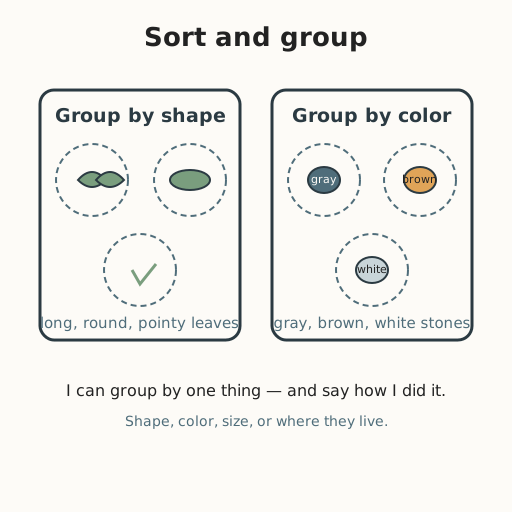
The living world is full of many things. Science’s first way of making sense of them is to sort — to put things into groups by a feature they share. Learners sort a collection by shape, color, size, or where something lives, and — the important part — explain how they grouped them. They learn that the same things can be sorted many different ways, and none of those ways is wrong.
Objectives
- Sort and group objects or events by one or more features and explain how they grouped them. (D06.S1.02.02)
Connection
At home you already sort things: spoons with spoons, socks with socks, seeds with seeds. When you put all the round stones in one pile and all the flat stones in another, you are doing what a scientist does — sorting by a feature. The trick is to say how you sorted: “I put all the round ones together.” That explanation is how others understand your thinking.
Materials
- A collection of things to sort (leaves, shells, stones, seeds, buttons, or picture cards of living things)
- Sorting circles, trays, or drawn hoops
- Paper and crayons
Preparation
- Gather a collection with clear, safe features to sort by (shape, color, size, texture).
- Set out two or three sorting spaces (trays, hoops, or chalk rings).
- Plan a quick first example to model sorting and explaining the rule aloud.
Facilitator note
This lesson is written to the learner (“you”). The skill here is not just sorting — it is explaining the rule (“I grouped them by shape”), which is where thinking becomes visible. Model once aloud (worked example), then guide, then release. Honor that there is no single “right” way: the same leaf could go with “green things” or with “long things,” and both are good — what matters is that the learner can say the rule. Include objects and living things from many places (desert, sea, forest, mountain) so sorting carries a global lens. Sorting by “where it lives” quietly previews habitats, which arrive in Lesson 5 — this is intentional spacing.
Procedure
- Gather and remember (5 min). What did you predict and test these last two days? Today we use a new science tool: sorting.
- Sort together (10 min). Look at the collection. Choose one feature — shape, color, or size. Put the things into groups by that feature. Say the rule out loud: “I am putting all the long leaves here and all the round leaves there — I sorted by shape.”
- Sort your own (15 min). Take a set yourself. Choose your own feature and sort the things into two or three groups. When you finish, tell a partner your rule: “I sorted these by color — all the brown stones together.”
- Sort another way (10 min). Now sort the same set by a different feature. How did the groups change? Tell your partner: “This time I sorted by size, not color.”
- Draw your sort (7 min). Draw your two sorts and label each with the feature you used — “by shape,” “by color,” “by size.”
- Close (3 min). Sorting is how a scientist begins to make sense of many things. There is no one right way — there is only the way you can explain.
Differentiation
- Support: Sort with one clear feature (shape) and use the spoken frame “I put all the ___ together.”
- Support (non-speaking): Sort by pointing or moving objects, then point to a picture of the feature (a color patch, a shape) to show the rule.
- Support (blind/low-vision): Sort by touch — rough and smooth, heavy and light, round and flat — with a partner naming each object.
- Extension: Sort one set by two features at once (e.g., color and size) and explain how the groups overlap.
Assessment
- Formative (observation): Can the learner sort a collection by at least one feature and say the rule they used?
- Peer: Partners restate each other’s sorting rule in their own words.
- Artifact (portfolio): The labeled “my sorts” drawing.
Home connection
At home, help sort one real thing — the spoons, the socks, or the seeds — and say your rule out loud: “I am grouping these by…” Sorting is everywhere, and you already know how.
Resources
- BBC Bitesize (KS1 Science), “Everyday materials” — objects and materials, and describing materials by their properties. https://www.bbc.co.uk/bitesize/topics/zrssgk7