Lesson 04 — A Seed Grows
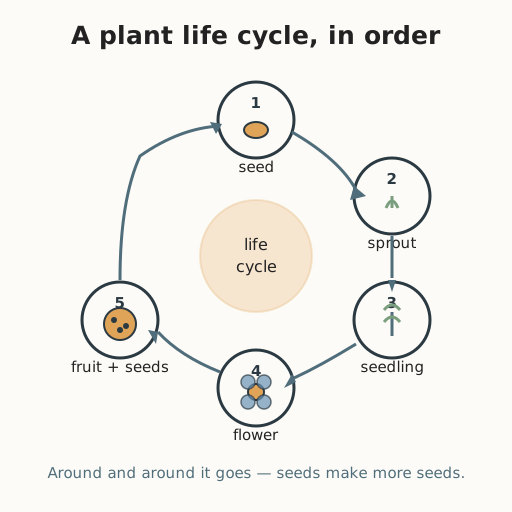
Learners describe the life cycle of a plant in order — seed, sprout, seedling, flower, fruit with new seeds — and plant a real seed they will watch over the coming weeks. They see that a life cycle is a circle: a plant makes seeds that make new plants.
Objectives
Objectives
- D06.S2.02.01 Describe the life cycle of a plant or animal (such as seed to plant or egg to adult) in order.
Essential question
What are the stages of a plant's life cycle, in order?
Key vocabulary
Materials
Standard materials
- Pictures or cards of plant life-cycle stages · 1 set Seed, sprout, seedling, plant, flower, fruit with seeds
- A real seed to plant (a bean or a fast-growing seed) · 1 per learner A cup or small pot with soil to watch it grow over the weeks
- Paper and crayons · per learner
Low-tech / no-cost
- Drawn stages in the dirt or on paper Draw the stages in order with a stick or chalk instead of cards
- A found seed and a patch of soil Plant a real seed outside and revisit it over the weeks
Enriched / lab & device
- A class life-cycle poster or time-lapse pictures · 1 To show how a seed changes over days into a plant
- A "my plant journal" booklet · per learner A small booklet to draw the plant each week as it grows
Works in different contexts
- large-group Order the stages together on a big timeline, then pairs shuffle and re-order their own set of cards
- self-directed A learner arranges the stages in order and draws the cycle with numbered steps one to five
- outdoor-only Find real plants at different stages outside (seed, sprout, flower, fruit) and order what you see
- multi-age Older learners label the stages with names while younger learners point and order the pictures
- level-grouped Learners who can compare two life cycles (a plant and an animal) do so; others order just the plant stages
Lesson 4 — A Seed Grows
Summary
Every living thing grows and changes in a repeating pattern called a life cycle. Learners put the stages of a plant’s life cycle in order — seed, sprout, seedling, flower, fruit with new seeds — and plant a real seed they will watch and record over the coming weeks. They discover that a life cycle is a circle: the plant makes seeds, and those seeds make new plants.
Objectives
- Describe the life cycle of a plant or animal (such as seed to plant or egg to adult) in order. (D06.S2.02.01)
Connection
You have seen a seed — a little hard thing that looks asleep. But inside it is a whole plant waiting. Put it in soil, give it water and light, and it grows: first a tiny sprout, then leaves, then a flower, then a fruit with new seeds inside. Then those seeds can start again. That circle of growing is a life cycle — and you can watch it happen with your own two eyes, wherever you live.
Materials
- Pictures or cards of plant life-cycle stages
- A real seed to plant (a bean or another fast-growing seed)
- Paper and crayons
Preparation
- Prepare or draw the stage cards (seed, sprout, seedling, plant, flower, fruit with seeds) and shuffle them.
- Set up a planting spot with soil and a cup or small pot per learner; keep water and light within reach.
- Plan to revisit the planted seeds across the rest of the unit and beyond.
Facilitator note
This lesson is written to the learner (“you”). A life cycle is a circle, so the order can start anywhere — but at Grade 2 we anchor it at the seed and move forward, so the learner has a clear sequence to hold. Model the ordering once (worked example), then let learners re-order their own shuffled set. Planting a real seed makes the abstract cycle concrete, and revisiting it over the weeks builds in spacing — real growth takes time, which is itself the lesson. Note honestly that some plants are grown for food and medicine in different ways around the world, and that caring for a seed is caring for a living thing (a small ethical step). If a seed does not sprout, that too is information, not failure — wonder about why.
Procedure
- Gather and remember (5 min). You have predicted, tested, and sorted. Now look at a seed and wonder: what is inside it, waiting to grow?
- Meet the stages (10 min). A plant’s life goes in a circle, called a life cycle. Meet the stages in order: seed → sprout → seedling → flower → fruit with new seeds → and back to a seed again. Say each one and point to its picture.
- Order the cycle (10 min). Take a shuffled set of cards and put them in the right order. Check with a partner: did we both start at the seed and go around the same way?
- Plant a seed (15 min). Plant your own seed in soil. Give it a little water and set it where it can get light. This is the very first stage of the cycle, happening in your own hands.
- Draw the cycle (7 min). Draw the life cycle as a circle with the stages numbered 1 to 5. Keep it — you will add to it as your seed grows.
- Close (3 min). A life cycle is a circle that keeps going: seeds make plants, and plants make seeds. You have started one today.
Differentiation
- Support: Order just three stages (seed, sprout, plant) and say them with a partner.
- Support (non-speaking): Point to and move the stage cards into order; a partner says each name.
- Support (blind/low-vision): Feel a real seed, a sprout, and a leaf; order the stages by touch and description with a partner.
- Extension: Describe an animal’s life cycle too (egg → caterpillar → chrysalis → butterfly, or egg → chick → hen) and tell how a plant’s and an animal’s cycle are alike and different.
Assessment
- Formative (observation): Can the learner order the plant life-cycle stages and name them (or point to them)?
- Artifact (portfolio): The numbered life-cycle circle drawing, kept to update as the seed grows.
Home connection
Plant a seed at home in an old cup or a patch of soil. Water it a little and watch it each day. Tell a grown-up what stage it is in now — seed, sprout, or seedling.
Resources
- BBC Bitesize (KS1 Science), “What is the life cycle of a plant?” — the stages from seed to flower to new seeds, in order. https://www.bbc.co.uk/bitesize/topics/zpxnyrd/articles/z2vdjxs