Lesson 03 — Rhythm and Melody Patterns
Learners play or sing a short rhythm or melody pattern and repeat it accurately. They discover that a pattern is sound you can say again, and that echo games are how music is shared the world over.
Objectives
Objectives
- D07.S2.02.01 Play or sing a short rhythm or melody pattern and repeat it accurately.
Essential question
How do I play or sing a short rhythm or melody pattern and repeat it accurately?
Key vocabulary
Materials
Standard materials
- Hands, voices, and feet · everyone The first instruments for rhythm and melody
- A small set of sound makers · 1 set per pair A pot, a shaker, a cup, a bell — to play patterns
Low-tech / no-cost
- Body percussion and voice Clap, pat, snap, and hum — rhythm and melody with the body alone
- Found objects Two sticks, two stones, a hollow gourd or pot — to tap a pattern
Enriched / lab & device
- A drum or shaker per pair · 1 per pair Homemade or store-bought, to play the pattern and feel the vibration
- A simple recording of a short pattern to echo · 1 device Optional, to hear and repeat a short rhythm or melody
Works in different contexts
- large-group Lead call-and-response — play or sing one short pattern, the whole group echoes it back exactly; keep patterns short so everyone can repeat them
- multi-age Older learners play a pattern and younger learners echo it, then trade; everyone leads a pattern and follows one
- self-directed A learner plays or sings a short pattern, repeats it the same way, and checks by clapping it twice to see if it matched
- level-grouped Some learners repeat a two-sound pattern; others repeat a four-sound pattern; match the challenge
- outdoor-only Tap a pattern on a stick or stone, hum a short melody, and repeat it under the open sky
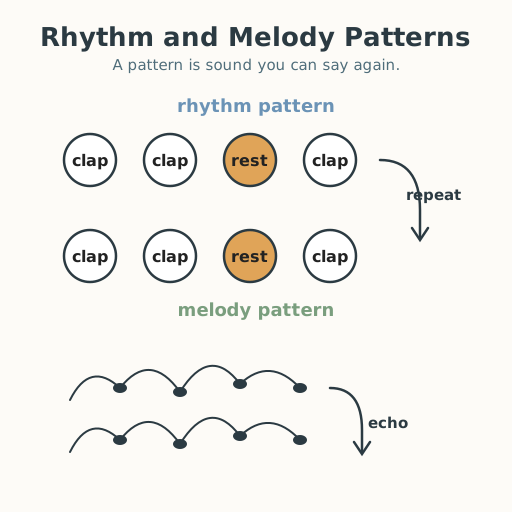
Lesson 3 — Rhythm and Melody Patterns
Summary
Learners play or sing a short rhythm or melody pattern and repeat it accurately. They discover that a pattern is sound you can say again, and that echoing back a pattern — call-and-response — is how people everywhere share music.
Objectives
- Play or sing a short rhythm or melody pattern and repeat it accurately. (D07.S2.02.01)
Connection
Think of the sounds that repeat in your day — footsteps, a heartbeat, a bird’s call, a song someone sings over and over. A pattern is sound that comes back the same way. All over the world, people share music by echoing: one person plays a short pattern, and others play it back exactly. Today you will play or sing a short pattern and repeat it so it comes back the same.
Materials
- Hands, voices, and feet
- A small set of sound makers (a pot, a shaker, a cup, a bell)
Preparation
- Gather a few sound makers that can tap or shake a clear pattern.
- Arrange the group in a circle so everyone can hear and see the leader.
Facilitator note
This lesson is written to the learner (“you”) so it works in a classroom and for a self-directed learner. Repeating a pattern is a skill, so teach it with explicit modeling and guided practice (Kirschner, Sweller & Clark, 2006): play one short pattern, have the group echo, then let learners lead. Keep patterns very short at first (two to four sounds). “Accurately” means “the same the second time” — not perfectly fast, and never “correct” vs “wrong.” A learner who is Deaf or hard of hearing repeats the pattern by feel and sight: watch the leader’s hands and feel the vibration of the beat through a drum, the table, or the floor, then tap it back the same way. A learner who does not sing or speak repeats the pattern by clapping, tapping, or humming. A learner who is blind or has low vision leads and repeats by ear and touch. Watching and echoing is full participation.
Procedure
- Gather (5 min). Pat your knees in a little pattern — pat, pat, rest, pat. That is a rhythm pattern. Now hum a few notes that go up and down — that is a melody pattern. A pattern is sound you can say again.
- Learn to echo (10 min). Listen to a short pattern a leader plays or sings. Play it back exactly the same — same sounds, same order, same length. That is an echo. Try a rhythm pattern (clap, clap, rest, clap) and a melody pattern (a few hummed notes).
- Repeat it accurately (10 min). Play or sing your own short pattern, then repeat it the same way a second time. Does the second time match the first? If it does, you have repeated it accurately. If it drifts, that is okay — try it again, because accuracy grows with practice.
- Lead and echo (10 min). Take a turn leading a short pattern while a friend echoes it back. Then trade. Leading and following are how patterns travel from one person to another.
- Close (5 min). Remember: a pattern is sound that comes back the same. When you echo a friend’s pattern, you carry their music for a moment — and that is how music is shared everywhere.
Differentiation
- Support: Use a two-sound pattern (clap, pat) and echo it slowly together, one sound at a time.
- Support (Deaf/HH): Repeat by feel and sight — watch the leader’s hands and feel the vibration through a drum or the floor, then tap it back.
- Support (non-speaking/non-singing): Repeat by clapping, tapping, or humming.
- Support (blind/low-vision): Lead and repeat by ear and touch.
- Extension: Invite learners to make a four-sound pattern and repeat it twice in a row without stopping, checking it stays the same.
Assessment
- Formative (observation): Does the learner play or sing a short rhythm or melody pattern and repeat it accurately?
- Performance: The learner’s pattern, played or sung live and repeated the same way.
Home connection
Teach someone at home a short pattern — clap, clap, rest, clap — and have them echo it back. Then let them lead a pattern for you to repeat.