Lesson 04 — Hearing Instruments and Mood
Learners listen with eyes closed and identify one instrument by its sound, then say whether the music feels happy, sad, or another way. Every culture has its own instruments, and the ear can tell them apart and feel their mood.
Objectives
Objectives
- D07.S2.02.02 Identify one instrument by its sound and say whether the music feels happy, sad, or another way.
Essential question
How do I identify one instrument by its sound and tell whether the music feels happy or sad?
Key vocabulary
Materials
Standard materials
- A few instruments or sound makers to hear · 1 set A drum, a shaker, a flute or whistle, a plucked string — real or homemade
- A blindfold or closed eyes · per learner To listen without looking
Low-tech / no-cost
- Body and found sounds A stomp, a whistle, a tap on a hollow log or pot — identify the sound by ear
- A told description of sounds Describe each sound in words so no instrument is needed
Enriched / lab & device
- Short recordings of instruments from different regions · 1 set A drum, a flute, a plucked string, and a shaker from more than one culture, played by living musicians
- A mood chart · 1 Faces for happy, sad, calm, excited, to point to while listening
Works in different contexts
- large-group Play one sound with eyes closed and have the whole group call out the instrument and the mood; keep turns short so many learners answer
- multi-age Older learners make a sound behind a cloth while younger learners name the instrument and the mood; then trade
- self-directed A learner closes their eyes, hears a sound, names the instrument, and says whether the music feels happy, sad, or another way
- level-grouped Some learners identify the instrument; others also name the mood; match the challenge
- outdoor-only Listen to sounds outside — a tapped log, a whistled note, a shaken seed pod — and identify the sound-maker and the mood
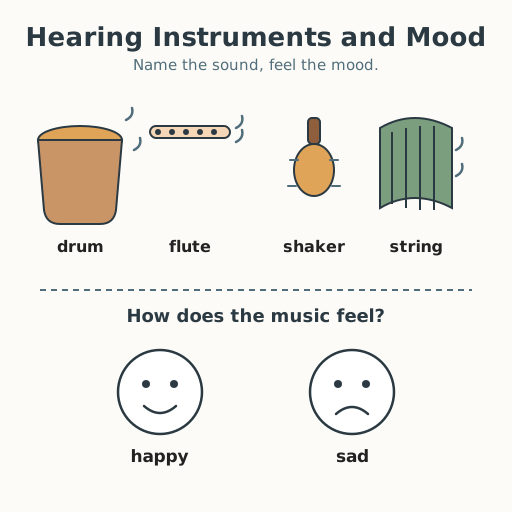
Lesson 4 — Hearing Instruments and Mood
Summary
Learners listen with their eyes closed and identify an instrument by its sound, then say whether the music feels happy, sad, or another way. They discover that every culture has its own instruments — drums, flutes, strings, shakers — and that the ear can tell them apart and feel the mood they make.
Objectives
- Identify one instrument by its sound and say whether the music feels happy, sad, or another way. (D07.S2.02.02)
Connection
Have you ever heard a drum before you saw it, or known a flute was playing from across a field? Our ears can name a sound-maker without our eyes. And music carries a mood — a song can make you feel like dancing, or make you feel quiet and a little sad. All over the world, people make instruments from wood, skin, metal, and gourd, and play them to share feelings. Today you will listen, name the instrument, and feel the mood.
Materials
- A few instruments or sound makers (a drum, a shaker, a flute, a plucked string)
- A blindfold, or just closed eyes
Preparation
- Gather a few instruments or sound makers with clearly different sounds.
- Arrange the group so the sound can be heard but not seen (behind a cloth or with eyes closed).
Facilitator note
This lesson is written to the learner (“you”) so it works in a classroom and for a self-directed learner. Honor the instruments you use as living people’s music-making, not curios — name the culture and the kind of sound respectfully, and do not treat any instrument as exotic or sacred in a way that tokenizes it. There is no wrong mood; one learner hears “happy” where another hears “excited,” and both are welcome — ask “what made you feel that?” to draw out the listening. A learner who is Deaf or hard of hearing identifies the instrument by feel and sight: feel the vibration of a drum through the floor or a table, and watch how the sound-maker is played; mood can be felt as fast or slow, strong or gentle vibration. A learner who does not speak points to the instrument and to a mood face or gesture. A learner who is blind or has low vision is a star at this — listening is their home ground.
Procedure
- Gather (5 min). Close your eyes (or look down). Listen. A sound is a clue that names its maker — a drum thumps, a flute whistles, a shaker rattles, a string plucks. Today your ears will do the identifying.
- Name the instrument (15 min). With eyes closed, hear one sound. What made it — a drum, a flute, a shaker, a string? Say its name, or point to a picture of it. If you can, feel its vibration through the floor or a table — a drum shakes big and slow, a shaker shakes fast and small.
- Feel the mood (15 min). Now hear a little music. Does it feel happy — bright and bouncing? Sad — slow and low? Or another way — calm, excited, brave? Show the mood with your face or hands, and try to say its name. There is no wrong feeling; the same music can feel different to different people.
- Share (10 min). Take turns naming one instrument you heard and one mood the music gave you. Listen to a friend — is their mood different from yours? Both are true.
- Close (5 min). Remember: your ears can name a sound-maker and feel its mood. Every instrument is a voice, and every culture has its own — and you can hear them all.
Differentiation
- Support: Offer one clear sound and one clear question (“drum or flute?”) and accept pointing or a hand signal.
- Support (Deaf/HH): Identify by feel (vibration) and sight (how it is played); feel mood as fast/slow or strong/gentle.
- Support (non-speaking): Point to the instrument picture and show the mood with face or gesture.
- Extension: Invite learners to identify two instruments played one after another, and to say whether the music’s mood changed and why they think so.
Assessment
- Formative (observation): Does the learner identify one instrument by its sound and say (or show) whether the music feels happy, sad, or another way?
Home connection
At home or outside, close your eyes and listen for one sound — a pot tapped, a voice, a bird. Name the sound-maker and tell a grown-up what mood it gives you.