Lesson 03 — Balanced Meals Around the World
Learners study balanced meals from several food traditions, find the groups in each, and draw their own balanced-meal plate. The lesson closes the meal-building objective by showing that every tradition has its own balanced meal, and every one is honored.
Objectives
Objectives
- D03.S3.02.01 Build a simple balanced meal by choosing foods from several different groups.
Essential question
How do families in different places build balanced meals from their own foods?
Key vocabulary
Materials
Standard materials
- World meal cards · 1 set Picture cards of balanced meals from several traditions — rice, beans, and greens; flatbread, lentils, and vegetables; maize, fish, and fruit; and more
- Paper and crayons · per learner For a balanced-meal plate drawing (portfolio artifact)
Low-tech / no-cost
- Remembered meals Talk through meals from home and the neighborhood and name the groups in each; no cards needed
- Drawn plates in the dirt Draw plates and sort foods into groups by naming them; no paper needed
Enriched / lab & device
- A world foods picture book or map · 1 A book or map showing where different staple foods and meals come from
- A class "meals of the world" chart · 1 A large chart to collect the many balanced meals learners name
Works in different contexts
- large-group Go around the circle so each learner shares one meal and its groups; collect them on the class chart and count the variety
- self-directed A learner studies the world meal cards, finds the groups in each, and draws one balanced meal of their own
- outdoor-only Look for food growing nearby and wonder what balanced meal a family could build from it; draw plates in the dirt
- multi-age Older learners write meal names and groups on the chart while younger learners point to the foods in each meal
- level-grouped Learners who can explain name the groups in each meal; others point to foods and match them to group cards
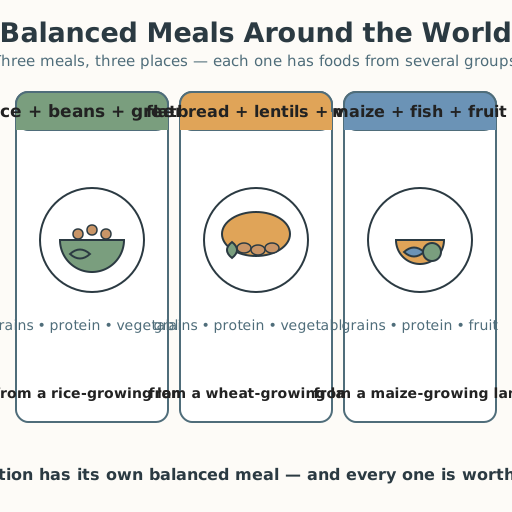
Lesson 3 — Balanced Meals Around the World
Summary
Learners study balanced meals from several food traditions — rice, beans, and greens; flatbread, lentils, and vegetables; maize, fish, and fruit — and find the food groups in each. They then draw their own balanced-meal plate, which becomes a portfolio artifact. The lesson closes the meal-building objective by showing that every tradition has its own balanced meal, and every one is worthy of honor.
Objectives
- Build a simple balanced meal by choosing foods from several different groups. (D03.S3.02.01)
Connection
A cook in a rice-growing land builds a meal from rice, beans, and greens. A cook in a wheat-growing land builds one from flatbread, lentils, and vegetables. A cook in a maize-growing land builds one from maize, fish, and fruit. The foods change with the land, but the idea stays the same: a balanced meal reaches into several groups. Today you will travel the world’s kitchens and find that idea everywhere.
Materials
- World meal cards (balanced meals from several traditions)
- Paper and crayons
Preparation
- Prepare world meal cards showing several balanced meals, each labeled with its foods.
- Prepare a class “meals of the world” chart to collect learners’ ideas.
- Remind learners: no meal and no tradition is ranked; all are honored.
Facilitator note
This lesson is written to the learner (“you”). Celebrate variety; rank nothing. The point is that “several groups” shows up in every food tradition, not that one tradition eats “better.” Some learners’ families may not have all foods available; honor what they do have, and never imply a family is failing. Vegetarian, plant-based, and fish- and meat-eating families are all honored — beans, lentils, eggs, and fish are proteins, so no meal needs meat to be balanced. If a learner’s family sometimes has little food, hold this gently and without comment on their family; the lesson speaks of variety and choice, never of scarcity as shame. A learner who is blind or has low vision explores the meals by touching real foods and hearing each food named; a learner who does not use a speaking voice points to the foods and groups. A learner who is deaf or hard of hearing follows the meal cards and group labels visually, since every food is shown and labeled. The balanced-meal plate drawing is a unit portfolio artifact — keep it. This lesson completes the D03.S3.02.01 meal-building strand before the unit turns to water.
Procedure
- Gather (5 min). Remember how we built a balanced meal last time. Today we will see that cooks everywhere build meals the same way — with foods from several groups.
- Meet meals from three lands (10 min). Look at the world meal cards. Find the groups in each meal: rice (grain), beans (protein), greens (vegetable); flatbread (grain), lentils (protein), vegetables (vegetable); maize (grain), fish (protein), fruit (fruit). Each meal reaches into several groups.
- Wonder together (10 min). What balanced meal might a family near you eat? What grows where you live — a grain, a root, a fruit, a fish, a bean? Build a meal in words from the foods of your own place, and name the group each food belongs to.
- Draw your balanced plate (15 min). Draw your own balanced meal using foods from at least three different groups, and add water to drink. Your plate may look like your own home and your own land.
- Share and celebrate (5 min). Share your plate with a partner. Notice how many different balanced meals the class has made — each one reaching into several groups.
- Close (5 min). Every tradition has its own balanced meal. Every one is worthy of honor.
Differentiation
- Support: Find the groups in just one world meal together, then draw a plate using three familiar foods.
- Support (blind/low-vision): Build with real foods by touch and describe the groups aloud; the plate drawing can be made with textured materials.
- Extension: Draw a second balanced meal from a different tradition and write which group each food belongs to.
Assessment
- Formative (observation): Can the learner find the food groups in a meal and draw a plate that reaches into several groups, in their own way?
- Portfolio: The balanced-meal plate drawing becomes a unit portfolio artifact.
- Self: The learner names the groups they included and one group they could add next time.
Home connection
At home, talk with a grown-up about one balanced meal your family makes. Name the group each food belongs to, and draw it together if you like.
Resources
- World Health Organization, “Healthy diet” (variety across food groups): https://www.who.int/news-room/fact-sheets/detail/healthy-diet