Lesson 03 — A Day in Another Child's Life
Learners meet the daily life of children in another place and time — food, homes, work, and play — and sort what is alike and what is different from their own day, with respect and no ranking.
Objectives
Objectives
- D08.S2.02.01 Describe the daily life of children in another place or time, including food, homes, work, and play, using stories or pictures.
Essential question
What is daily life like for children in another place or time — their food, homes, work, and play?
Key vocabulary
Materials
Standard materials
- Two or three "a day in a child's life" picture sets · 1 set each Simple picture cards showing food, home, work, and play for a child in another place (and one from long ago)
- A compare chart with four rows · 1 per learner or pair Rows labeled food, home, work, play — to sort what is alike and what is different
Low-tech / no-cost
- Told stories and acting The facilitator tells a short "day in the life" story; learners act the food, home, work, and play with their bodies
- Drawn picture cards Learners draw four cards — food, home, work, play — for one child's day; no printed set needed
Enriched / lab & device
- A picture book of children's lives around the world · 1 A book like DK/UNICEF's Children Just Like Me, showing real children's daily lives side by side
- A short video or photo set · 1 Optional — a gentle video or photos of a child's day in another place
Works in different contexts
- large-group Read one child's day aloud while the whole group acts each part — eating, sleeping, helping, playing — in a big circle
- self-directed The learner reads or looks at two child-life picture sets and fills the four-row chart (food, home, work, play) alone
- outdoor-only Act out one child's day outside using found objects — a leaf for food, a stick for a tool, a circle of stones for a home
- multi-age Older learners read the picture cards aloud and scribe while younger learners act the food, home, work, and play
- level-grouped Learners who finish the chart early coach peers by asking "what does this child eat? where do they sleep?" rather than telling
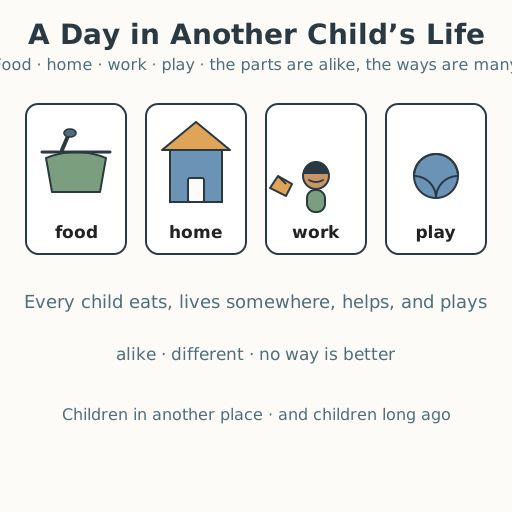
Lesson 3 — A Day in Another Child’s Life
Summary
Learners step into the daily life of children in another place and time — what they eat, where they live, how they help, and how they play — and sort what is alike and what is different from their own day. Every child’s day is real and worthy; no way is “better.”
Objectives
- Describe the daily life of children in another place or time, including food, homes, work, and play, using stories or pictures. (D08.S2.02.01)
Connection
You wake up, you eat, you live in a home, you help, and you play. So does almost every child, everywhere. What changes from place to place is how: one child eats bread and another eats rice, one lives in a house of wood and another in a home of clay or a tent, one helps carry water and another helps herd animals. Looking at another child’s day — and seeing both what is alike and what is different — is how we come to know and respect one another.
Materials
- Two or three “a day in a child’s life” picture sets (food, home, work, play)
- A compare chart with four rows: food, home, work, play
Preparation
- Choose or draw two or three short child-life picture sets. Good, well-documented examples: a Quechua-speaking child in the high Andes who helps farm potatoes and herd llamas (see Resources), a child in a Pacific island community who helps fish and paddle, and a child from long ago in a farming village who helps with the harvest.
- Prepare the four-row compare chart (food, home, work, play).
Facilitator note
This lesson is written to the learner (“you”). Hold the examples with respect, as real children’s lives, not costumes. Do not present any place as “exotic” or any life as “sad” — the goal is accurate, warm description of food, homes, work, and play, and noticing what is alike across all of us (every child eats, sleeps, helps, and plays). Use present tense for living ways and past tense only for “long ago” examples — many children today still farm, herd, and fish, and that is not “backward,” it is a living way of life. Keep facts accurate and hedged (see Resources). Honor every body: describe the picture cards in words for a learner who cannot see them; a learner who does not use a speaking voice acts or sorts the cards. Never require a learner to compare their own home if that feels private — they may compare the two given children instead.
Procedure
- Gather (5 min). Think of your own day: one thing you eat, where you live, one way you help, and one way you play. Hold those in your mind.
- Meet a child’s day (15 min). Listen or look at the picture set of one child in another place. What do they eat? What is their home like? What work do they help with? How do they play?
- Sort alike and different (15 min). On the four-row chart, sort each part — food, home, work, play. Which parts are like your day, and which are different? Say one thing aloud: “We both… “ and “Here, one way it is different is…”
- Meet a second child (10 min). Look at a second child’s day — from another place, or from long ago. Notice the same four parts: food, home, work, play.
- Close (5 min). Children everywhere eat, live somewhere, help, and play — the parts are alike, the ways are many. Every way is real and worthy of respect.
Differentiation
- Support: Meet just one child and name only two parts (food and play) with heavy pointing support.
- Support (blind/low-vision): Hear the day described in clear words and sort real objects (a grain for food, cloth for home, a tool for work, a ball for play).
- Support (non-speaking): Sort picture cards onto the chart and point to “alike” and “different” spots instead of speaking.
- Support (Deaf/HH): The picture sets are already visual — read them with your eyes, and sign each part (food, home, work, play) as you place it.
- Support (motor-difference): Use larger cards and a stable chart; direct a partner to place each card while you point, sign, or eye-gaze.
- Extension: Write or tell one sentence about each part for the second child, using the words “alike” and “different.”
Assessment
- Formative (observation): Can the learner name at least three of the four parts of another child’s day — food, home, work, play?
- Formative (oral/performance): Does the learner say or show one thing that is alike and one thing that is different, without ranking either child’s life as better?
Resources
- DK / UNICEF, Children Just Like Me — a book that shows real children’s daily lives (food, homes, work, play) across many countries, side by side. (Book; no URL.)
- International Potato Center (CIP), “Potato” — notes the potato was first domesticated in the Andes mountains of South America and that thousands of native potato varieties are still grown there, supporting the Andean child-life example. https://cipotato.org/potato/
Home connection
Ask someone at home about a child’s day in a place they know — maybe where they grew up, or a place far away. What did that child eat, and how did they play? What is like your day, and what is different?