Lesson 04 — A Knowledge and Skill People Developed
Learners meet one knowledge and skill a particular people developed — Polynesian wayfinding, reading stars, waves, birds, and clouds to sail the open ocean — and explain what it helps them do, alongside farming and weaving as other living knowledge traditions.
Objectives
Objectives
- D08.S2.02.02 Identify one knowledge or skill a particular people has developed, such as farming, weaving, or wayfinding, and explain what it helps them do.
Essential question
What is one knowledge or skill a particular people has developed, and what does it help them do?
Key vocabulary
Materials
Standard materials
- Wayfinding picture cards · 1 set Cards showing stars, ocean waves, a sailing canoe, and a navigator — the signs wayfinders read
- Paper and crayons · per learner For drawing one knowledge or skill and what it helps people do
Low-tech / no-cost
- The sky and a bowl of water Look at the real sky for stars and clouds, and ripple water in a bowl to see "waves" — the very signs wayfinders read
- Body and voice Act out reading the stars (look up), feeling the wave (sway), and steering a canoe; no printed cards needed
Enriched / lab & device
- A short video or picture set of traditional wayfinding · 1 Optional — a gentle clip or photos of the Hōkūleʻa canoe and its navigators
- A weaving sample to touch · 1 A woven cloth or basket, to feel a knowledge passed down hand to hand
Works in different contexts
- large-group Read the wayfinding story aloud while the whole group acts out reading stars, waves, birds, and clouds, then steering the canoe
- self-directed The learner studies the picture cards and draws one knowledge or skill and one sentence about what it helps people do
- outdoor-only Find the Sun or the stars, watch the wind move leaves (like waves), and talk about how people read these signs to find their way
- multi-age Older learners read the wayfinding story and write the "what it helps" sentence, while younger learners act the signs
- level-grouped Learners who finish early coach peers by asking "what sign do they read? what does it help them do?" rather than telling
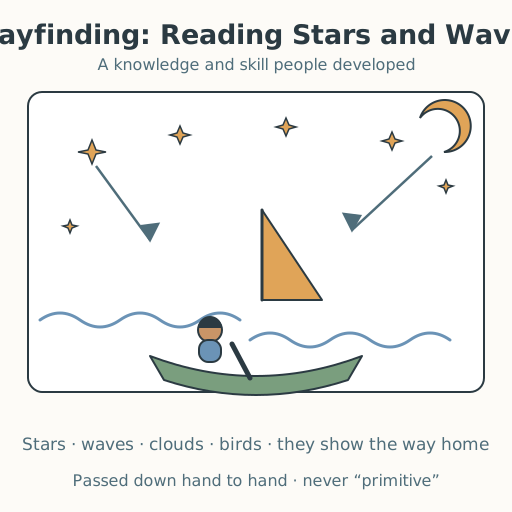
Lesson 4 — A Knowledge and Skill People Developed
Summary
Learners meet one knowledge and skill a particular people developed — wayfinding, the Polynesian skill of reading stars, waves, birds, and clouds to sail across the open ocean — and explain what it helps people do. They hold it alongside farming and weaving as other living knowledge traditions, passed down hand to hand, never “primitive.”
Objectives
- Identify one knowledge or skill a particular people has developed, such as farming, weaving, or wayfinding, and explain what it helps them do. (D08.S2.02.02)
Connection
Think of a skill you are learning — reading, cooking, fixing something. Someone taught you, and someone taught them, back and back. Every people has developed its own knowledge and skills this way, over a very long time. One of the most remarkable is wayfinding: long before maps and machines, Pacific Island navigators learned to read the stars, the ocean waves, the clouds, and the birds to sail their canoes across thousands of kilometres of open sea — and they still do it today.
Materials
- Wayfinding picture cards (stars, waves, a sailing canoe, a navigator)
- Paper and crayons
Preparation
- Prepare or draw the wayfinding picture cards.
- Prepare to tell the story accurately: Polynesian and Micronesian navigators read the night sky, ocean swells, clouds, and birds to find their way; in 1976 the Hōkūleʻa canoe sailed from Hawaiʻi to Tahiti guided by the Micronesian master navigator Mau Piailug using these traditional skills (see Resources).
- Have ready one or two other knowledge examples — farming (terracing and potatoes in the Andes) and weaving — to offer as choices.
Facilitator note
This lesson is written to the learner (“you”). This is the unit’s clearest chance to honor a non-European knowledge tradition as real science, not legend. Wayfinding is careful observation and deep knowledge — navigators read the rising points of stars, the feel of ocean swells, the shapes of clouds, and the flight of birds to know where land lies, sometimes over thousands of kilometres of open water. Tell it with respect and accuracy, and name the people: Pacific Island navigators across Polynesia and Micronesia, and the 1976 Hōkūleʻa voyage guided by master navigator Mau Piailug (see Resources). Never call it “primitive” or “simple,” and never rank it below a compass or GPS — it is a different, living way of knowing. Offer farming and weaving as other examples so learners see that knowledge traditions are many, on every continent. Honor every body: describe the cards in words for a learner who cannot see them; a learner who does not use a speaking voice acts the signs or points to the cards.
Procedure
- Gather (5 min). If you were in a boat on the wide sea with no map and no phone, how would you know which way to go? Pause and wonder.
- Meet wayfinding (15 min). Listen to the story. Long ago, and still today, Pacific Island navigators sail canoes across the ocean. They read the stars (which rise where), the waves (how the sea swells and bends around islands), the clouds (which gather over land), and the birds (which fly home to land at dusk). These signs tell them where they are and which way to sail.
- Say what it helps them do (10 min). Together, finish the sentence: “Wayfinding helps people…” (cross the open ocean, find islands, travel between homes, share food and family). Point, act, or sign your answer.
- Meet another knowledge (10 min). Look at two more: farming (people in the Andes built terraces on steep mountains to grow potatoes) and weaving (people weave cloth and baskets, passing the patterns from elder to child). Each helps people live — food, clothing, carrying.
- Draw and tell (10 min). Draw one knowledge or skill and write or tell one sentence: “This helps people…” You may choose wayfinding, farming, weaving, or a skill your own family or people keep.
- Close (5 min). Every people has developed knowledge and skill, passed down hand to hand. All of it is real, and all of it helps people live.
Differentiation
- Support: Meet only wayfinding, and finish the “it helps people…” sentence together with picture support.
- Support (blind/low-vision): Feel a woven sample, ripple water in a bowl to feel “waves,” and hear the story told clearly; describe aloud what the skill helps do.
- Support (non-speaking): Act out reading the stars and steering the canoe, and point to the “what it helps” picture instead of speaking.
- Support (Deaf/HH): The cards are already visual — read them with your eyes, and sign “stars,” “waves,” and “sail” as you place each one.
- Support (motor-difference): Direct a partner to move the canoe card and the sign cards while you point, sign, or eye-gaze.
- Extension: Name a second knowledge or skill and tell one thing it helps people do, and how it is passed from one person to the next.
Assessment
- Formative (observation): Can the learner name one knowledge or skill a people developed and identify at least one sign or step of it?
- Formative (oral/performance): Does the learner explain, in a finished sentence, what the knowledge or skill helps people do?
Resources
- Polynesian Voyaging Society (Hōkūleʻa) — documents traditional Polynesian wayfinding (reading stars, swells, clouds, and birds) and the 1976 Hōkūleʻa voyage from Hawaiʻi to Tahiti, guided without instruments by master navigator Mau Piailug. https://hokulea.com/
- International Potato Center (CIP), “Potato” — the potato was first domesticated in the Andes of South America; thousands of native varieties are still farmed there, supporting the Andean farming/terracing example. https://cipotato.org/potato/
- UNESCO Intangible Cultural Heritage — frames living heritage as the practices, knowledge, and skills that communities pass from one generation to the next, supporting the idea of knowledge passed down hand to hand. https://ich.unesco.org/
Home connection
Ask someone at home: what is one skill or piece of knowledge our family keeps — a recipe, a song, a way of making or fixing something? What does it help us do, and who taught it to whom?