Lesson 01 — Right and Wrong, With a Reason
Learners tell the difference between something that is right to do and something that is wrong to do, and practice giving a reason ("because…"). Reasons help us understand a choice — without making a wrong choice right.
Objectives
Objectives
- D09.S1.02.01 Tell the difference between something that is right to do and something that is wrong to do, and give a reason.
Essential question
How do I tell something that is right to do from something that is wrong to do, and give a reason?
Key vocabulary
Materials
Standard materials
- Right-or-wrong situation cards · 1 set Pictures of everyday moments where a choice can be right or wrong (returning a found coin, taking without asking, helping someone up, leaving a friend out of a game)
- Crayons and paper · per learner
Low-tech / no-cost
- Voice and body Act out each situation together; no cards needed
- Found objects A cup, a stone, or a scarf to stand in for a coin, a toy, or a snack
Enriched / lab & device
- Laminated situation cards · 1 set per pair Durable, wipeable cards for repeated sorting of right and wrong choices
- A tablet or camera · 1 per group To photograph learners acting out a right choice and its reason, for a class "reasons" gallery
Works in different contexts
- large-group Hold each card up large for all to see; the whole group names one right and one wrong choice, then acts each out and gives a reason
- self-directed The learner looks at each card, names a right and a wrong choice, and tells or writes a reason for each
- outdoor-only Find real moments outdoors (a dropped object to return, a spot someone wants) and name a right and a wrong choice with a reason for each
- multi-age Older learners model giving a reason, then younger learners try with their own examples
Lesson 1 — Right and Wrong, With a Reason
Summary
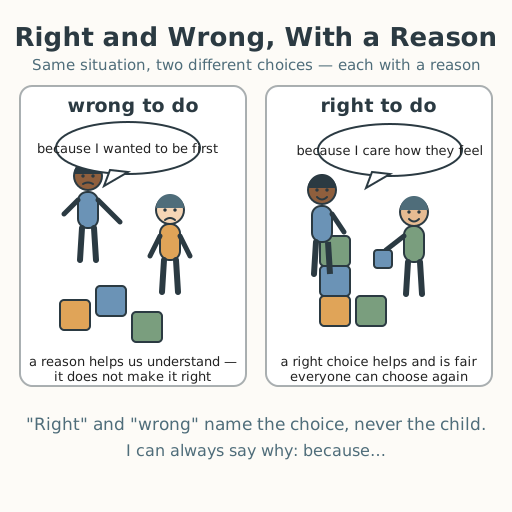
Learners meet the words “right” and “wrong” as names for choices (not for children), and practice telling the difference between something that is right to do and something that is wrong to do — then giving a reason with the word “because.” Reasons help us understand a choice; they do not make a wrong choice right.
Objectives
- Tell the difference between something that is right to do and something that is wrong to do, and give a reason. (D09.S1.02.01)
Connection
Think of a time you found something that was not yours — a coin on the path, a toy left behind. You could keep it, or you could give it back. One of those is the right thing to do, and the other is the wrong thing to do. And you can always say why: “I gave it back because it belonged to someone else, and they would miss it.” Everywhere in the world — in a busy market, a quiet village, a boat, or a classroom — people make choices every day and can give a reason for them. Today you will practice telling right from wrong, and saying why.
Materials
- Right-or-wrong situation cards (returning a found coin, taking without asking, helping someone up, leaving a friend out of a game)
- Crayons and paper
Preparation
- Prepare or draw a set of right-or-wrong situation cards showing everyday moments.
- Arrange a circle for gathering and acting out.
Facilitator note
Written to the learner (“you”) so it works in a classroom and for a self-directed learner. The central commitment is name the act, never the child: say “that choice was wrong,” never “you are a bad child.” Right and wrong here name choices, not people — everyone makes wrong choices sometimes, and everyone can choose again. Right and wrong are held as a question to explore (“what does this choice do for the other person?”) rather than a rule handed down. A reason is the “because” behind a choice; invite learners to give one, and accept every honest reason — there is no single correct answer, and a choice can be right in one situation and wrong in another. A learner who does not speak aloud names the choice and its reason by pointing to a card or a “because” picture, or by signing; a learner who is deaf or hard of hearing reads each situation from the cards or the acted-out scene and gives the reason by signing or pointing; a learner who is blind or low-vision hears each situation described and gives the reason aloud or by touch; a learner with a motor difference can direct a partner to act out the choice. Do not require anyone to speak in front of the group; a learner may always pass.
Procedure
- Gather (5 min). Sit comfortably. Think of a time you did the right thing — or the wrong thing. Could you say why you did it?
- Meet the words (10 min). Something that is right to do helps people and is fair to them. Something that is wrong to do hurts someone or is unfair. These words name the choice, not the person — everyone can choose again.
- Tell which is which, and why (15 min). For each situation card, name one right choice and one wrong choice, and give a reason with “because.” Say it, sign it, point to it, or act it out. Wonder together: what does each choice do for the other person?
- Draw your right choice and reason (10 min). Draw one right choice you could make — for a friend, a family member, an animal, or the earth. Under it, write or tell the reason: “because…” If drawing is not your way, build it from found objects, act it out, or have a partner draw or scribe while you direct. Tell a partner what it is and why it is right.
- Close (5 min). Right and wrong name choices, and you can always give a reason. Tomorrow you can choose again.
Differentiation
- Support: Offer just two situations; model one sentence “That choice is right because…” with a word and a gesture. A non-speaking learner points to a card and a “because” picture and nods or shakes; a learner with limited movement directs a partner.
- Extension: Invite learners to think of one choice that could be right in one situation and wrong in another (for example, shouting to warn of danger vs. shouting at a friend) and wonder why.
Assessment
- Formative (observation): Can the learner tell the difference between something right and something wrong to do, and give a reason?
- Artifact (portfolio): The “my right choice and its reason” drawing (or a built, acted, or partner-scribed version), kept in the learner’s portfolio.
Home connection
Tonight, notice one right choice and one wrong choice around you — in your home, on the street, or in a story. Tell a grown-up which is which, and give a reason for each.
Resources
- CASEL SEL Framework (foundational competencies, including responsible decision-making): https://casel.org/fundamentals-of-sel/