Lesson 03 — Same Is Not Always Fair
Learners discover that fair does not always mean the same: treating everyone the same can leave some people out, while giving each person the support they *need* lets everyone take part. They practice matching needs to supports and explaining why.
Objectives
Objectives
- D09.S2.02.01 Explain why treating everyone the same is not always fair, using an example like different needs.
Essential question
Why is treating everyone the same not always fair?
Key vocabulary
Materials
Standard materials
- A needs-and-supports picture set · 1 set Pictures of people with different needs (a small child who cannot reach, a person who uses a wheelchair, a tall person) and different supports (a step stool, a ramp, nothing needed)
- Blocks or boxes of different heights · 1 set For building "same support for all" vs "the support each one needs"
Low-tech / no-cost
- Found objects Stones, sticks, or stacked leaves to show same vs. different support
- Voice and body Act out reaching a high shelf with the same and then different support
Enriched / lab & device
- A set of measuring or balancing tools · 1 set A ruler or balance to compare what is the same and what is different
- A "fairness needs" picture book · 1 Any gentle book showing different needs met in different ways
Works in different contexts
- large-group Act out the shelf scene with three learners of different heights, trying the same box and then different supports, while the group wonders which is fairer
- self-directed The learner matches each person to the support they need and tells or writes why the same support is not fair for all
- outdoor-only Use a real high branch of fruit; try the same and then different supports (a stump, a stick, a friend's boost) and wonder which is fair
- multi-age Older learners ask "what does each person need?" while younger learners place the supports
Lesson 3 — Same Is Not Always Fair
Summary
Learners meet the unit’s central fairness idea: same is not always fair. Treating everyone exactly the same can leave some people out, while giving each person the support they need lets everyone take part. They practice matching needs to supports and explaining why, held as a question to keep wondering about.
Objectives
- Explain why treating everyone the same is not always fair, using an example like different needs. (D09.S2.02.01)
Connection
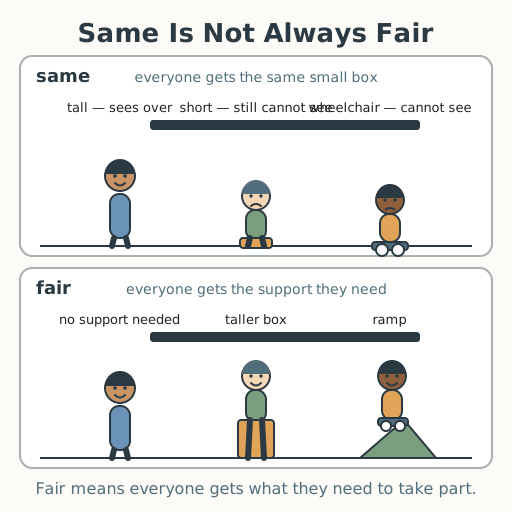
Think of three people trying to see over a wall: a tall grown-up, a small child, and a child who uses a wheelchair. If you give all three the same small box to stand on, the tall one sees over easily, the small child still cannot see, and the wheelchair user cannot reach at all. Same — but not fair. If instead you give each one the support they need — nothing for the tall one, a taller box for the small child, a ramp for the wheelchair — then all three see. People everywhere figure this out: a village gives a fishing net to the one who can cast it and a basket to the one who carries. Today you will practice telling same from fair.
Materials
- A needs-and-supports picture set (a small child who cannot reach, a person who uses a wheelchair, a tall person; a step stool, a ramp, nothing needed)
- Blocks or boxes of different heights
Preparation
- Prepare the needs-and-supports pictures, or gather blocks and boxes of different heights.
- Set up a “wall” (a table edge, a line, or a branch) that is hard for some to see over.
Facilitator note
Written to the learner (“you”). This lesson holds two ideas open, side by side, as a question: equality — same for everyone — and equity — what each one needs. The lesson does not teach that sameness is wrong; it teaches that sameness is not the whole of fairness. Keep the examples gentle and real: reaching a shelf, seeing over a wall, reading a sign, drinking from a fountain. Never single out or shame a learner for a need — frame needs as ordinary and universal (everyone has needs; some are just easier to see). Include ability naturally: a ramp and a step stool are just two ways people get where they need to go, not a “special” case. A learner who does not speak aloud shows which support matches which person by pointing or placing blocks; a learner who is blind or low-vision feels the different heights of the blocks and hears the scene described; a learner with a motor difference can direct a partner to place the supports. The goal is the learner’s own explanation — “the same box is not fair because they have different needs” — not a memorized phrase. A learner may always pass.
Procedure
- Gather (5 min). Remember a time something was too high, too far, or too hard for you but easy for someone else. Did the same help work for everyone?
- Meet “same” and “fair” (10 min). Same means everyone gets exactly the same thing. Fair means everyone gets what they need to take part. Look at the pictures: same box for all, or the support each one needs.
- Build it (15 min). Set up your wall. Try giving everyone the same small box. Who can see? Who cannot? Now try giving each person what they need — nothing, a taller box, a ramp. Who can see now? Say, sign, or point to which way is fair, and why.
- Explain why (10 min). Finish the sentence: “Treating everyone the same is not always fair because…” Use your example. Wonder together: is there ever a time when same is fair?
- Close (5 min). Fair does not always mean the same. Fair means everyone gets what they need to take part — a question to keep wondering about.
Differentiation
- Support: Use just two people and two supports; model “the same box is not fair because…” A non-speaking learner points to the support each person needs; a learner with limited movement directs a partner.
- Extension: Invite learners to invent a new need (a friend who cannot read small print, someone with a broken arm) and wonder what support would make it fair.
Assessment
- Formative (observation): Can the learner explain why treating everyone the same is not always fair, using a different-needs example?
- Performance: The built scene — same vs. what-each-needs — explained aloud.
Home connection
At home, notice a place where people have different needs (a high shelf, a heavy bucket, a door). Wonder with someone: what support would let everyone take part?
Resources
- The “equality vs. equity” distinction, explained simply for children (adapted from the well-known fence illustration): a version is discussed in the UNICEF and United Nations materials on children’s rights and inclusive education.