Lesson 04 — The Rights Every Child Has
Learners name a right that children have — such as the right to play or to learn — and explain why it matters. They learn that rights belong to every child, everywhere on Earth, not just to some.
Objectives
Objectives
- D09.S2.02.02 Name a right that children have, such as the right to play or learn, and why it matters.
Essential question
What right does every child have, and why does it matter?
Key vocabulary
Materials
Standard materials
- Rights picture cards · 1 set Pictures for a few children's rights — to play, to learn, to be safe, to be heard, to rest — each with a simple icon
- Crayons and paper · per learner
Low-tech / no-cost
- Voice and body Act out each right together (playing, reading, resting); no cards needed
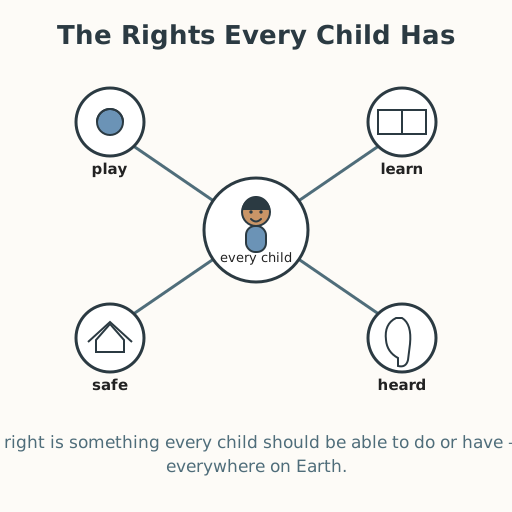
- A drawn rights wheel Draw a circle with the learner at the center and the rights around the edge
Enriched / lab & device
- Laminated rights cards · 1 set per pair Durable cards for repeated sorting and matching of rights to their icons
- A short video or story about children's rights · 1 A gentle, child-friendly story showing children's rights being honored around the world
Works in different contexts
- large-group Hold each rights card up large; the group names the right and one reason it matters, then acts it out
- self-directed The learner picks one right, draws or writes it, and tells or writes why it matters
- outdoor-only Walk and name rights you can see honored outdoors (a place to play, a safe path, shade to rest) and why they matter
- multi-age Older learners read a right aloud and explain it; younger learners draw or act it
Lesson 4 — The Rights Every Child Has
Summary
Learners meet the idea of a right — something every child should be able to do or have, everywhere on Earth. They name a right children have, such as the right to play or to learn, and explain why it matters, noticing that a right belongs to every child, not just some.
Objectives
- Name a right that children have, such as the right to play or learn, and why it matters. (D09.S2.02.02)
Connection
Think of a day when you could play, or learn, or rest when you were tired, or be listened to when you spoke. Those are not just lucky days — they are rights: things every child should be able to do or have, no matter where on Earth they live, how much money their family has, or what their body can do. The right to play, the right to learn, the right to be safe, the right to be heard. People have written these down so that every child is counted. Today you will name one and say why it matters.
Materials
- Rights picture cards (to play, to learn, to be safe, to be heard, to rest)
- Crayons and paper
Preparation
- Prepare the rights picture cards, each with a simple icon and a label.
- Arrange a circle for acting out and sharing.
Facilitator note
Written to the learner (“you”). This lesson introduces children’s rights gently and universally. Ground the idea in the United Nations Convention on the Rights of the Child, which says every child has the right to things like play, learning, safety, rest, and being heard — but keep it concrete for age 7–8: a right is something every child should be able to do or have. Emphasize that rights belong to every child everywhere — this is an egalitarian, global claim, not one nation’s rule. Hold it as a should (a shared hope and agreement) rather than a claim that every child already has these things honored; learners may notice that not every child gets to play or learn, and that noticing is welcome — it is the beginning of caring. Do not frighten; connect any gap to agency and hope (“we can help make it true”). A learner who does not speak aloud points to a rights card or signs; a learner who is deaf or hard of hearing follows the rights through the cards and sign; a learner who is blind or low-vision hears each right described and names it aloud; a learner with a motor difference can direct a partner to act out the right. A learner may always pass.
Procedure
- Gather (5 min). Think of something you did today — played, learned, rested, or spoke. Did anyone have to give you permission? You have a right to it.
- Meet “right” (10 min). A right is something every child should be able to do or have, everywhere on Earth. Look at the cards: play, learn, be safe, be heard, rest. Each is a right.
- Name one and why it matters (15 min). Pick one right (point, sign, or say it). Finish the sentence: “Every child has the right to…, and it matters because…” Wonder together: what would life be like without it?
- Draw your rights wheel (10 min). Draw yourself in the center of a circle, and around the edge draw or write the rights you think every child should have. If drawing is not your way, build it from found objects, act it out, or have a partner draw while you direct. Tell a partner why one of them matters.
- Close (5 min). Rights belong to every child, everywhere. Naming a right is the first step to caring that every child gets it.
Differentiation
- Support: Offer two rights cards and model one sentence “Every child has the right to play because…” A non-speaking learner points to the card; a learner with limited movement directs a partner.
- Extension: Invite learners to wonder whether there is a right they would add that is not on the cards, and why it matters.
Assessment
- Formative (observation): Can the learner name a right children have and say why it matters?
- Artifact (portfolio): The “rights wheel” drawing (or a built, acted, or partner-scribed version), kept in the learner’s portfolio.
Home connection
At home, ask a grown-up: what right did you love most as a child — to play, to learn, to be safe, or to be heard? Tell them which right matters most to you and why.
Resources
- United Nations Convention on the Rights of the Child (child-friendly summary): https://www.unicef.org/child-rights-convention