Lesson 03 — Where Did That Information Come From?
Learners practice naming where a piece of information came from — a book, a grown-up, or a screen — and asking one question about it: who made it, how do they know, or is it new or old. They learn that information always comes from somewhere and from someone, and that asking is the first step of reading carefully.
Objectives
Objectives
- D10.S2.02.01 Tell where a piece of information came from, such as a book, a grown-up, or a screen, and ask one question about it.
Essential question
Where did a piece of information come from, and what question can I ask about it?
Key vocabulary
Materials
Standard materials
- Source cards (book, grown-up, screen) and fact cards · 1 set Three source cards and several simple facts, each learned from one source (a fact from a book, from a grown-up, from a screen)
- Paper and crayons · per learner For drawing a fact and its source
Low-tech / no-cost
- Real things and spoken facts Hold a real book, point to a real grown-up, and say a fact each gave you; no printed cards needed
- Voice and body Say a fact and act out the source — reading a book, asking a grown-up, watching a screen — and let a partner name the source
Enriched / lab & device
- A device to show one fact on a screen · 1 per group Optional, used gently — show one short fact on a screen to practice "this came from a screen"
- A "source detective" question card set · 1 set One question per card — Who made it? How do they know? Is it new or old?
Works in different contexts
- large-group Hold each fact up big; the whole group names the source (book, grown-up, screen), and one learner asks one question about it
- self-directed A learner matches facts to sources alone, then writes or says one question about one fact
- outdoor-only Find a fact outside (a bird singing, a plant growing) and say who told you or where you read it, then ask one question about it
- multi-age Older learners read the facts aloud and coach younger ones in asking one question about the source
- level-grouped Learners who finish early explain how a grown-up checks a fact before telling it; others match one fact to its source
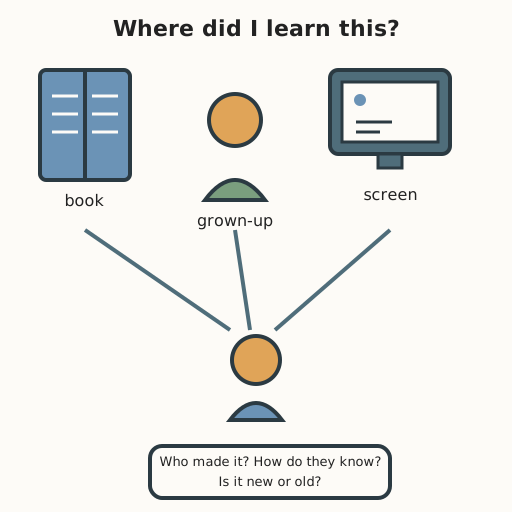
Lesson 3 — Where Did That Information Come From?
Summary
Learners learn that every piece of information comes from somewhere — a book, a grown-up, or a screen — and from someone. They practice saying the source of a fact and asking one question about it: Who made it? How do they know? Is it new or old? They meet asking as a treasure, not a suspicion: it is how careful readers learn.
Objectives
- Tell where a piece of information came from, such as a book, a grown-up, or a screen, and ask one question about it. (D10.S2.02.01)
Connection
Where did you learn that the sky is blue, or that a plant needs water to grow? Maybe a grown-up told you. Maybe you read it in a book. Maybe you saw it on a screen. Information always comes from somewhere and from someone. Knowing where it came from — and asking one question about it — is how we begin to read carefully, in every language and every place.
Materials
- Source cards (book, grown-up, screen) and simple fact cards
- Paper and crayons
Preparation
- Prepare three source cards — a book, a grown-up, a screen — and several simple facts, each clearly from one source (a fact from a book, from a grown-up, from a screen).
- Prepare the question starters: Who made it? How do they know? Is it new or old?
- Set out paper and crayons.
Facilitator note
This lesson is written to the learner (“you”). Build on Grade 1’s “who made it and for
whom” and grow it into “where did it come from, and what do I ask?” Keep the tone warm —
asking about a source is a treasure of a careful reader, never a rude challenge. Honor all
sources equally: a grandmother’s spoken word, a printed book, and a screen can all carry
true information, and all deserve a question. Hold the stance of the whole curriculum:
question gently, never cynically. In places where it is not safe to question an adult,
frame it as wondering together (see docs/contexts.md), and let learners write or drop
questions into a “wonder box” instead of speaking them. Honor every body: a learner who
is blind or has low vision can hear each fact and name its source by voice, and feel a
book’s pages or a screen’s edge; a non-speaking learner points to the source card and to a
question card to show the answer.
Procedure
- Gather (5 min). Where do you learn things? Name one place you learned something this week. Was it from a person, a book, or a screen?
- Meet the three sources (10 min). Look at the source cards: a book, a grown-up, a screen. Each one can give you information. For each, say one thing you could learn from it.
- Play “name the source” (10 min). Hear each fact card. Then say where it came from: “I learned this from a book.” “A grown-up told me this.” “I saw this on a screen.”
- Ask one question (10 min). Pick one fact. Ask one question about it: Who made this? How do they know? Is it new or old? A partner helps you answer if they can.
- Draw a fact and its source (8 min). Draw one fact you know, and draw or write where it came from — a book, a grown-up, or a screen. Add one question you would ask.
- Close (2 min). Information always comes from somewhere and someone. Naming the source and asking one question is how careful readers learn — everywhere, in every language.
Differentiation
- Support: Match one fact to one source and ask one question together aloud, with the question card in front of you.
- Blind/low vision: Hear each fact and name its source by voice; feel a book’s pages and a screen’s edge to tell them apart by touch.
- Deaf/hard of hearing / non-speaking: Show the source with a sign, picture, or card; ask a question by pointing to a question card (Who? How? New or old?).
- Motor differences: Point to the source card and to a question card; direct a partner’s hands to draw the fact while the learner chooses the source.
- Extension: Tell how a grown-up might check a fact before telling you, and name one question you would ask a book.
Assessment
- Formative (observation): Can the learner tell where one piece of information came from (a book, a grown-up, or a screen) and ask one question about it?
Home connection
At home, tell a grown-up one thing you learned this week and where it came from. Ask the grown-up: where did they learn the thing they know best, and what question would they ask about it?
Resources
- Common Sense Media (Common Sense Education), “News & Media Literacy” — teaching children to ask where information comes from and to question it (its K-2 strand names wondering where information comes from and asking questions), supporting the lesson’s core skill. https://www.commonsense.org/education/digital-citizenship/topic/news-and-media-literacy