Lesson 07 — The Groups I Belong To
Learners name the several groups they belong to at once — family, class, community, a club or team, a faith or cultural community, a language group — and see themselves at the center of a web of belonging. This is the first half of understanding how group membership shapes identity.
Objectives
Objectives
- D01.S2.03.02 Name several groups they belong to and how each one shapes who they are.
Essential question
What groups do I belong to?
Key vocabulary
Materials
Standard materials
- My Groups web · 1 per learner A page with "me" in the center and empty circles around it to fill with the groups the learner belongs to
- Group idea chart · 1 A reference list of kinds of groups (family, class, community, club or team, faith or culture, language)
Low-tech / no-cost
- Voice and body Name your groups aloud and count them on your fingers; no page needed
- A circle of stones Put yourself in the middle and place one stone for each group around you
Enriched / lab & device
- A reusable 'my groups' wheel with labels · 1 per learner A wheel the learner can spin and fill with their own groups, kept in the portfolio
- Photos or objects from each group · 1 set Real keepsakes to place on the web at each group's circle
Works in different contexts
- large-group Brainstorm kinds of groups together first, then learners fill their own webs and share one group aloud
- multi-age Older learners scribe the groups a younger learner names, then share one group they share in common
- self-directed A learner fills the web alone and reads the groups back to check they named several, not just one
- level-grouped Learners ready to extend sort their groups into kinds (family, place, interest, language, faith or culture)
- outdoor-only Stand in the center of a ring of stones or leaves and name each group as you point to its marker
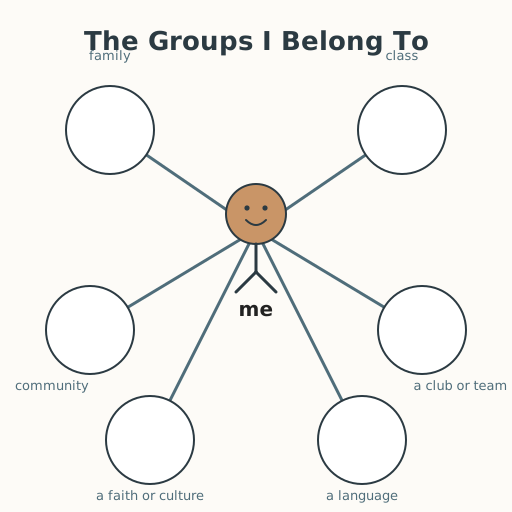
Lesson 7 — The Groups I Belong To
Summary
Learners name the several groups they belong to at once — family, class, community, a club or team, a faith or cultural community, a language group — and see themselves at the center of a web of belonging. This is the first half of understanding how group membership shapes who they are.
Objectives
- Name several groups they belong to. (D01.S2.03.02)
Connection
Right now you belong to more than one group at the same time. You are in a family, a class, a neighborhood or village, maybe a team or club, maybe a faith or cultural community, and you speak at least one language with others who speak it too. Being in a group means you share something with the other people in it. In a big city apartment block, a child belongs to a family, a class, a football team, and a grandmother’s village far away — all at once. Belonging is like a web with you in the middle.
Materials
- My Groups web
- Group idea chart
- Crayons and pencils
Preparation
- Copy a “My Groups” web page for each learner.
- Prepare the group idea chart (kinds of groups).
- Arrange a circle for sharing.
Facilitator note
This lesson is written to the learner (“you”). The goal is breadth — that a learner can name several groups, not just one or two. Normalize that everyone belongs to many groups, and that some groups are chosen (a club, a team) while others are given (a family, a birthplace, a language). Honor every kind of group without ranking: a faith community is not “better” than a sports team, and a child with no formal club still belongs to their family, class, and community. Where natural, invite learners to name a group that meets far away or online — belonging can cross distance. Keep the web open and welcoming; there is no “correct” number of groups.
Procedure
- Gather (5 min). You have been telling the story of your life. Now look at the groups you belong to — the circles you stand inside every day.
- Meet the web (10 min). Look at the page: you are in the middle, and empty circles wait around you. Each circle is a group you belong to. A group is people you share something with — a home, a class, a place, a game, a belief, a language.
- Brainstorm kinds of groups (5 min). Read the idea chart: family, class, community, a club or team, a faith or culture, a language. Can you think of more? A choir, a farm, a group of cousins, a group that meets online.
- Fill your web (15 min). Draw or write one group in each circle — your own real groups. Try to name several, not just one. If you run out of circles, draw more.
- Share and count (5 min). With a partner, name your groups and count them. Notice how many groups one person can belong to — and how your list and theirs are different.
Differentiation
- Support: Provide picture cards of group kinds (a house, a school, a ball, a place of gathering, a speech bubble) to place in the circles; scribe the names.
- Extension: Sort your groups into kinds — family, place, interest, language, faith or culture — and label each circle.
Assessment
- Formative (observation): Can the learner name several (three or more) groups they belong to?
Home connection
Ask someone at home what groups they belong to, and add one new idea to your own web.
Resources
- CASEL SEL Framework (self-awareness and social awareness): https://casel.org/fundamentals-of-sel/