Lesson 06 — The People and Places in My Story
Learners add the "characters" and "settings" to their life story. They return to their life line and place the important people and places at the correct stops in order, completing the objective of telling their own story with its people and places — and honoring many kinds of family and home.
Objectives
Objectives
- D01.S2.03.01 Tell a simple story of their own life so far, in order, including important people and places.
Essential question
Who and what places matter in my story, and where do they fit in order?
Key vocabulary
Materials
Standard materials
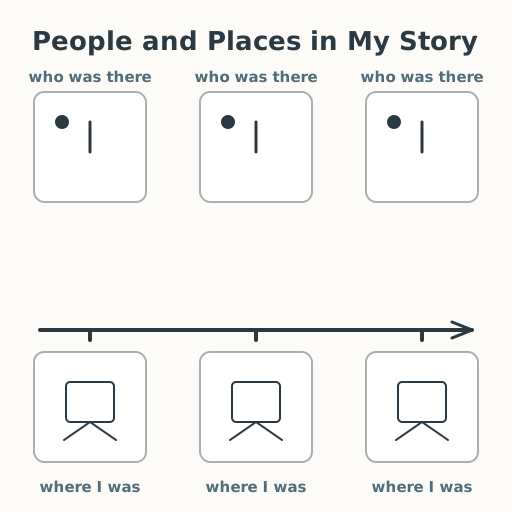
- Story map chart · 1 A timeline with spaces to add "who was there" and "where I was" at each stop
- Blank story map page · 1 per learner The learner's life line with empty who/where boxes at each stop
- Crayons and pencils · per learner
Low-tech / no-cost
- A drawn line with stick figures and houses Draw the life line on the ground and add a stick figure and a house at each stop
- Voice and body Tell who was there and where you were at each stop aloud, in order
Enriched / lab & device
- A 'My Story Map' poster booklet · 1 per learner A larger map with more stops and room for drawn people and places, kept in the portfolio
- A map or photo of a place from home · 1 per learner A real place to attach at its correct stop
Works in different contexts
- large-group Build one shared story map together, then learners add their own people and places in small groups
- multi-age Older learners scribe who/where for a younger learner and help place each on the correct stop
- self-directed A learner fills who/where at each stop alone and reads the story back in order
- level-grouped Learners ready to extend describe one place in detail — what it looked, sounded, or smelled like
- outdoor-only Stand at a real place and recall who was with you there and when in your story it happened
Lesson 6 — The People and Places in My Story
Summary
Learners add the “characters” and “settings” to their life story. They return to their life line and place the important people and important places at the correct stops, in order. This completes the objective of telling their own story with its people and places, and it honors the many shapes a family and a home can take.
Objectives
- Tell a simple story of their own life so far, in order, including important people and places. (D01.S2.03.01)
Connection
Every story has characters and settings. The “characters” of your story are the people who have helped raise and shape you — a parent, a grandparent, a sibling, a teacher, a friend, a neighbor. The “settings” are the places you have lived, played, and learned — a house, a yard, a market, a riverbank, a school, a high-rise, a village. Placing them on your life line shows where and with whom your story happened. Families come in many shapes, and homes come in many kinds — all of them are real.
Materials
- Story map chart
- Blank story map page
- Crayons and pencils
Preparation
- Print or draw the story map chart (timeline with who/where boxes).
- Copy a blank story map page for each learner.
- Have learners bring or recall their life line from the last lesson.
Facilitator note
This lesson is written to the learner (“you”). The skill is placing people and places at the correct stop in the story — the ordering still matters, even as the content becomes richer. Honor every family structure and living situation: a learner may name a grandmother, two mothers, an aunt, a guardian, or no one at a stop — all are valid, and none is ranked. Keep the focus on who was there for you and where you felt at home, not on any one “correct” family model. If a learner’s story includes a place that no longer exists or a person who is gone, hold it gently and let them choose what to share.
Procedure
- Gather (5 min). Last time you told your life story in order. Today you fill it in: the people and places that make it yours.
- Meet the story map (10 min). Look at the timeline. At each stop there are two boxes: “who was there” and “where I was.” A story’s characters are its people; its settings are its places. Both matter, and both sit in order along the line.
- Add people and places to the example (10 min). Go back to the worked example life line. At stop 2 (“a first memory”), the person is my grandmother, and the place is her kitchen. At stop 4 (“a big change”), the people are my whole family, and the place is our new home by the sea. See how each person and place fits its own stop?
- Build your own story map (15 min). Take your life line. At each stop, draw or write who was there and where you were. If a stop has many people, choose the ones that matter most to you. Keep them in order.
- Share one stop (5 min). Tell a partner one stop — who and where — and why it matters to you. Listen to theirs; notice how many different kinds of people and homes are in one room.
Differentiation
- Support: Use one stop only (the “now” stop) and name one person and one place; offer picture choices of people and places.
- Extension: Describe one place with your senses — what it looked, sounded, and smelled like.
Assessment
- Formative (observation): Can the learner place important people and places at the correct stops of their life story, in order?
- Artifact (portfolio): The story map page.
Home connection
Ask someone at home to tell you about one important person or place from their story, and where it fits in their life.
Resources
- CASEL SEL Framework (self-awareness competency): https://casel.org/fundamentals-of-sel/