Lesson 01 — Senses Team Up
Learners discover that two senses can work as a team. By tasting a familiar food with the nose pinched and then open, they notice that much of what we call flavor comes from smell and taste working together, and they draw the nose-and-tongue team.
Objectives
Objectives
- D03.S1.03.01 Describe how two senses can work together, such as taste and smell, to give a fuller picture of something.
Essential question
How do taste and smell work together to give me a fuller picture of food?
Key vocabulary
Materials
Standard materials
- Small pieces of a familiar safe food · 1 per learner A peeled orange slice, a piece of bread, or another food the learner's family already eats — nothing new, nothing that could be an allergen
- A clean napkin or hand towel · per learner To gently pinch the nose closed during the taste test
- Paper and crayons · per learner To draw the taste-and-smell team
Low-tech / no-cost
- Your own nose and mouth Pinch your nose and taste plain water or plain bread, then let go — no special food needed
- Voice Say the two senses aloud as you notice each one working
Enriched / lab & device
- Several familiar foods with clear smells · 1 set A sliced orange, a peeled banana, a piece of bread — so learners can compare taste with nose pinched and open
- A "smell jars" set (small covered cups with cotton) · 1 set A drop of a safe scent (orange, mint, vanilla) on cotton to smell before tasting
Works in different contexts
- large-group Do the taste test all together by count — everyone tastes with nose pinched, then with nose open — and share one word each
- self-directed A learner tries the pinch-and-taste on their own with a safe familiar food and records what they notice
- outdoor-only Taste and smell a safe familiar food outside, and notice how the air and place change what you smell
- multi-age Older learners guide younger ones through the pinch-and-taste, then everyone draws the nose-and-tongue team together
- level-grouped Learners who finish early compare two foods and guess which smell goes with which taste before trying
Lesson 1 — Senses Team Up
Summary
Learners meet the unit’s big idea: senses do not work alone. They taste a familiar food twice — first with the nose gently pinched closed, then with the nose open — and notice that flavor grows fuller when smell joins taste. They close by drawing the nose-and- tongue team.
Objectives
- Describe how two senses can work together, such as taste and smell, to give a fuller picture of something. (D03.S1.03.01)
Connection
Think of biting into a sweet, juicy mango or a warm piece of bread. You might say “this tastes good” — but your tongue is not working alone. Your nose is smelling the mango at the same time, and the two are talking to your brain together. Taste and smell are partners: together they make the fuller picture we call flavor.
Materials
- Small pieces of a familiar safe food (orange, bread, or a food your family already eats)
- A clean napkin or towel to gently pinch the nose
- Paper and crayons
Preparation
- Check for any food allergies or food needs in the group first, and choose only foods that are safe and familiar for every learner.
- Cut or portion small pieces of the food, one per learner, and set out napkins.
- Prepare paper and crayons for the closing drawing.
Facilitator note
This lesson is written to the learner (“you”) so it works in a classroom and for a self-directed learner. Prepare the food and napkins, then lead the pinch-and-taste before learners draw. This spirals up from Grade 2, where learners matched each sense to its body part — today two senses join forces. Safety first: never require a learner to taste anything, and never use a food that could be an allergen or is unfamiliar to a family; plain water or plain bread works for everyone. Honor every body: some people smell or taste more or less strongly than others, and some cannot smell or taste at all — every answer about what they notice is true for them, and “I notice nothing different” is a real and welcome observation. The factual idea here — that much of what we call flavor comes from smell and taste together — is well established in sensory science (see Resources).
Procedure
- Gather (5 min). Last year you matched each sense to its body part: tongue for taste, nose for smell. Today you will find out what happens when two senses work as a team.
- Predict (5 min). Look at your piece of food. Guess: will it taste the same if you pinch your nose closed? Say or write your guess.
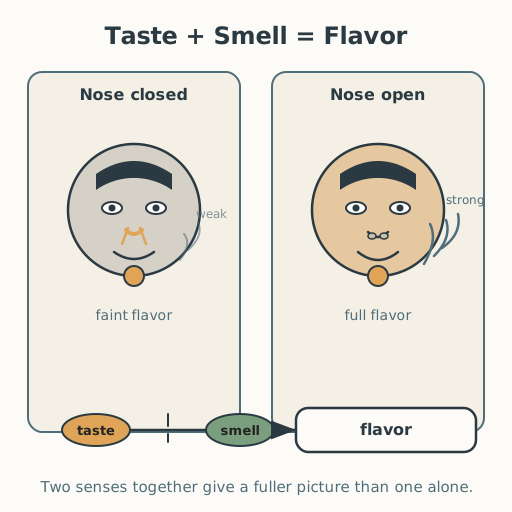
- Taste with the nose pinched (10 min). Gently pinch your nose closed with your napkin and put a small piece of food on your tongue. Chew slowly and notice the taste. What do you get? Maybe sweet, salty, or a little bland. Then let go of your nose. What changes? Most people find the flavor suddenly gets fuller and stronger.
- Taste with the nose open (10 min). Now taste a second small piece with your nose open and free. Notice how the smell and the taste arrive together. That fuller picture is called flavor — taste and smell teamed up.
- Draw the team (15 min). Draw a nose and a tongue with an arrow meeting in the middle, and label them “smell” and “taste” joining to make “flavor.” Write one sentence about what you noticed.
- Close (5 min). Say it together: “taste and smell team up to make flavor.” Two senses together give a fuller picture than one alone.
Differentiation
- Support: Use only one familiar food and guide the pinch-and-taste step by step; accept spoken or drawn answers instead of written ones.
- Extension: Ask learners to compare two foods and guess which smell goes with which taste, or to name another pair of senses that might team up.
Assessment
- Formative (observation/self): Can the learner describe, in their own words or drawing, that smell and taste work together to give a fuller picture of a food?
- Artifact (portfolio): The nose-and-tongue “team” drawing with its one sentence, kept in the learner’s portfolio.
Resources
- World Health Organization — global health and wellbeing reference: https://www.who.int/
- U.S. National Institute on Deafness and Other Communication Disorders (NIDCD) — Taste and Smell: https://www.nidcd.nih.gov/health/taste-smell
Home connection
At your next meal, ask someone at home to pinch their nose and taste one bite, then let go — and tell them what you learned about taste and smell teaming up.