Lesson 04 — Hunger and Fullness
Learners learn to read two body signals — hunger and fullness. They match each signal (a rumbling empty tummy, a satisfied comfortable tummy) to a helpful response (eat a meal or snack, stop when satisfied), then draw the two signals. Bodies differ, and there is no single "right" amount — noticing is the skill.
Objectives
Objectives
- D03.S1.03.02 Recognize early body signals of hunger, fullness, thirst, and tiredness and say one helpful response to each.
Essential question
What are the early signals of hunger and fullness, and what helpful response does each one ask for?
Key vocabulary
Materials
Standard materials
- Signal cards · 1 set Four cards — a rumbling empty tummy (hunger), low energy (hunger), a satisfied comfortable tummy (fullness), and slowing down (fullness)
- Paper and crayons · per learner To draw the hunger and fullness signals
Low-tech / no-cost
- Your own body Notice and name what your tummy feels like right now, with no cards needed
- Voice Say each signal aloud and its helpful response together
Enriched / lab & device
- A "before and after a meal" chart · 1 set A two-column chart — how a body may feel before eating and how it may feel after — to sort signal cards into
- Laminated signal cards · 1 set per pair Durable cards for repeated matching and sorting of signals to responses
Works in different contexts
- large-group Hold each signal card up high and have the group point to their own tummy, then call out the helpful response together
- self-directed A learner sorts the signal cards into hunger and fullness and matches each to a response, then draws their own two signals
- outdoor-only After a walk or a game, notice whether the body feels hungry (empty, rumbling) and discuss what the body is asking for
- multi-age Older learners read the signal cards while younger learners act out the tummy feeling, then everyone matches a response
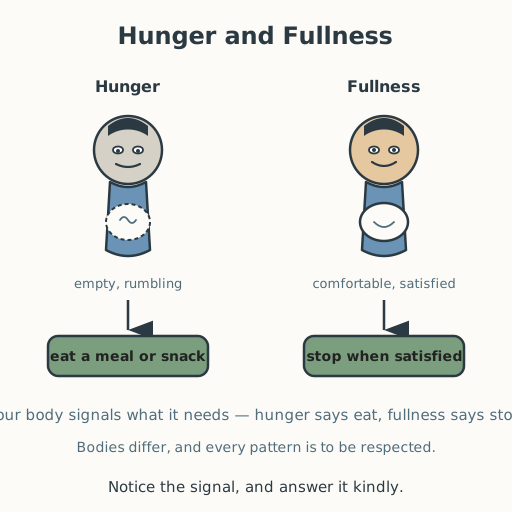
Lesson 4 — Hunger and Fullness
Summary
Learners meet two of the body’s signals: hunger and fullness. They learn the early signs of each — a rumbling, empty feeling and low energy for hunger; a comfortable, satisfied feeling and slowing down for fullness — and name one helpful response to each. They close by drawing the two signals.
Objectives
- Recognize early body signals of hunger, fullness, thirst, and tiredness and say one helpful response to each. (D03.S1.03.02)
Connection
Have you ever been playing or working and suddenly noticed your tummy feels empty and rumbling, and you keep thinking about food? That is your body sending a signal: hunger. Later, after a meal, your tummy feels comfortable and satisfied — that is the signal of fullness. Your body talks to you. Learning its signals is how you take good care of it.
Materials
- Signal cards (rumbling tummy, low energy, comfortable tummy, slowing down)
- Paper and crayons
Preparation
- Print or draw the four signal cards.
- Prepare paper and crayons for the closing drawing.
- Arrange a circle for the signal-matching game.
Facilitator note
This lesson is written to the learner (“you”) so it works in a classroom and for a self-directed learner. Prepare the cards, then guide the matching and drawing. This spirals up from Grade 1, where learners first noticed hunger and thirst as body signals — now they add fullness and name a helpful response to each. Hold this topic with great care: food and bodies are sensitive. Never comment on how much or how little a learner eats, never praise or shame a body or an amount, and never make hunger a problem to be “fixed” by willpower. Bodies differ — in size, in hunger, in how often they need food — and different families eat on different schedules and in different ways; every pattern is to be respected. Some learners may not have enough food at home; frame hunger as a body signal to answer when we can, and respond with care if this comes up. The goal is noticing, never judgment. Learners with certain conditions may have different hunger signals; all observations are welcome.
Procedure
- Gather (5 min). Put a hand on your tummy. How does it feel right now? Today you will learn two of its signals: hunger and fullness.
- Meet hunger (10 min). Hunger is your body asking for food. Its early signals: your tummy feels empty and may rumble, and your energy dips so you feel tired or find it hard to focus. What is a helpful response? Eat a meal or a snack. Notice the signal early, and answer it.
- Meet fullness (10 min). Fullness is your body saying it has had enough. Its signals: your tummy feels comfortable and satisfied, not stuffed, and you may slow down and stop thinking about food. What is a helpful response? Stop eating and notice you are satisfied. Fullness is a good, gentle feeling, not a rule about how much to eat.
- Match the signals (10 min). Sort the four cards into two groups — hunger and fullness — and match each to its helpful response: hunger → eat; fullness → stop. Point to your own tummy for each one.
- Draw your two signals (10 min). Draw your tummy empty and rumbling, and your tummy comfortable and satisfied. Write one helpful response under each.
- Close (5 min). Say it together: “when I am hungry, I eat; when I am full, I stop.” Your body knows — you just have to listen.
Differentiation
- Support: Introduce one signal at a time and act it out together; accept spoken or drawn answers.
- Extension: Ask learners to name a time they noticed a hunger or fullness signal early, and what happened when they answered it.
Assessment
- Formative (observation/self): Can the learner name one signal of hunger and one signal of fullness, and a helpful response to each, without any judgment of amounts or bodies?
Resources
- World Health Organization — global health and wellbeing reference: https://www.who.int/
Home connection
At your next meal, notice together with your family what your tummy feels like before you eat and when you begin to feel satisfied. Name the signal aloud — “I feel full” — in your own words.