Lesson 10 — My Body, My Senses & Movement
A capstone that brings the whole unit together: learners name a sense team, read a body signal and its response, perform a movement sequence with rhythm and balance, and aim at a target — then celebrate everything their one body can sense, signal, and do.
Objectives
Objectives
- D03.S1.03.01 Describe how two senses can work together, such as taste and smell, to give a fuller picture of something.
- D03.S1.03.02 Recognize early body signals of hunger, fullness, thirst, and tiredness and say one helpful response to each.
- D03.S2.03.01 Perform a short movement sequence, such as a dance or obstacle course, with rhythm and balance.
- D03.S2.03.02 Improve hand-eye coordination through games and tasks such as tossing, catching, and aiming at a target.
Essential question
How do my senses, my body's signals, and my movement all work together in my one body?
Key vocabulary
Materials
Standard materials
- Sense cards and signal cards · 1 set Reuse the senses cards (Lessons 1–3) and body-signal cards (Lessons 4–6)
- Soft balls or beanbags and a target · 1 set per pair For the aiming station
- A beat source · 1 Clapping, a drum, or a steady-beat song for the rhythm-and-balance station
- Paper and crayons · per learner For the "my body celebration" drawing
Low-tech / no-cost
- Your own body and voice Name a sense team, read a body signal, perform a rhythm-and-balance sequence, and aim a rolled-up sock — no props needed
- Found objects A stone for a target, a line in the dirt for balance, a stick to tap a beat
Enriched / lab & device
- A four-station rotation with a timer or music · 1 set Four labeled stations — senses, signals, move, aim — to rotate through
- A camera or tablet · 1 per group Photograph or record each learner's celebration work to make a class "our bodies" book
Works in different contexts
- large-group Run four short stations and rotate small groups through senses, signals, move, and aim, then gather for a shared celebration
- self-directed A learner moves through all four tasks on their own — naming a sense team, reading a body signal, performing a rhythm-and-balance sequence, and aiming — then draws their celebration
- outdoor-only Hold the whole capstone outside — name the senses you use, read a body signal, move with rhythm and balance across a clear space, and aim a soft ball at a stone ring
- multi-age Older learners lead each station and help younger learners name sense teams, read signals, move with rhythm and balance, and aim
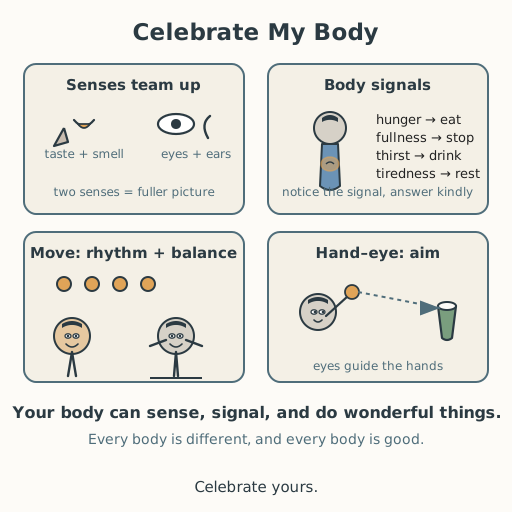
Lesson 10 — My Body, My Senses & Movement
Summary
The capstone gathers the whole unit: learners name two senses that team up, read a body signal and its helpful response, perform a movement sequence with rhythm and balance, and aim at a target. They close by celebrating everything their one body can sense, signal, and do.
Objectives
- Describe how two senses can work together to give a fuller picture of something. (D03.S1.03.01)
- Recognize early body signals of hunger, fullness, thirst, and tiredness and say one helpful response to each. (D03.S1.03.02)
- Perform a short movement sequence, such as a dance or obstacle course, with rhythm and balance. (D03.S2.03.01)
- Improve hand-eye coordination through games and tasks such as tossing, catching, and aiming at a target. (D03.S2.03.02)
Connection
You have spent this whole unit getting to know the body that is yours — how its senses team up, the signals it sends, the way it moves with rhythm and balance, and how its eyes and hands work together. Today you put it all together. Every body is different, and every body can do wonderful things in its own way. This is a day to notice and celebrate yours.
Materials
- Sense cards and body-signal cards
- Soft balls or beanbags and a target
- A beat source
- Paper and crayons
Preparation
- Set up four stations: Senses (sense cards), Signals (body-signal cards), Move (a clear space and a beat source), Aim (soft balls and a target).
- Prepare paper and crayons for the closing celebration drawing.
- Plan the rotation so every learner visits every station.
Facilitator note
This lesson is written to the learner (“you”) so it works in a classroom and for a self-directed learner. Set up the four stations, run the rotation, then lead the closing celebration. The capstone is a celebration of growth, not a test: observe what each learner can now do and note it for the portfolio without ranking anyone. Honor every body in its own way — adapted movement, adapted aiming, and spoken or drawn answers all count fully. Keep body-signal responses gentle and private, as in the earlier lessons: a learner shares only what they choose, and no body or amount of food, water, or sleep is ever judged. If a learner shows they are hungry, thirsty, or tired, honor it. Close with joy: the measure of this unit is that each learner leaves feeling their body is known, capable, and good. Where a camera or tablet records the celebration for a class book, notice what the tool can do — keep a picture for later — and what it cannot: it does not feel the beat, smell the air, or know when a body needs water or rest. Tools help us remember; the body does the sensing.
Procedure
- Gather (5 min). Look back over the unit. What did you learn about your body? Name one thing you are proud of.
- Senses station (10 min). Name two senses that team up — taste and smell, or eyes and ears. Say one clue each sense adds. How do they make a fuller picture together?
- Signals station (10 min). Look at the signal cards. Pick one — hunger, fullness, thirst, or tiredness. Point to where it shows up in your body and say one helpful response. Share only if you want.
- Move station (10 min). Perform a short sequence with rhythm and balance — a stomp-stomp-clap-turn, then a slow balanced walk along a line. Do it in your own body’s way, with wheels, seated, or with support if that is you.
- Aim station (10 min). With a friend, toss and catch a soft ball, then take turns aiming it at the target. Use kind words: “Nice aim!” “Your turn!”
- Celebrate (10 min). Draw or show one sense team, one body signal and its response, and one thing your body can do with rhythm and balance. Share it if you want. Your body is yours, and it can do wonderful things.
Differentiation
- Support: Shorten the rotation to two stations (senses and move), with an adult or partner helper at each.
- Extension: Ask learners to combine everything into a short “all about my body” share — naming a sense team, a signal, and a movement in one flow.
Assessment
- Summative (performance/observation): Can the learner name a sense team, read a body signal and its response, perform a movement sequence with rhythm and balance, and aim at a target, in their own body’s way?
- Artifact (portfolio): The “my body celebration” drawing, kept in the learner’s portfolio.
Home connection
Show someone at home your “my body celebration” drawing and tell them one sense team, one body signal and its response, and one thing your body can do with rhythm and balance.