Lesson 09 — Hand–Eye Coordination
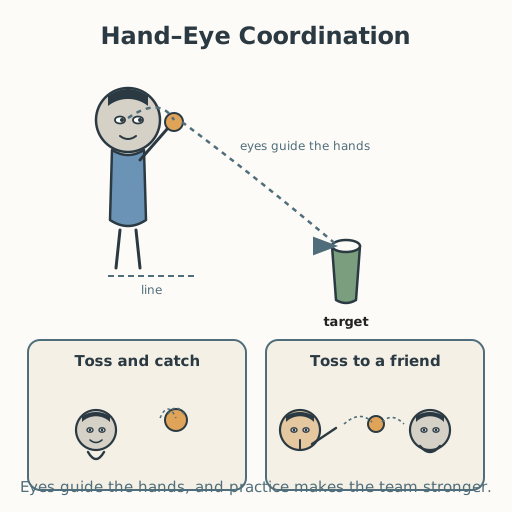
Learners build hand-eye coordination — the teamwork of eyes and hands. They practice tossing and catching a soft ball, then aiming at a target from a distance that fits them, learning that eyes guide the hands and practice makes the team stronger.
Objectives
Objectives
- D03.S2.03.02 Improve hand-eye coordination through games and tasks such as tossing, catching, and aiming at a target.
Essential question
How do my eyes and hands work together to toss, catch, and aim at a target?
Key vocabulary
Materials
Standard materials
- Soft balls or beanbags · 1 per learner or pair In a range of sizes and softnesses so each learner can choose what fits
- A target · 1 set A bucket, hoop, or chalk circle for aiming
- Floor markers · 1 set Cones, chalk, or rope to mark the throwing line
Low-tech / no-cost
- Rolled-up socks or crumpled paper balls A safe, no-cost ball that is easy to toss and catch
- A basket, box, or chalk circle A simple target made from what is around
Enriched / lab & device
- Balls of several sizes and softnesses · 1 set So each learner can choose the size and softness that fits their hands
- A ring toss or beanbag-toss game · 1 set To practice aiming with a little more challenge
Works in different contexts
- large-group Set up a row of targets and throw all in one direction toward them, so no one is in the line of throw
- self-directed A learner tosses to themselves, throws at a target, and checks their own aim, trying different distances
- outdoor-only Throw beanbags or soft balls into a bucket or a stone ring outside, and toss to a partner across a clear space
- level-grouped Learners who catch and aim easily use a smaller ball and stand farther back, while others use a larger, softer ball and a closer line
Lesson 9 — Hand–Eye Coordination
Summary
Learners build hand-eye coordination — the teamwork of their eyes and hands. They practice tossing and catching a soft ball, then aiming it at a target from a distance that fits them. Eyes guide the hands, and practice makes the team stronger.
Objectives
- Improve hand-eye coordination through games and tasks such as tossing, catching, and aiming at a target. (D03.S2.03.02)
Connection
Have you ever tossed a ball into a basket, or caught one a friend threw to you? Your eyes and hands are working as a team: your eyes tell your hands where the ball is, and your hands move to meet it. This is hand-eye coordination, and it is how people play tossing and aiming games in every corner of the world — bocce in Italy, pétanque in France, and the hoop-and-stick and stone games children play across Africa, the Americas, and Asia — in a courtyard, a beach, a field, or a schoolyard.
Materials
- Soft balls or beanbags
- A target (bucket, hoop, or chalk circle)
- Floor markers for a throwing line
Preparation
- Set up a throwing line and one or more targets at a reachable distance.
- Set out a range of soft balls and beanbags so each learner can choose what fits.
- Clear the throwing lane so no one is in the path of a throw.
Facilitator note
This lesson is written to the learner (“you”) so it works in a classroom and for a self-directed learner. Prepare the targets and line, then model a gentle toss-and- catch and an aimed throw slowly before learners try (explicit modeling, then guided practice). This builds on Grade 2’s throw-and-catch and now adds aiming — the eyes and hands working together, which also returns to the unit’s senses-teaming idea. The skill, not the score, is the goal: celebrate control and growing accuracy, never distance or speed, and never rank learners. Honor every body: a learner who uses a wheelchair throws and catches seated, a learner who needs a larger or softer ball or a scoop uses one, and every version counts fully. Offer adapted versions as real choices. Supervise throws so everyone faces the same direction and no one is hit; pair learners so a confident partner can toss gently to one still learning.
Procedure
- Gather (5 min). You have learned that senses team up. Today your eyes and hands will team up in a game of toss, catch, and aim.
- Warm up (5 min). Roll a ball between your hands, then toss it a little up and catch it with both hands. Keep your eyes on the ball all the way — your eyes are the guide.
- Toss and catch (10 min). Toss the ball up and catch it with both hands. Watch it all the way in, and catch it softly. Try a little higher, then a little lower. With a partner, toss gently back and forth, eyes on the ball every time.
- Aim at a target (15 min). Stand at the line and look at the target. Hold the ball with both hands, look, and throw it toward the target. Your eyes tell your hands where to send it. Try again — each try, your eyes and hands get better at working together. If you want, step back a little and try from farther.
- Check your aim (10 min). Count your hits in a friendly way — not to win, but to notice your own growing accuracy. What helped your aim: looking first, throwing softly, trying again?
- Close (5 min). Shake out your hands. Say it together: “my eyes and hands are a team.” With every try, the team gets stronger.
Differentiation
- Support: Stand close to the target, use a large soft ball or beanbag, and catch with a scoop or a basket before bare hands.
- Extension: Ask learners to aim at a smaller target or from farther back, or to toss with one hand and then the other.
Assessment
- Formative (observation/self): Can the learner toss and catch a soft ball and aim it at a target with growing control, in their own body’s way?
Resources
- World Health Organization — physical activity fact sheet (children need regular movement for healthy growth): https://www.who.int/news-room/fact-sheets/detail/physical-activity
Home connection
At home, toss a rolled-up pair of socks into a basket or box with someone, and tell them how your eyes and hands are working together as a team.