Lesson 01 — Taking Turns, Building On
Learners practice the two halves of a good group discussion — taking turns and building on what a classmate said — and see how ideas grow when everyone adds on.
Objectives
Objectives
- D02.S1.03.01 Take turns speaking in a group discussion and build on what a classmate said.
Essential question
How do I take turns speaking in a group and build on what a classmate said?
Key vocabulary
Materials
Standard materials
- Soft turn marker · 1 A ball, stone, or beanbag passed around to show whose turn it is to speak
- Build-on starters chart · 1 Sentence starters — "I like what ___ said, and…", "That makes me think…", "I want to add…"
- Discussion topic cards · 1 set Small friendly topics — "the best way to share a game," "what our classroom needs most," "a story we all know"
Low-tech / no-cost
- Voices and bodies Pass a found object (a pebble, a seed pod) and speak aloud; no paper or cards needed
- A found turn marker Any small found object can show whose turn it is to speak
Enriched / lab & device
- A talking stick or chime · 1 A calm sound to signal turn changes in a large group
- A voice recorder · 1 per group Record the build-on circle and listen back to hear how ideas grew
Works in different contexts
- large-group Run the build-on circle in one big ring; use the turn marker and a gentle chime so every voice gets a turn
- self-directed A learner reads the starters, then writes or records three turns of a pretend discussion — their idea, a "build on," and a "thank you" back
- outdoor-only Sit in a circle on the ground; pass a found object (a leaf, a stone) and build on each other's ideas in the open air
- multi-age Older learners model a build-on sentence; younger learners repeat the "I like what ___ said" part and add one word of their own
- level-grouped Group by comfort with speaking, not age; every group practices the same starters, and confident speakers model first
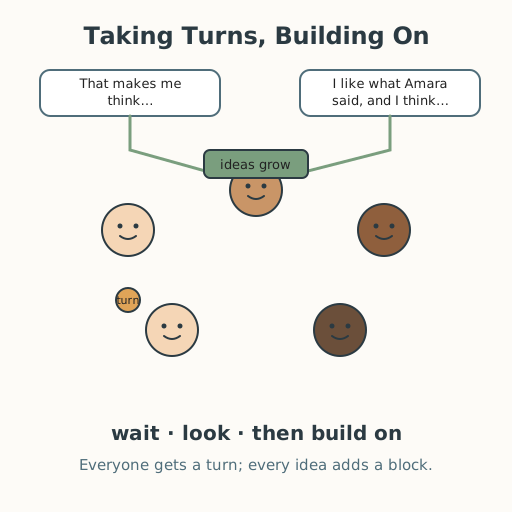
Lesson 1 — Taking Turns, Building On
Summary
Learners practice the two halves of a good group discussion: taking turns (waiting for a turn instead of interrupting) and building on (adding to what a classmate said, not just waiting to say your own thing). They see how ideas grow taller when everyone adds on, like blocks in a tower.
Objectives
- Take turns speaking in a group discussion and build on what a classmate said. (D02.S1.03.01)
Connection
Think of a circle of friends talking about how to share a game, or where to plant a garden. If everyone talks at once, no one hears anything. If each person waits for a turn and then adds to what the last person said, the talk grows like a tower of blocks — each new block rests on the one below it. “I like what Amara said, and I think we should…” That is called building on, and every group of people, everywhere, uses it to think together.
Materials
- A soft turn marker (ball, stone, or beanbag)
- A build-on starters chart (“I like what ___ said, and…”, “That makes me think…”, “I want to add…”)
- Discussion topic cards
Preparation
- Arrange a circle for gathering.
- Post the build-on starters where everyone can see them.
- Choose one friendly discussion topic to begin with.
Facilitator note
Taking turns and building on are the two parts of discussion, a skill CASEL places inside relationship skills. Teach them as explicit, worked instruction: name the rule, model it, then guide practice before learners try it alone (Kirschner, Sweller & Clark, 2006). The key idea to protect: building on is not “waiting for your turn to say your own thing” — it is listening and then adding to what came before. Model the difference with a clear example. Keep the topic friendly and small so no learner’s life is put on display. A learner who does not speak with their mouth builds on with sign, a gesture, a picture card, or a written note — all count fully, and their turn is honored the same as any other. This is an egalitarian moment: the quiet voice and the loud voice each get one turn, and no idea is “better” for being louder. Read the procedure aloud; model each starter with voice and body.
Procedure
- Gather (5 min). Sit in a circle. Think: when did a group talk get tangled because everyone spoke at once? What would have helped?
- Meet the two rules (10 min). Learn the two rules of a good discussion: one, take turns — wait until it is your turn, and look at the speaker; two, build on — listen, then add to what the last person said. Say the starters together: “I like what ___ said, and…”, “That makes me think…”, “I want to add…”.
- Watch a worked example (10 min). Two volunteers (or the facilitator and a learner) model it: the first shares an idea; the second says, “I like what you said, and I think…” Notice how the second person added on, not just waited to speak.
- Build-on circle (15 min). Pass the turn marker around the circle. When it comes to you, take one of two paths: share a new idea, or build on the idea that just came before you using a starter. Everyone gets a turn; no one is skipped.
- Close (5 min). Remember: a group thinks better when each person takes a turn and builds on the person before. Your turn, plus your listening, grows the tower.
Differentiation
- Support: Offer the exact starter “I like what ___ said” and model one build-on with a partner. A non-speaking learner signs or points to a starter card.
- Extension: Invite learners to build on two ideas at once (“I like what both Amara and Jae said, and I think…”).
Assessment
- Formative (observation): Does the learner wait for a turn, and do they add on to a classmate’s idea rather than only stating their own?
- Peer (check): In the circle, did each person get a turn, and did at least one idea get built on?
Home connection
At home, the next time your family or friends talk about a plan, wait for your turn and try a build-on: “I like what you said, and I think…” Notice how the plan grows.
Resources
- CASEL SEL Framework (relationship skills competency): https://casel.org/fundamentals-of-sel/