Lesson 02 — I Feel, Without Blame
Learners learn the four-part "I statement" and practice saying how they feel without blaming — the calm, honest way to step into a conflict and invite a fix.
Objectives
Objectives
- D02.S1.03.02 Use I statements to say how they feel without blaming during a conflict.
Essential question
How can I say how I feel without blaming the other person during a conflict?
Key vocabulary
Materials
Standard materials
- I-statement frame chart · 1 The four-part frame — "I feel ___ when ___ because ___. I need ___."
- Blame-to-I-statement cards · 1 set Sentences to convert, e.g. "You always grab the ball!" into an I statement
- Soft turn marker · 1 For the practice circle
Low-tech / no-cost
- Voices and bodies Say and act out the frame aloud; no chart or cards needed
- A found object Any small object can stand in for the shared thing in a role-play
Enriched / lab & device
- Puppets or small figures · 1 set Act out a small conflict and its I-statement solution for the whole group
- A recording or video clip of a gentle conflict being solved · 1 per group To talk through how the words changed the feeling in the room
Works in different contexts
- large-group Model the frame up front with two volunteers while the whole group says the four parts together
- self-directed A learner reads the frame, rewrites two blame sentences as I statements, and says them aloud to a grown-up or into a recorder
- outdoor-only Role-play a small conflict over a found object — a good stick, a turn on the swing — and solve it with an I statement
- multi-age Older learners demonstrate the frame; younger learners practice just the "I feel ___" part
- level-grouped Pair learners so each pair has one who can model the full frame and one who repeats the "I feel" part
Lesson 2 — I Feel, Without Blame
Summary
Learners learn the four-part “I statement” — I feel… when… because… I need… — and practice turning blame words into feeling words. They discover that saying how you feel without blaming invites the other person to help fix things, instead of making them defend themselves.
Objectives
- Use “I” statements to say how they feel without blaming during a conflict. (D02.S1.03.02)
Connection
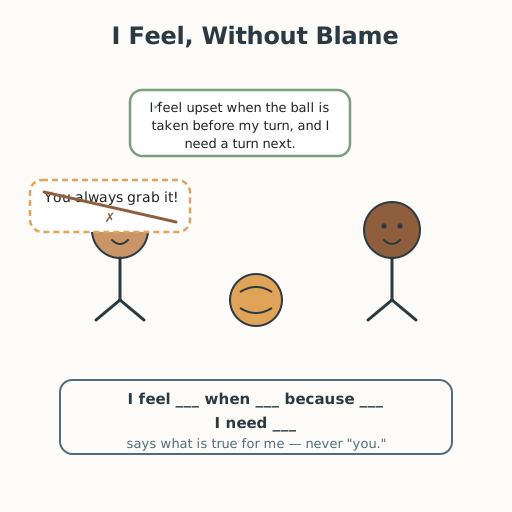
Someone bumps into you, or takes the ball before your turn, or says something sharp. You could shout, “You’re mean! You always grab it!” — and now the other person gets angry back, and the problem grows. Or you could say, “I feel upset when the ball is taken before my turn, because I was waiting, and I need a turn next.” The first is blame; the second is an “I” statement. The I statement says what is true for you without attacking the other person — and that leaves room to fix the problem together. Communities around the world make arguments gentler in many ways — an elder who helps two sides listen, a circle that repairs what broke, a quiet apology shared over food. The I statement is one honest tool among many, and it is the one you are learning today.
Materials
- An I-statement frame chart (“I feel ___ when ___ because ___. I need ___.”)
- Blame-to-I-statement cards
- A soft turn marker
Preparation
- Post the I-statement frame where everyone can see it.
- Prepare blame sentences to convert, such as “You always grab the ball!” and “You never let me play!”
Facilitator note
This lesson sharpens Grade 2’s “solve it with words” into the precise tool of the “I” statement, a core CASEL relationship-skill. Teach it as explicit, worked instruction: show the frame, convert a blame sentence together, then let learners try (Kirschner, Sweller & Clark, 2006). Protect the key idea: an I statement names your feeling and your need — it never says “you.” When a learner offers “I feel you are mean,” gently re-steer: that is still a hidden “you”; try “I feel hurt when…”. Keep the conflicts small and fictional so no learner relives a real hurt. Honor that anger is a real feeling, not a wrong one — the skill is in saying it without blame, not in hiding it. Learners who do not speak with their mouth use sign, a picture card, or a written sentence for the frame. Read the procedure aloud and model each part.
Procedure
- Gather (5 min). Think of a small conflict — someone cut the line, took your turn, said something that stung. What did you want to say? What did you actually say?
- Meet the frame (10 min). Learn the four parts of an I statement: I feel ___, when ___, because ___, I need ___. Say them together. Notice: the frame talks about me, not you — it says what is true for me and asks for what I need.
- Watch a worked example (10 min). Take the blame sentence “You always grab the ball!” and turn it together into: “I feel upset when the ball is taken before my turn, because I was waiting, and I need a turn next.” See how the second one says the same hurt without attacking.
- Convert and practice (15 min). Take a blame-to-I-statement card. With a partner, turn the blame into an I statement using all four parts. Then switch roles: one says the I statement, the other listens and answers, “What do you need?” and makes a small plan.
- Close (5 min). Remember: blame makes a wall; an I statement opens a door. You can say how you feel — honestly, without blaming.
Differentiation
- Support: Offer the frame with blanks and a word bank of feelings; practice just the “I feel ___” part first.
- Extension: Invite learners to turn a blame sentence into an I statement and then say what the other person might feel, using two I statements back to back.
Assessment
- Formative (observation): Does the learner say how they feel using the I-statement frame without blaming (“you”) during the role-play?
- Peer (check): Did the partner hear a feeling and a need, and was the plan fair to both sides?
Home connection
The next time you feel upset with someone at home, try one I statement — “I feel ___ when ___ because ___. I need ___.” Notice how the other person answers.
Resources
- CASEL SEL Framework (relationship skills and self-management competencies): https://casel.org/fundamentals-of-sel/