Lesson 04 — A Day in Someone Else's Shoes
Learners imagine and describe what it is like to be someone else in a familiar place — a new student, a wheelchair user, a grandparent, a child new to the language — and notice how the same place feels different to different people.
Objectives
Objectives
- D02.S2.03.02 Imagine and describe what it is like to be someone else in a familiar place.
Essential question
What is it like to be someone else in a familiar place?
Key vocabulary
Materials
Standard materials
- Familiar place poster · 1 One everyday place — a classroom, market, or playground — drawn or printed
- Someone else cards · 1 set People to imagine being — a new student, a child who uses a wheelchair, a grandparent, a child new to the language, a baby sibling
- Paper and crayons · per learner To draw the place through another person's eyes
Low-tech / no-cost
- Voices and bodies Walk through the familiar place imagining each person's day aloud; no cards needed
- A found object A stone or leaf can stand in for "whose eyes" you are seeing through
Enriched / lab & device
- A photo or short video of a familiar place · 1 per group A real view of the classroom, market, or playground to look at together
- A camera or tablet · 1 per group Take one picture from a high view and one from a low view to feel how the same place changes
Works in different contexts
- large-group Walk one "someone else" through the place as a whole group, pausing so learners name what that person sees, hears, and needs
- self-directed A learner picks a familiar place and a "someone else," then writes or draws that person's day — what they see, hear, feel, and need
- outdoor-only Use the real outdoors — imagine the path to the water pump or the play field from a small child's, an elder's, or a wheelchair user's view
- multi-age Older learners describe the day in detail while younger learners act out one moment (reaching a high shelf, climbing a step)
- level-grouped Group by comfort with describing; every group imagines the same place, and each chooses a "someone else" to describe
Lesson 4 — A Day in Someone Else’s Shoes
Summary
Learners step inside another person’s day in a familiar place — the classroom, the market, the playground — and describe what that person sees, hears, feels, and needs. They discover that the same place feels very different depending on who you are in it.
Objectives
- Imagine and describe what it is like to be someone else in a familiar place. (D02.S2.03.02)
Connection
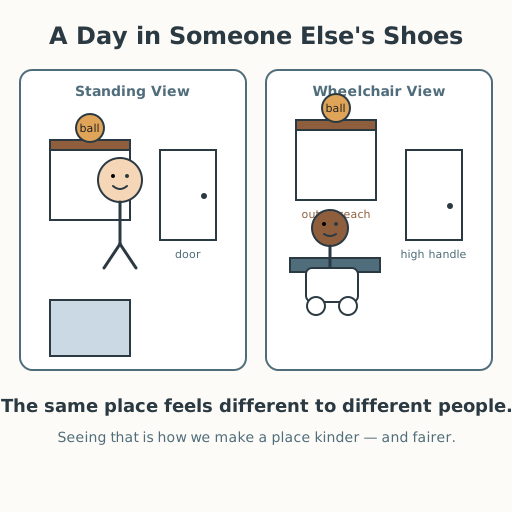
Walk into your classroom. To you, the ball on the shelf is right there. To a child who uses a wheelchair, it may be too high to reach. To a new student who does not yet speak the language, the teacher’s words are a blur. To a grandparent, the floor may feel far down and the noise very loud. It is the same room, but it is a different room to each person in it. Imagining another person’s day in a place you know well is how you learn to make that place kinder for everyone.
Materials
- A “familiar place” poster (classroom, market, or playground)
- “Someone else” cards
- Paper and crayons
Preparation
- Hang or draw the familiar-place poster.
- Prepare the “someone else” cards with a mix of people of different ages, abilities, and situations.
Facilitator note
This lesson carries CASEL’s social-awareness competency — perspective-taking — into a place the learner knows, which is the deepest and most honest test of it. Keep every “someone else” respected and specific, never pitied: a wheelchair user is not “sad,” a new student is not “behind” — each has a real, full experience worth understanding. Name barriers as things the place could change (a step, an unexplained routine), not shortcomings of the person — that is the egalitarian heart of the lesson, and it turns empathy into the power to make a place fairer. Invite many kinds of people across the cards, including older people, people who are Deaf or hard of hearing, people who use mobility aids, and people new to a language — and welcome learners to add their own. Read the procedure aloud; model one full “day” first, then let learners try (Kirschner, Sweller & Clark, 2006).
Procedure
- Gather (5 min). Look around a familiar place in your mind — your classroom, the market, the playground. It feels one way to you. Does it feel the same to everyone?
- Meet the place (10 min). Look at the poster. Walk through it together: what do you see, hear, touch? Now pick a “someone else” card. Does the ball on the high shelf look the same to them? Does the noisy corner sound the same?
- Watch a worked example (10 min). The facilitator imagines one full day as one “someone else”: “I am new here, and I do not know the words yet. When the teacher speaks, I watch faces and hands to understand…” Notice: the place stays the same; the experience changes.
- Describe a day (15 min). Choose your own “someone else.” Walk them through the place in your mind and describe their day: what do they see, hear, feel, and need? Draw one moment of their day as they see it.
- Close (5 min). The same place is a different place to each person in it. Seeing that is how you make it kinder — and fairer — for everyone.
Differentiation
- Support: Offer one person to imagine and a sentence starter (“As a ___, I see…”). A non-speaking learner draws the place from that person’s view.
- Extension: Invite learners to name one small change to the place that would make it easier for their “someone else,” and explain why.
Assessment
- Formative (observation): Does the learner describe the familiar place from the chosen person’s point of view — naming what they see, hear, feel, or need?
- Artifact (portfolio): The “a day in someone else’s shoes” drawing, kept in the learner’s portfolio.
Home connection
At home, imagine one familiar room through someone else’s eyes — a younger sibling, a grandparent, a visitor — and tell someone what you think that person sees and needs there.
Resources
- CASEL SEL Framework (social awareness competency): https://casel.org/fundamentals-of-sel/