Lesson 05 — My Community and One Far Away
Learners compare their own community with one in a different place or culture, finding what is alike and what is different — and learning that no way of living is better or worse, only different.
Objectives
Objectives
- D02.S3.03.01 Compare their own community with a community in a different place or culture.
Essential question
How is my community like, and different from, a community far away?
Key vocabulary
Materials
Standard materials
- A community far away picture sheet · 1 per pair One community in a different place — a river village, a mountain town, a desert settlement, or a busy city — drawn or printed
- Same-and-different chart · 1 per pair Two columns — "alike" and "different" — to fill together
- Paper and crayons · per learner To draw one shared need met in two ways
Low-tech / no-cost
- Voices and bodies Tell about the far-away community aloud and list alike/different by voice; no sheets needed
- Found objects A stone, leaf, and seed can stand for food, water, and shelter in both places
Enriched / lab & device
- A photo set or short film of a far-away community · 1 per group Real images or a clip showing daily life — getting water, growing food, children at play
- A world map or globe · 1 To point to where each community lives and feel the distance and the shared Earth
Works in different contexts
- large-group Compare one far-away community as a whole group, calling out "alike" and "different" onto a big shared chart
- self-directed A learner studies the picture sheet and writes or draws a same-and-different chart, then shares it with a grown-up
- outdoor-only Think of the community around you — how people here get water, food, and shelter — and compare it with a far-away one by voice
- multi-age Older learners write the chart while younger learners point to the pictures for each need
- level-grouped Group by comfort with comparing; every group fills the same chart, with confident readers modeling the first row
Lesson 5 — My Community and One Far Away
Summary
Learners compare their own community with one in a different place or culture — a river village, a mountain town, a desert settlement, or a busy city. They find what is alike (everyone needs food, water, shelter, care, and play) and what is different (how each place meets those needs), and they learn that no way of living is better or worse, only different.
Objectives
- Compare their own community with a community in a different place or culture. (D02.S3.03.01)
Connection
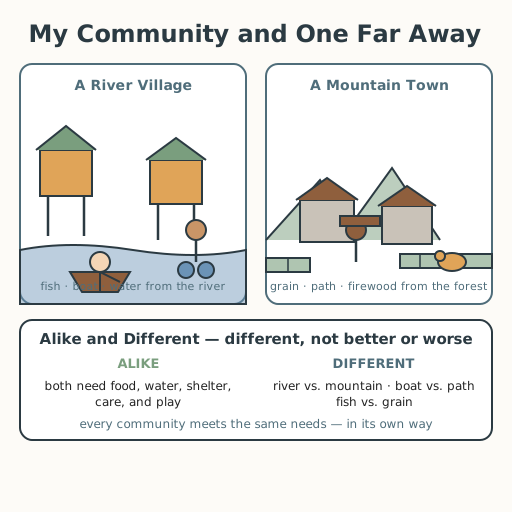
A river village and a mountain town look nothing alike. The river village has houses on stilts and boats and fish; the mountain town has stone houses and terraced fields and firewood. But look closer: both people cook food, fetch water, shelter their families, care for their children, and gather to celebrate. Every human community, everywhere, solves the same needs — food, water, shelter, care, learning, belonging — in its own way, shaped by its place and its tools and its story. Comparing them honestly, without saying one is “better,” is how we come to understand the whole human family.
Materials
- “A community far away” picture sheet
- Same-and-different chart
- Paper and crayons
Preparation
- Prepare the far-away-community picture sheet (choose one place).
- Print the same-and-different chart with two columns.
- Write the shared needs large: food, water, shelter, care, learning, play, belonging.
Facilitator note
This lesson teaches comparison without ranking, the egalitarian core of the unit’s global lens. The risk to guard against is the quiet message that one way of life is “simple” or “backward” — a river village is not “less” than a city; it is adapted to its place and its tools. Frame every difference as “this place shapes this way of living” (the environment and technology lenses), never as better/worse. Choose the far-away community with care so it is respectful and specific, and let learners from those very places speak first if present. Cite that anthropologists describe cultures from within, not from above; we follow that same humility. The same-needs anchor keeps the comparison fair: every community meets the same human needs, differently. Read the procedure aloud; model one “alike” and one “different” row before learners fill their own (Kirschner, Sweller & Clark, 2006).
Procedure
- Gather (5 min). Picture your own community: how do people here get water, food, and shelter? How do they care for children and celebrate?
- Meet the far-away place (10 min). Look at the picture sheet. Walk through the far-away community’s day: where does water come from? What do people eat? Where do children play? Notice the place and the tools that shape each answer.
- Watch a worked example (10 min). Fill the first two rows together: one thing that is alike (“both communities need water”) and one that is different (“here we carry it from a tap; there they draw it from the river”). Say it plainly: different, not better or worse.
- Compare (15 min). With a partner, fill your chart: find three things alike and three things different. Then draw one shared need met in two ways — once in your community, once in the far-away one.
- Close (5 min). Every community meets the same needs in its own way. Seeing that is how we honor the whole human family — alike in need, different in way.
Differentiation
- Support: Offer a ready chart with picture labels for each need; learners place a mark under “alike” or “different.” A non-speaking learner points to the pictures.
- Extension: Invite learners to compare a third community and find one need met three different ways.
Assessment
- Formative (observation): Does the learner name at least one thing alike and one thing different between the two communities, without ranking one as better?
- Artifact (portfolio): The same-and-different chart, kept in the learner’s portfolio.
Home connection
At home, ask someone about a place their family once lived, and together find one thing alike and one thing different between that place and where you live now.
Resources
- CASEL SEL Framework (social awareness competency): https://casel.org/fundamentals-of-sel/