Lesson 10 — Caring, Perspective & Belonging
The capstone gathers the whole unit: learners name and show each of the eight skills of caring, perspective, and belonging, fill a "caring community" page, and celebrate that care is how a community holds everyone.
Objectives
Objectives
- D02.S1.03.01 Take turns speaking in a group discussion and build on what a classmate said.
- D02.S1.03.02 Use I statements to say how they feel without blaming during a conflict.
- D02.S2.03.01 Retell a story from another character's point of view.
- D02.S2.03.02 Imagine and describe what it is like to be someone else in a familiar place.
- D02.S3.03.01 Compare their own community with a community in a different place or culture.
- D02.S3.03.02 Explain how rules and routines help a community work fairly for everyone.
- D02.S4.03.01 Practice cooperation by contributing fairly to a group goal.
- D02.S4.03.02 Give an example of how people in a community help one another.
Essential question
How do caring, seeing through others' eyes, and belonging all fit together?
Key vocabulary
Materials
Standard materials
- Caring community page · per learner A page with eight small frames — one for each skill from the unit
- Paper and crayons · per learner To fill the page and celebrate
- Soft turn marker · 1 For the closing sharing circle
Low-tech / no-cost
- Voices, bodies, and the ground Do the whole capstone by voice and action — name each skill and show it — with a stick to draw in the dirt if there is no paper
- Found objects A stone, leaf, and seed can stand for the three big words — care, perspective, belonging
Enriched / lab & device
- A camera or tablet · 1 per group Photograph each learner's caring-community page to bind into a class book
- A four-station rotation with a timer or music · 1 set Four stations — listen, see, belong, help — to visit and celebrate
Works in different contexts
- large-group Run the celebration as a shared circle, then let each learner fill their page and share one frame aloud
- self-directed A learner fills the caring-community page alone, then reads it back to check every skill is there, and shares it with a grown-up
- outdoor-only Hold the celebration outside — show each skill by voice and action, and draw the page in the dirt or on any paper
- multi-age Older learners lead each station and help younger learners name and show each skill
- level-grouped Group by comfort with sharing; every learner fills the same eight frames, and each shares in their own way — voice, sign, or drawing
Lesson 10 — Caring, Perspective & Belonging
Summary
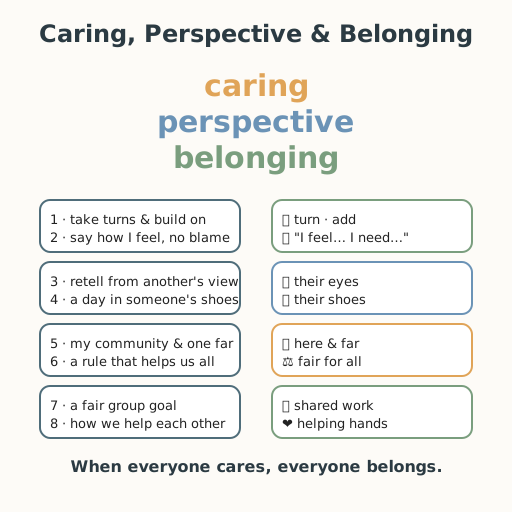
The capstone gathers the whole unit. Learners name and show each of the eight skills of caring, perspective, and belonging — taking turns and building on, an I statement, retelling from another’s view, a day in someone else’s shoes, comparing communities, a fair rule, a fair group goal, and helping one another — then fill a “caring community” page and celebrate that care is how a community holds everyone.
Objectives
- Take turns speaking in a group discussion and build on what a classmate said. (D02.S1.03.01)
- Use “I” statements to say how they feel without blaming during a conflict. (D02.S1.03.02)
- Retell a story from another character’s point of view. (D02.S2.03.01)
- Imagine and describe what it is like to be someone else in a familiar place. (D02.S2.03.02)
- Compare their own community with a community in a different place or culture. (D02.S3.03.01)
- Explain how rules and routines help a community work fairly for everyone. (D02.S3.03.02)
- Practice cooperation by contributing fairly to a group goal. (D02.S4.03.01)
- Give an example of how people in a community help one another. (D02.S4.03.02)
Connection
You have spent this unit turning outward — learning to take turns and build on, to say how you feel without blaming, to see through another’s eyes, to compare communities fairly, to explain fair rules, and to contribute and help. Today you put it all together. Caring is not one big act; it is these small, real skills, practiced together. And when everyone practices them, a community becomes a place where every person belongs. That is worth celebrating.
Materials
- A “caring community” page (eight frames)
- Paper and crayons
- A soft turn marker
Preparation
- Print the caring-community page with eight frames, one per skill.
- Set up the sharing circle with the turn marker.
- Plan the four-station rotation if using it (listen, see, belong, help).
Facilitator note
This lesson is written to the learner (“you”) so it works in a classroom and for a self-directed learner. The capstone is a celebration of growth, not a test: observe what each learner can now name and show, and record it for the portfolio without ranking anyone. Honor every way of showing — voice, sign, drawing, acting, or a written line — all count fully, and every family and community shape is welcomed. Keep the closing warm and inclusive; the measure of this unit is that each learner leaves feeling they belong and can help others belong. Where a camera or tablet records the pages for a class book, notice what the tool can do — keep a picture to remember — and what it cannot: it does not feel the warmth of a shared circle or the fairness of a given turn. Tools help us remember; the caring is done by people, with the living world around them. Close with joy: caring, perspective, and belonging are skills for life, and these learners now hold them.
Procedure
- Gather (5 min). Look back over the unit. Name one skill of caring you learned. What are you proud of?
- Name the eight skills (10 min). Together, say and show the eight skills: take turns and build on (pass the marker); say how I feel without blame (one I statement); retell from another’s view (one line as a character); a day in someone else’s shoes (one imagined detail); my community and one far away (one alike, one different); a fair rule (one rule and why); a fair group goal (one shared part); help one another (one example).
- Fill the caring-community page (20 min). In each of the eight frames, draw or write your own example of that skill — a turn you took, an I statement you used, a story you retold, a place you imagined, two communities you compared, a rule you explained, a group goal you shared, a way people help.
- Share (15 min). In the circle, pass the turn marker. When it comes to you, show one frame and tell why it matters. Build on the person before you if you can: “I like what ___ showed, and…”
- Close (5 min). You can care, you can see through another’s eyes, and you can help a community belong. Carry these skills everywhere — they are how the world becomes a kinder place.
Differentiation
- Support: Offer the eight frames with picture prompts and a starter sentence for each; a non-speaking learner fills each frame with a drawing.
- Extension: Invite learners to write one sentence beneath each frame connecting all eight skills into a short “how we care” paragraph.
Assessment
- Summative (performance/observation): Can the learner name and show each of the eight skills — taking turns and building on, an I statement, a retell from another’s view, an imagined day, a community comparison, a fair rule, a fair group contribution, and an example of helping — in their own way?
- Artifact (portfolio): The “caring community” page, kept as the unit’s portfolio artifact.
Home connection
Share your caring-community page with someone at home, and tell them one skill you will keep practicing — and one way you saw people help each other this week.
Resources
- CASEL SEL Framework (all five competencies): https://casel.org/fundamentals-of-sel/