Lesson 09 — Perspective Rehearsal
A rehearsal that joins the unit's two big skills — taking turns and building on, and retelling from another's point of view — in one real discussion, so learners practice listening, adding, and seeing through another's eyes all at once.
Objectives
Objectives
- D02.S1.03.01 Take turns speaking in a group discussion and build on what a classmate said.
- D02.S2.03.01 Retell a story from another character's point of view.
Essential question
How do I listen, take turns, and see through another's eyes — all at once?
Key vocabulary
Materials
Standard materials
- Soft turn marker · 1 A ball, stone, or beanbag to show whose turn it is to speak
- Build-on and retell starters chart · 1 Starters from Lessons 1 and 3, together — "I like what ___ said, and…", "As the ___, I saw…"
- A short discussion scene · 1 One friendly topic everyone can speak to — "the best way to share our space," "a story we all know"
Low-tech / no-cost
- Voices and bodies Run the discussion with a found turn marker and no paper; retell by acting out the other's view
- A found object A pebble or leaf can be the turn marker and the "other's eyes"
Enriched / lab & device
- A voice recorder · 1 per group Record the discussion, then retell it from another's point of view on playback
- A "two-hat" prop · 2 per group One hat for "my turn," one for "their eyes" — to make the switch of perspective playful and visible
Works in different contexts
- large-group Run one discussion circle with the turn marker, then have pairs retell the same discussion from a partner's point of view
- self-directed A learner writes a short pretend discussion, then retells it from the other speaker's point of view and checks both sides are honored
- outdoor-only Hold the discussion in a circle outside and retell each other's views while walking the path in the open air
- multi-age Older learners lead the turn-taking and model a retell; younger learners say one line of the other person's view
- level-grouped Group by comfort with speaking; every group runs the same discussion and retell, with confident speakers modeling first
Lesson 9 — Perspective Rehearsal
Summary
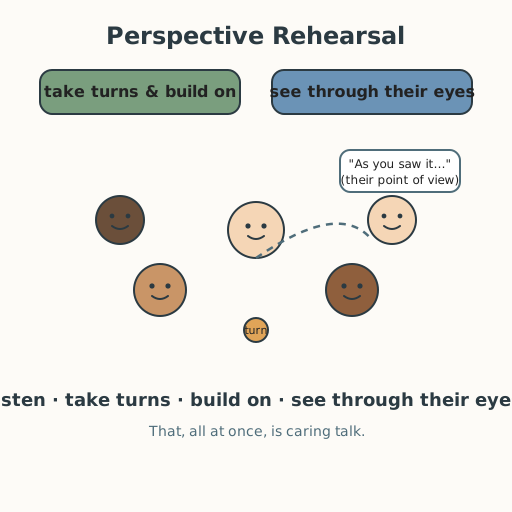
A rehearsal that joins the unit’s two big skills. Learners run a real discussion — taking turns and building on — and then retell the same discussion from a partner’s point of view. They practice listening, adding, and seeing through another’s eyes all at once.
Objectives
- Take turns speaking in a group discussion and build on what a classmate said. (D02.S1.03.01)
- Retell a story from another character’s point of view. (D02.S2.03.01)
Connection
You have practiced two skills this unit: taking turns and building on, and seeing through another’s eyes. But in real life, they happen together. In a real conversation, you listen, you wait your turn, you add on — and all the while you are imagining what the other person sees and feels. Today you rehearse the two skills woven into one, because that is how caring talk actually works.
Materials
- A soft turn marker
- A build-on and retell starters chart
- A short discussion scene
Preparation
- Arrange a circle for gathering.
- Post the combined starters chart (build-on from Lesson 1, retell from Lesson 3).
- Choose one friendly discussion topic everyone can speak to.
Facilitator note
This rehearsal is retrieval and spacing in action: it deliberately revisits and combines two earlier skills (Lessons 1 and 3) rather than teaching something new. The goal is fluent, automatic practice — turn-taking and building on while holding another person’s point of view. Run the discussion lightly; the point is that every learner gets a turn and that at least one idea gets retold from another’s view. Keep the topic friendly so no one’s life is on display, and protect the two rules from earlier lessons: every voice gets one turn (egalitarian), and retelling another’s view never ranks it as wrong (ethics). Learners who do not speak with their mouth take their turn with sign, gesture, or a written line, and retell by drawing the other’s view. Read the procedure aloud; model the combined move once — “I like what Amara said, and as the new student, I think…” — before learners try (Kirschner, Sweller & Clark, 2006).
Procedure
- Gather (5 min). Quick recall: what are the two rules of a good discussion? What does it mean to retell from another’s point of view?
- Review the starters (5 min). Say the build-on starters and the retell starters together so they are warm in your mouth.
- Run the discussion (15 min). Pass the turn marker around the circle on the chosen topic. Each turn, either share an idea, build on the idea before you, or — the new move — say a line from another person’s point of view (“As the ___, I think…”). Everyone gets a turn.
- Retell the discussion (15 min). Pick a partner. Retell the whole discussion you just had, but from your partner’s point of view — what did they see, feel, and say, and why? Then swap so each of you retells the other’s view.
- Close (5 min). You just listened, took turns, built on, and saw through another’s eyes — all at once. That is caring talk, and you can do it.
Differentiation
- Support: Offer the exact combined starter “I like what ___ said, and as the ___, I think…”. A non-speaking learner draws the other’s view on a card.
- Extension: Invite learners to retell the discussion from two different people’s points of view and compare how the two retellings differ.
Assessment
- Formative (observation): Does the learner take a turn, build on an idea, and retell at least one idea from another’s point of view during the discussion or the retell?
- Peer (check): In the retell swap, did each partner hear their own view told back fairly and without ranking?
Home connection
At home, have a small family discussion, then retell it back from someone else’s point of view — and ask them to retell yours — and notice how the two views differ.
Resources
- CASEL SEL Framework (relationship skills and social awareness competencies): https://casel.org/fundamentals-of-sel/