Lesson 01 — Listening and Retelling in Sequence
Learners listen to a partner tell a short, four-step happening or explanation, then retell it back in the correct sequence, including its key details, using first, next, then, and last to hold the story's shape.
Objectives
Objectives
- D04.S1.03.01 Retell a spoken story or explanation in sequence, including key details.
Essential question
How do I retell a spoken story or explanation in sequence, including its key details?
Key vocabulary
Materials
Standard materials
- A spoken story or explanation to share · 1 A short happening or simple how-to with four clear steps, told in the home language
- Sequence cards · 1 set per pair Cards labeled first, next, then, last, with room to draw or write each step
Low-tech / no-cost
- Four small objects Stones, seeds, or sticks moved one by one as each step is retold
- A story told aloud from memory No book needed; a remembered happening or how-to of four steps
Enriched / lab & device
- A short recorded telling · 1 A voice or video clip the learner re-listens to while checking the sequence
- Laminated sequence cards · 1 set per pair Reusable cards for repeated retelling practice
Works in different contexts
- large-group Model one retelling in four clear moves with the whole group, then have partners retell to each other while the facilitator listens for sequence and key details
- self-directed A learner chooses a recorded telling, listens twice, then retells the four steps aloud to a grown-up, a sibling, or into a recording, marking each step
- multi-age Older learners tell a four-step happening; younger learners move one object per step as they hear it, then trade roles
- level-grouped Pair learners who retell fluently with those still learning sequence; the stronger partner tells first as a model, then the learner retells back
- outdoor-only Walk to four spots as the four steps are retold — first, next, then, last — so the sequence lives in the body and the place
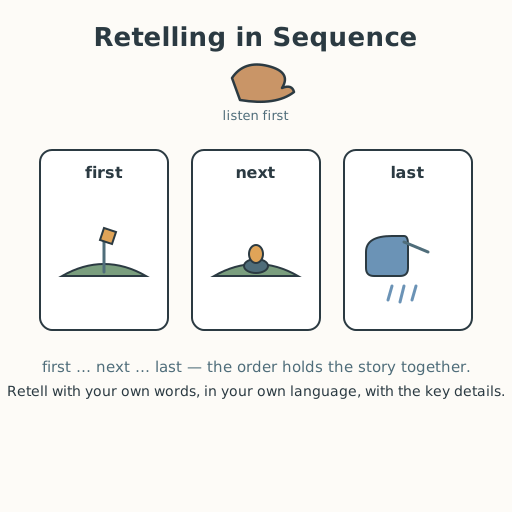
Lesson 1 — Listening and Retelling in Sequence
Summary
Learners listen to a partner tell a short, four-step happening or explanation, then retell it back in the correct sequence, including its key details. Sequence is the goal — not exact words — and every language has its own words for “first,” “next,” and “last.”
Objectives
- Retell a spoken story or explanation in sequence, including key details. (D04.S1.03.01)
Connection
All day people tell you things that happen in steps: how to make a meal, the way to the market, what happened at the river or on the farm. If the steps come out of order, the story breaks — like putting the roof on a house before the walls. Listening for the sequence and retelling it back with its key details is how people everywhere pass along know-how, one generation to the next.
Materials
- A spoken story or explanation to share (four clear steps, in the home language)
- Sequence cards (first, next, then, last)
- Four small objects, such as stones or seeds (low-tech)
Preparation
- Choose or remember a short happening or explanation with four clear steps.
- Prepare the sequence cards or four small objects.
- Arrange partners so each pair can sit facing one another.
Facilitator note
This lesson is written to the learner (“you”) so it works in a classroom and for a self-directed learner. Retelling honors the speaker’s meaning, not their exact words — celebrate a learner’s own wording, in their own language and their own way of speaking; there is no single “correct” accent. Model one retelling in four clear moves before partners work, then guide the practice. Oral traditions everywhere carry stories by retelling; this is an ancient and universal human skill. A learner who is Deaf or hard of hearing retells in sign, in pictures, or with objects moved in order; a learner who does not use a speaking voice retells by pointing, signing, drawing, or using a communication device — holding the sequence and the key details is what counts.
Procedure
- Gather (5 min). Sit facing your partner. Remember what listening feels like: your full attention on the speaker — with your eyes, your ears, or both. If you listen by watching faces and hands in sign, that is listening too.
- Meet the sequence words (5 min). Learn the words that hold a story in order: first, next, then, last. Say them in your home language. Every language has its own words for these steps.
- Listen once (5 min). Your partner tells a short happening or explanation with four steps. Listen all the way through, without talking, with your whole body.
- Listen again and mark the sequence (10 min). Hear it a second time. As you hear each step, move one object or touch one card: first… next… then… last. Notice the key details — the ones the story would not make sense without.
- Retell it back (15 min). Now retell the happening to your partner in order, using your own words and the sequence words, and keeping the key details. Then trade roles: your partner tells, you listen, and you retell.
- Close (5 min). Sequence is what keeps a story whole, and key details are what make it true. First, next, then, last — the shape of every telling, in every language.
Differentiation
- Support: Retell with just three steps first (first, next, last), then add the fourth; use objects instead of words if helpful.
- Support (non-speaking): Retell by moving four objects in order, signing, or pointing to four pictures — the sequence and the key details are the retelling.
- Extension: Retell a five-step happening and notice where each extra step belongs in the order.
Assessment
- Formative (observation): Can the learner retell a partner’s four-step happening or explanation in the correct sequence, in their own words and in their own language, including its key details?
Home connection
Ask someone at home to tell you how to do one small task in four steps, then retell it back to them in order and ask, “Did I keep the order and the important details?”
Resources
- CASEL SEL Framework (listening and relationship skills): https://casel.org/fundamentals-of-sel/