Lesson 02 — Asking Questions to Understand
Learners practice the five question words — who, what, where, when, and why — to ask and answer questions about a short talk, and discover that questions are the tool that turns listening into understanding.
Objectives
Objectives
- D04.S1.03.02 Ask and answer questions to understand a speaker's meaning, and explain one idea to a small group.
Essential question
How do I ask and answer questions to understand what a speaker means?
Key vocabulary
Materials
Standard materials
- Question word cards · 1 set Cards for who, what, where, when, and why, each with a simple picture cue
- A short talk or explanation to hear · 1 A partner shares a small topic, a happening, or an idea to wonder about
Low-tech / no-cost
- Fingers for the five questions One finger for each question word — who, what, where, when, why
- A remembered happening to talk about No text needed; a partner speaks and the learner asks about it
Enriched / lab & device
- A recorded short talk · 1 A voice or video clip the learner pauses to ask and answer questions about
- Question word cards with multiple languages · 1 set The five question words written in classroom languages, side by side
Works in different contexts
- large-group Hear one short talk as a group, then invite five learners to each ask one of the five questions before the speaker answers
- self-directed A learner listens to a recorded talk, pauses it, writes or records the five questions, and answers what they can — then re-listens to check
- multi-age Older learners ask the five questions of a younger teller and model patient listening for the answers; then trade roles
- level-grouped Pair learners by confidence; those who ask fluently model the questions first, then the partner practices one at a time
- outdoor-only Ask the five questions about something observed outside — a bird, a plant, a cloud — using fingers to count each question
Lesson 2 — Asking Questions to Understand
Summary
Learners practice asking and answering the five questions — who, what, where, when, and why — about a short talk or explanation. They discover that a question is not a test of the speaker but a tool the listener uses to reach the speaker’s meaning.
Objectives
- Ask and answer questions to understand a speaker’s meaning. (D04.S1.03.02)
Connection
Think of a friend describing a game you have never played, or a grown-up explaining a recipe you want to cook. If you only nod, you may miss the point. But if you ask, “Where do I put it?” or “When do I add the water?” or “Why do I stir?” — suddenly the meaning comes clear. Questions are how a listener reaches inside a speaker’s words and finds the idea they are really trying to share.
Materials
- Question word cards (who, what, where, when, why, each with a picture cue)
- A short talk or explanation to hear
Preparation
- Prepare the five question word cards.
- Choose a short topic or happening for partners to talk about.
- Arrange partners so each pair can face one another.
Facilitator note
This lesson is written to the learner (“you”) so it works in a classroom and for a self-directed learner. Teach the five question words as explicit, worked instruction: name each word, model the question it makes, then guide practice (Kirschner, Sweller & Clark, 2006). The key idea to protect: a question is an act of attention, not a challenge. Model asking with a warm, curious voice, and model answering with patience. Questions may be spoken, signed, written, or shown by pointing to a card — all count fully. Keep the talk friendly and small; no learner’s private life is put on display. This is an egalitarian moment: every question is worth an answer, and no question is “foolish.”
Procedure
- Gather (5 min). Think of a time you really wanted to understand something someone said. What did you do? Chances are, you asked.
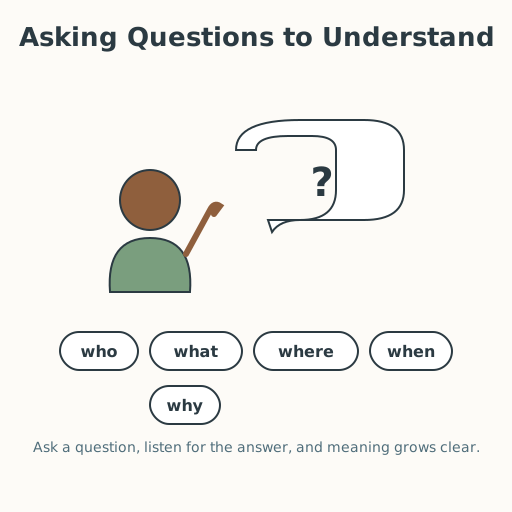
- Meet the five questions (10 min). Learn the five question words: who (a person), what (a thing or happening), where (a place), when (a time), why (a reason). Say them in your home language. Put up one finger for each.
- Watch a worked example (10 min). The facilitator (or a volunteer) tells one short thing — a happening or an idea. Then the group asks the five questions, one at a time, and the teller answers. Notice how each answer adds a piece to the meaning.
- Ask and answer with a partner (15 min). Your partner tells a short happening or idea. Ask the five questions, one by one, and listen for each answer. Then trade roles: you tell, your partner asks, and you answer.
- Close (5 min). Who, what, where, when, why — five keys that open a speaker’s meaning. Asking is caring: it says, “I want to understand you.”
Differentiation
- Support: Start with just who and what, then add where, when, and why one at a time; use the cards as a guide.
- Support (non-speaking): Point to the question cards, sign, or write a question; the asking is what matters, not the voice.
- Extension: After a question is answered, ask a follow-up — “and why is that?” — to dig one step deeper into the meaning.
Assessment
- Formative (observation): Can the learner ask and answer the five questions about a short talk, and does the asking lead them closer to the speaker’s meaning?
Home connection
Tonight, when someone at home tells you about their day, ask one of the five questions — who, what, where, when, or why — and notice how much more you understand.
Resources
- CASEL SEL Framework (relationship skills and social awareness): https://casel.org/fundamentals-of-sel/