Lesson 04 — Reading with Accuracy
Learners practice reading grade-level text accurately — sounding out each word, blending it, and checking that it fits the meaning — in their own writing system, with no single script assumed.
Objectives
Objectives
- D04.S2.03.01 Read grade-level texts with accuracy and fluency, self-correcting when meaning breaks down.
Essential question
How do I read grade-level words accurately in my own writing system?
Key vocabulary
Materials
Standard materials
- A grade-level text · 1 A short passage at the learner's level, in the home writing system
- A reading pointer · 1 A finger, stick, or card to slide under each word while reading
Low-tech / no-cost
- A remembered sentence or rhyme Read a known line word by word, pointing to each word
- A finger or twig as a pointer Slide along the line to keep the place
Enriched / lab & device
- A recording of the learner reading · 1 Record today's reading and listen back to check each word was read accurately
- Word-building cards · 1 set Cards to build and blend words by sound, in the home writing system
Works in different contexts
- large-group Read a short passage together, then have a few learners read a line each while the group follows with a pointer
- self-directed A learner reads a passage, records it, plays it back while following the text, and marks any word that was not read accurately to try again
- multi-age Older learners model accurate reading of a line; younger learners echo it word by word, pointing to each word
- level-grouped Each group reads a passage at its own level, so every learner practices accuracy on text that is not too hard
- outdoor-only Read a remembered sentence aloud, pointing with a twig to an imaginary line in the air or marks drawn in sand
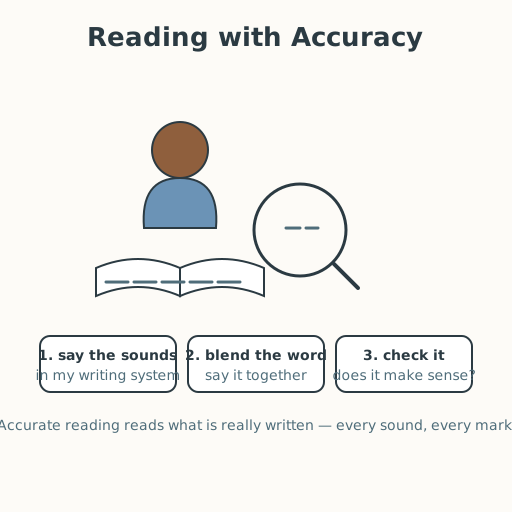
Lesson 4 — Reading with Accuracy
Summary
Learners practice reading grade-level text accurately — reading what is really written, not guessing. They sound out each word, blend it, and check it fits the meaning, all in their own writing system, whatever that script may be.
Objectives
- Read grade-level texts with accuracy, self-correcting when meaning breaks down. (D04.S2.03.01)
Connection
When you copy a friend’s phone number or read a sign to know which road to take, one wrong mark changes everything. Accuracy means reading what is really there. A recipe, a medicine label, a road sign — each one works only if the reader reads it truly. That is why readers everywhere slow down, sound out, and check: accuracy is how written words keep their promise.
Materials
- A grade-level text (in the home writing system)
- A reading pointer (finger, stick, or card)
Preparation
- Choose a short passage at the learner’s level, in the home writing system.
- Prepare a pointer for each learner.
- Arrange the text so the learner can follow it comfortably.
Facilitator note
This lesson is written to the learner (“you”) so it works in a classroom and for a self-directed learner. Accuracy means reading the word that is actually written, not a guess that “looks close.” Teach the three-step routine explicitly — say the sounds, blend, check it makes sense — as worked instruction, then guide practice before independent reading (Kirschner, Sweller & Clark, 2006). The routine is script-agnostic: the deeper rule — read what is really written, then check that it makes sense — holds in every writing system, though the exact step looks different in each. In a sound- or syllable-based script (Hangul, Devanagari, Ethiopic, Arabic, or the Latin alphabet), you read each part and put the parts together. In a character-based script (such as Chinese), you recognize each whole character and check its meaning. Never assume the Latin alphabet; a learner’s “letters” may be characters, syllables, or marks of another kind. A learner who is Deaf or hard of hearing reads accurately in sign or fingerspelling; accuracy of the word is what counts. A learner who is blind or has low vision reads accurately in braille, in large print, or by listening to the text read aloud and echoing it — braille is a writing system too, and accuracy is the goal in it just the same. Celebrate each learner’s accuracy against their own yesterday, never against a peer.
Procedure
- Gather (5 min). Think of a time one small mistake changed everything — a wrong number, a wrong turn. Reading accurately means reading the real thing.
- Meet the routine (5 min). Learn the three steps of accurate reading: one, say the sounds — read each part of the word; two, blend — put the parts together; three, check — does it make sense in the sentence?
- Watch a worked example (10 min). The facilitator reads one word slowly, doing all three steps aloud: say the sounds, blend the word, check it fits. Watch how the pointer slides under each word.
- Read accurately (15 min). Read your passage, sliding the pointer under each word. For each word, say the sounds, blend it, and check it makes sense. If a word is hard, stop and do the three steps again.
- Listen to yourself (5 min). If you can, read to a partner or record yourself. Notice: which words did you read truly? Which need another try? Read those again.
- Close (5 min). Accuracy is a kind of honesty — reading the word that is really there, in your own writing system, in your own language.
Differentiation
- Support: Read one short, familiar sentence, doing the three steps slowly on a single word; accuracy, not speed, is the only goal.
- Support (Deaf/Hard of Hearing): Read accurately in sign or fingerspelling, checking each word against the text.
- Support (blind/low vision): Read in braille, large print, or by listening and echoing; check each word against the text in your own way.
- Extension: Read a slightly harder passage and mark with a light pencil any word you want to try again, then re-read just those words.
Assessment
- Formative (observation/self): Can the learner read each word accurately — the word that is actually written — using the say-blend-check routine in their own writing system?
Home connection
Read a short line from anything at home — a package, a note, a book — and check each word against the page, asking, “Did I read what is really written?”
Resources
- National Reading Panel (2000), report on reading instruction — systematic, explicit instruction in the sounds and letters of one’s own writing system builds accuracy. (Cited as a widely used evidence base.)