Lesson 05 — Reading with Fluency
Learners practice reading fluently — smoothly, at a talking pace, and with expression — by re-reading a familiar grade-level text and noticing their own pace and ease grow, with punctuation as the signposts for voice.
Objectives
Objectives
- D04.S2.03.01 Read grade-level texts with accuracy and fluency, self-correcting when meaning breaks down.
Essential question
How do I read grade-level text smoothly and with expression, like talking?
Key vocabulary
Materials
Standard materials
- A familiar grade-level text · 1 A passage at the learner's level, in the home writing system, already read once
- A fluency chart · 1 A simple tracker to mark re-readings and growing smoothness
Low-tech / no-cost
- A remembered rhyme or song line Read a familiar line again and again until it flows
- A finger or pointer Slide along the line to keep a steady pace
Enriched / lab & device
- A recording of the learner reading · 1 Record today's reading and listen back to hear the smoothness grow
- A one-minute timer · 1 Count words read in a minute, then try again to read a few more — competing only with oneself
Works in different contexts
- large-group Read a familiar passage together, matching pace and expression, then have a few learners read a line solo
- self-directed A learner records their own reading, listens back, marks a fluency chart, and re-reads to improve — competing only with themselves
- multi-age Older learners read a passage smoothly as a model; younger learners echo each line, then read it on their own
- level-grouped Each group re-reads a passage at its own level, so every learner practices smoothness on text that is not too hard
- outdoor-only Read a remembered rhyme aloud with a steady, smooth voice while walking, letting the feet set the pace
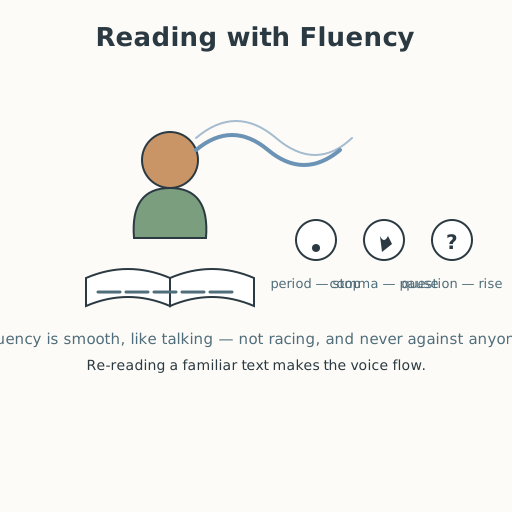
Lesson 5 — Reading with Fluency
Summary
Learners practice reading fluently — smoothly, at a talking pace, and with expression — by re-reading a familiar grade-level text and tracking how their reading eases. Fluency grows through repetition, not through racing or ranking, and punctuation is the signpost for voice.
Objectives
- Read grade-level texts with accuracy and fluency, self-correcting when meaning breaks down. (D04.S2.03.01)
Connection
When you first walk a path, you go slowly and watch your feet. After a few trips, you walk it without thinking. Reading is the same: the first time through a sentence is bumpy, but after you re-read it, the words flow — like talking. A fluent voice lets the meaning come through, so a story sounds the way it would if the teller were speaking it to you. Punctuation is the map: a period says stop, a comma says pause, a question mark says rise.
Materials
- A familiar grade-level text (in the home writing system)
- A fluency chart to mark re-readings
Preparation
- Choose a short passage the learner already knows and has read once.
- Prepare a simple fluency chart (three or four rows to mark re-readings).
Facilitator note
This lesson is written to the learner (“you”) so it works in a classroom and for a self-directed learner. Fluency means accuracy plus a smooth, expressive pace — the goal is meaning, not speed, and there is no competition and no “correct” accent. Reading should sound like the learner’s own natural way of speaking, in their own language. Re-reading is the engine of fluency; the National Reading Panel’s evidence base points to re-reading and guided oral reading as the core practice, so keep the text easy enough to be enjoyed, not struggled with. Teach punctuation as explicit signposts: period, comma, question mark. A learner who is Deaf or hard of hearing builds fluency in sign — a smooth, expressive signing of the text is fluent reading. A learner who is blind or has low vision builds fluency in braille, in large print, or by listening — a smooth, expressive re-reading by touch or ear is fluent reading too. Celebrate each learner’s growth against their own yesterday, never against a peer. Where a timer or a recording is used, notice what the tool does — a timer counts words but does not race you, and a recording lets you hear your own voice like a patient friend — and what it cannot do: it cannot feel whether the reading made sense; your own mind does that. A tool is a helper, never a judge.
Procedure
- Gather (5 min). Think of a path or a song you know so well you can do it without thinking. Reading gets like that with practice.
- Meet fluency (5 min). Fluency means reading smoothly, at a talking pace, with expression — so the meaning comes through. Meet the punctuation signposts: a period says stop, a comma says pause, a question mark says rise.
- Read it once (5 min). Read the familiar text once. It is okay if it is bumpy — that is the first walk on the path.
- Re-read and smooth it out (15 min). Read it again, a little smoother, letting the punctuation guide your voice. Then a third time. Slide a finger or pointer along the line to keep a steady pace. Mark each re-reading on your fluency chart.
- Listen to yourself (10 min). If you can, record your reading or read to a partner. Notice: where is it still bumpy? Where does it already flow like talking? Re-read the bumpy part once more.
- Close (5 min). You did not race anyone — you grew against your own first try. Smooth reading lets the meaning sing.
Differentiation
- Support: Re-read a single short, very familiar line several times; smoothness is the only goal.
- Support (Deaf/Hard of Hearing): Practice a smooth, expressive signed reading of the text; re-signing builds fluency the same way.
- Support (blind/low vision): Re-read in braille, large print, or by listening; smooth, expressive re-reading by touch or ear builds fluency the same way.
- Extension: Read with a partner, taking turns by sentence, and match each other’s smooth, expressive pace.
Assessment
- Formative (observation/self): Does the learner’s reading grow smoother and more expressive across re-readings, sounding like natural talk in their own language, with punctuation guiding the voice?
Home connection
Read the same short favorite text aloud at home twice tonight, and notice how much smoother the second reading feels.
Resources
- National Reading Panel (2000), report on reading fluency — re-reading and guided oral reading build fluency. (Cited as a widely used evidence base.)
- CASEL SEL Framework (self-efficacy and growth mindset): https://casel.org/fundamentals-of-sel/