Lesson 06 — Self-Correcting When Meaning Breaks Down
Learners practice monitoring their own reading — noticing the moment meaning breaks down, stopping, and fixing it by re-reading or trying another word — so they become readers who correct themselves.
Objectives
Objectives
- D04.S2.03.01 Read grade-level texts with accuracy and fluency, self-correcting when meaning breaks down.
Essential question
How do I notice when meaning breaks down as I read, and fix it myself?
Key vocabulary
Materials
Standard materials
- A grade-level text with one tricky spot · 1 A passage at the learner's level, in the home writing system, containing a word or two that will trip meaning
- A "stop and fix" bookmark · 1 A small card reminding the reader — does it make sense? if not, go back and fix
Low-tech / no-cost
- A remembered sentence with a nonsense word slipped in Hear it, notice the meaning broke, and fix it with the right word
- A finger or pointer Slide back to the spot where meaning broke and re-read
Enriched / lab & device
- A recording of a reading with planted errors · 1 Listen, catch where the meaning broke, and say how to fix it
- A "fix-up strategies" poster · 1 Re-read, look at the pictures, read on, ask what makes sense
Works in different contexts
- large-group Read a passage aloud with one planted error, and let the group call out "stop!" when the meaning breaks, then fix it together
- self-directed A learner reads, marks the spot where meaning broke, uses the fix-up bookmark, and re-reads until it makes sense
- multi-age Older readers model stopping and fixing aloud; younger readers practice the same "does it make sense?" check on a simpler line
- level-grouped Each group reads a passage at its own level with one planted tricky spot, so every learner practices monitoring meaning
- outdoor-only Read a remembered sentence, swap in a wrong word, and let the group stamp a foot or clap when the meaning breaks, then fix it
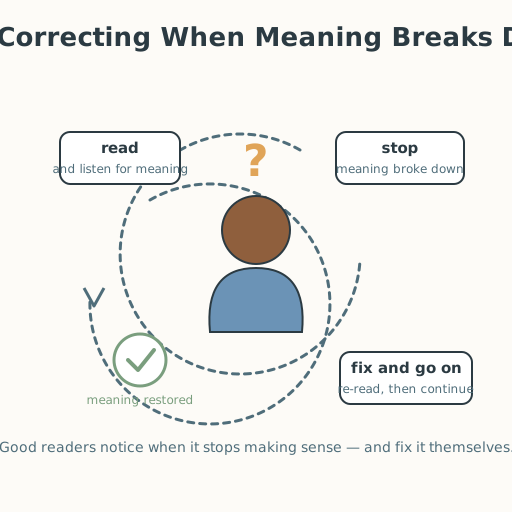
Lesson 6 — Self-Correcting When Meaning Breaks Down
Summary
Learners practice monitoring their own reading: noticing the moment the meaning stops making sense, stopping, and fixing it — by re-reading, trying another word, or reading on and checking. Self-correction is the mark of a reader who reads for meaning, not just for sounds.
Objectives
- Read grade-level texts with accuracy and fluency, self-correcting when meaning breaks down. (D04.S2.03.01)
Connection
Imagine you are walking a path you know and suddenly you are in a place you do not recognize. You do not keep walking — you stop, look around, and find the way. Reading is the same. When the words stop making sense, a good reader does not just push on; they stop, go back, and fix it. Meaning is the path, and self-correcting is how you stay on it.
Materials
- A grade-level text with one tricky spot (in the home writing system)
- A “stop and fix” bookmark (does it make sense? if not, go back and fix)
Preparation
- Choose a passage at the learner’s level with one word that will trip meaning.
- Prepare the “stop and fix” bookmark.
- Arrange the text so the learner can follow it comfortably.
Facilitator note
This lesson is written to the learner (“you”) so it works in a classroom and for a self-directed learner. Self-correction is comprehension in action: the reader notices meaning broke and repairs it. Teach it explicitly with a worked example — read a sentence, plant an error, model the “stop,” the re-read, and the fix — then guide practice (Kirschner, Sweller & Clark, 2006). The routine is script-agnostic and language-neutral: it works in any writing system and any language. The key idea to protect: a mistake is not a failure; noticing your own mistake and fixing it is skill, and it is celebrated. A learner who is Deaf or hard of hearing monitors meaning in sign the same way — a sign that breaks the sense is stopped and fixed. A learner who is blind or has low vision monitors meaning in braille, large print, or by listening — a word that breaks the sense is stopped and fixed the same way. Never make this a test of reading aloud in front of peers against a timer; it is a quiet, private practice of attention.
Procedure
- Gather (5 min). Remember a path you know well. What do you do the moment you realize you are in the wrong place? You stop, look, and find the way.
- Meet the routine (5 min). Learn the self-correct routine: one, read and listen for meaning; two, stop when it no longer makes sense; three, fix — go back, re-read, or try another word; four, go on.
- Watch a worked example (10 min). The facilitator reads a sentence with a planted wrong word, then stops and says, “Wait — that does not make sense.” They go back, re-read, try the right word, and continue. Watch the fix.
- Practice stopping and fixing (15 min). Read your passage. When the meaning breaks — the tricky spot — use your bookmark: does it make sense? Go back and fix it, then read on. Read the whole passage smoothly once more.
- Share what you fixed (5 min). Tell a partner (or write) one spot where the meaning broke and how you fixed it.
- Close (5 min). The best readers do not never-make-mistakes. They notice, stop, and fix — because meaning is the path, and they stay on it.
Differentiation
- Support: Use a very short passage with one planted error; practice stopping and fixing that single spot before reading a longer text.
- Support (Deaf/Hard of Hearing): Monitor meaning in sign; a sign that breaks the sense is stopped and re-signed correctly.
- Support (blind/low vision): Monitor meaning in braille, large print, or by listening; a word that breaks the sense is stopped and fixed.
- Extension: Read a longer passage and mark every spot you self-corrected, then count them with pride — each mark is evidence of a reading mind at work.
Assessment
- Formative (observation/self): Can the learner notice when meaning breaks down, stop, and fix it — by re-reading or trying another word — then continue reading smoothly?
Home connection
Tonight, when you read anything at home, ask yourself after each sentence, “Does that make sense?” If not, stop and fix it — and tell someone how you caught it.
Resources
- National Reading Panel (2000), report on reading comprehension — monitoring and self-correction are core comprehension strategies. (Cited as a widely used evidence base.)
- CASEL SEL Framework (self-management — noticing and correcting one’s own work): https://casel.org/fundamentals-of-sel/