Lesson 08 — Supporting Details
Learners learn to identify the supporting details of a text — the facts and examples that back up the main idea — and to check that each detail really does support the big idea, using the image of pillars holding up a roof.
Objectives
Objectives
- D04.S2.03.02 Identify the main idea and supporting details of a short informational or narrative text.
Essential question
How do supporting details hold up the main idea?
Key vocabulary
Materials
Standard materials
- A short informational or narrative text · 1 A grade-level passage in the home language with a clear main idea and details
- A main-idea-and-details chart · 1 A chart with a main-idea banner and detail pillars beneath it
Low-tech / no-cost
- A remembered story or happening Name the main idea, then list the details that support it on fingers
- Three small objects One object stands for the main idea; the others stand for the details that hold it up
Enriched / lab & device
- Several short passages · 3–4 Practice sorting main idea from supporting details across different texts
- A details graphic organizer · 1 A printed organizer with a main-idea roof and detail pillars
Works in different contexts
- large-group Read one passage together, name the main idea, then invite learners to each contribute one supporting detail to the chart
- self-directed A learner reads a passage, writes the main idea, then lists two or three details and checks that each one really supports the idea
- multi-age Older learners name the main idea; younger learners point to or retell one detail, and together they build the pillar chart
- level-grouped Each group reads a passage at its own level and sorts main idea from details, then compares their charts
- outdoor-only Choose one main idea about something observed — "this tree is home to many living things" — and name the details that support it
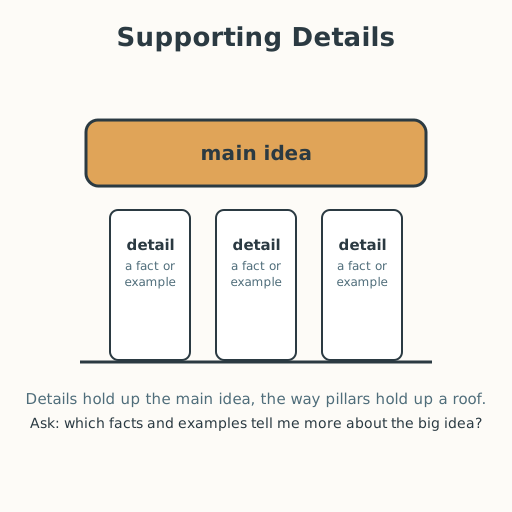
Lesson 8 — Supporting Details
Summary
Learners learn to find the supporting details of a text — the facts and examples that back up the main idea — and to check that each detail really does support the big idea, using the image of pillars holding up a roof.
Objectives
- Identify the main idea and supporting details of a short informational or narrative text. (D04.S2.03.02)
Connection
Think of a house: the roof is one big thing, but it stands because pillars hold it up. A text works the same way. The main idea is the roof; the supporting details are the pillars — the facts and examples that keep the big idea from falling down. When a reader asks “what tells me more about this?”, they are looking for the pillars that hold the roof.
Materials
- A short informational or narrative text (in the home language)
- A main-idea-and-details chart
Preparation
- Choose a short grade-level passage with a clear main idea and several details.
- Prepare the chart (main idea as roof, details as pillars).
- Arrange the text so the learner can read and mark it.
Facilitator note
This lesson is written to the learner (“you”) so it works in a classroom and for a self-directed learner. Identifying supporting details is a taught skill: model it with a worked example — name the main idea, then find each detail and test whether it really supports it — before guided practice (Kirschner, Sweller & Clark, 2006). The test is the discipline to teach: “does this detail hold up the main idea, or does it belong somewhere else?” This works in any language and any writing system. Accept details named in the learner’s own words and language. A learner who is Deaf or hard of hearing names details in sign or writing. A learner who is blind or has low vision names details from a braille or large-print text, or from listening, then says them aloud or in writing. Keep it sense-making, not a test with one right list; honor any detail that genuinely supports the idea.
Procedure
- Gather (5 min). Remember the main idea from last time: the big idea a text is mostly about. Today we find what holds it up.
- Meet the pillar test (5 min). Learn: a supporting detail is a fact or example that backs up the main idea. The test: does it hold up the roof, or does it belong somewhere else?
- Watch a worked example (10 min). The facilitator reads a short text, names the main idea, then finds two details and checks each one: “Does this hold up the main idea? Yes.” Watch how the pillars fit under the roof.
- Find the details yourself (15 min). Read your text. Write or say the main idea. Then find two or three supporting details and check each one with the pillar test. Which details truly hold up the main idea?
- Share (5 min). Tell a partner your main idea and one detail, and ask: “Does this detail hold it up?”
- Close (5 min). A main idea without details is a roof without pillars. Together they make a text stand, in every language on Earth.
Differentiation
- Support: Give the main idea already stated, and have the learner find one detail that supports it, then a second.
- Support (non-speaking): Point to, sign, or circle the details in the text that support the main idea.
- Support (blind/low vision): Listen to the text read aloud, or read it in braille or large print, and name the details aloud or in writing.
- Extension: Find a detail that does not support the main idea (a “wobbly pillar”) and say where it might belong instead.
Assessment
- Formative (observation): Can the learner name two or three supporting details of a text and explain, in their own words and language, how each one supports the main idea?
Home connection
When someone at home tells you a story, listen for the main idea, then ask, “And what tells you more about that?” to gather the supporting details.
Resources
- National Reading Panel (2000), report on comprehension — identifying main ideas and supporting details is a core comprehension strategy. (Cited as a widely used evidence base.)