Lesson 09 — Writing a Topic Sentence
Learners learn to write a strong topic sentence — the first sentence that tells the reader what the paragraph will be about — and practice the check, "does it tell what my paragraph is about?"
Objectives
Objectives
- D04.S3.03.01 Write a paragraph with a topic sentence, at least two supporting details, and a closing sentence.
Essential question
How do I write a strong topic sentence that tells what my paragraph is about?
Key vocabulary
Materials
Standard materials
- A topic to write about · 1 A friendly, familiar topic the learner knows well — a place, an animal, a task, a game
- A paragraph frame · 1 A sheet with a highlighted first line for the topic sentence
Low-tech / no-cost
- Paper and pencil Write the topic sentence by hand; nothing else needed
- A spoken topic sentence Say the topic sentence aloud first, then write it
Enriched / lab & device
- A word processor or digital writing tool · 1 Type the topic sentence and highlight it in a different color
- Topic sentence example cards · 1 set Strong and weak topic sentences to sort and discuss
Works in different contexts
- large-group Brainstorm topics together, model one strong topic sentence, then have learners write their own while the facilitator circulates
- self-directed A learner chooses a topic, says the topic sentence aloud, writes it, and checks — does it tell what the paragraph is about?
- multi-age Older learners model a strong topic sentence; younger learners say their topic in one word, then try the full sentence
- level-grouped Group by writing comfort, not age; every group practices the same check — does it tell what the paragraph is about?
- outdoor-only Choose a topic from the outdoors — a tree, a bird, a cloud — and write its topic sentence on paper or in sand
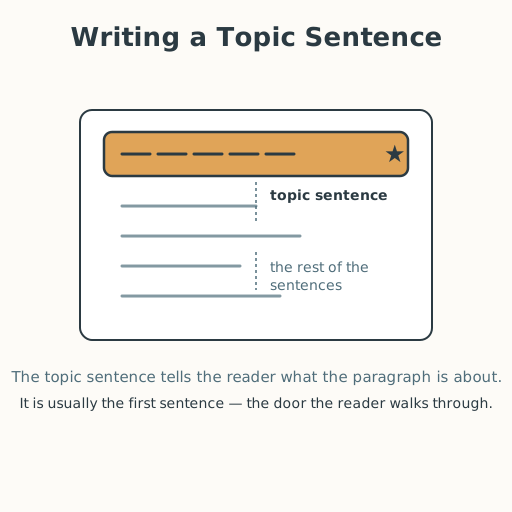
Lesson 9 — Writing a Topic Sentence
Summary
Learners learn to write a strong topic sentence — the first sentence that tells the reader what the paragraph will be about — and practice the check, “does it tell what my paragraph is about?”
Objectives
- Write a paragraph with a topic sentence, at least two supporting details, and a closing sentence. (D04.S3.03.01)
Connection
Think of a door to a house: the door tells you what kind of place you are about to enter. A topic sentence is the door to a paragraph — it tells the reader, in one sentence, what the whole paragraph will be about. Without it, the reader walks into a room blind. In every language and every writing system, a clear first sentence opens the door for the reader.
Materials
- A topic to write about (a place, an animal, a task, a game)
- A paragraph frame (with the first line highlighted)
Preparation
- Choose a few friendly topics learners know well.
- Prepare the paragraph frame.
- Have paper and pencils ready.
Facilitator note
This lesson is written to the learner (“you”) so it works in a classroom and for a self-directed learner. Writing a topic sentence is a foundational skill, so teach it explicitly: model a strong topic sentence, contrast it with a weak one, then guide practice (Kirschner, Sweller & Clark, 2006). The one check to protect: “does it tell what the paragraph is about?” A strong topic sentence names the topic and gives the reader a clear picture of what is coming. Learners write in their home language and their own writing system — script-agnostic, no Latin alphabet assumed. A learner who is Deaf or hard of hearing writes, signs, or dictates the sentence; the thinking is the writing. A learner who is blind or has low vision composes by dictation, on a braille writer, or by typing and listening back — the thinking is the writing. Celebrate a clear, honest topic sentence in any wording; there is no single “correct” sentence.
Procedure
- Gather (5 min). Think of a door you know. Before you open it, you already know a little about what is inside. A topic sentence is a door like that.
- Meet the topic sentence (10 min). Learn: a topic sentence is the first sentence of a paragraph, and it tells what the paragraph is about. It names the topic and gives a clear picture. Try the check: does it tell what my paragraph is about?
- Watch a worked example (10 min). The facilitator writes a weak sentence — “It is nice.” — then a strong one — “My grandmother’s garden is full of color in the morning.” Watch how the strong sentence opens a door the reader can see through.
- Write your topic sentence (15 min). Choose a topic you know well. Say your topic sentence aloud first. Then write it on the highlighted line. Read it back and ask: does it tell what my paragraph is about? Fix it if not.
- Share (5 min). Read your topic sentence to a partner. The partner guesses: “So your paragraph will be about…?” and you say yes or fix it.
- Close (5 min). One clear sentence, and the reader is in. That is the door, and you wrote it.
Differentiation
- Support: Provide a sentence starter — “My paragraph is about…” or “One thing I love is…” — and let the learner finish it.
- Support (non-speaking): Sign, dictate, or point to a picture and have the topic sentence written or typed.
- Support (blind/low vision): Compose by dictation, on a braille writer, or by typing and listening back; the thinking is the writing.
- Extension: Write two topic sentences for the same topic and choose which opens the door more clearly, saying why.
Assessment
- Formative (observation): Can the learner write a topic sentence that tells what their paragraph will be about, in their own language and writing system?
Home connection
Choose something at home you know well — a meal, a place, a pet — and write one topic sentence about it. Read it to someone and ask, “Do you know what my paragraph will be about?”
Resources
- CASEL SEL Framework (self-efficacy — writing with a clear purpose): https://casel.org/fundamentals-of-sel/