Lesson 04 — Division as Sharing & Grouping
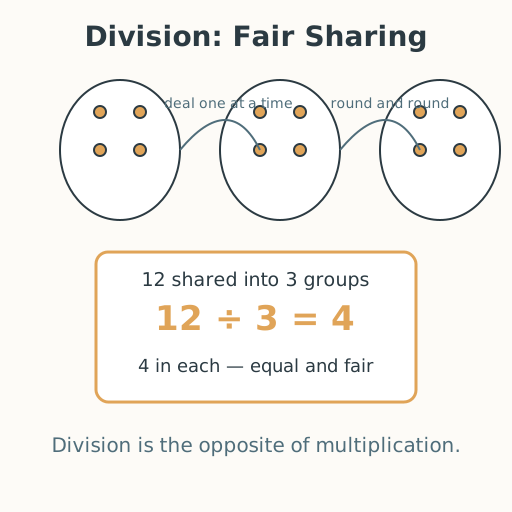
Learners act out two kinds of division — sharing a whole into fair shares, and grouping into equal groups of a given size — and discover that division is the opposite of multiplication: twelve shared into three groups is four, written 12 ÷ 3 = 4. Fairness is the picture behind the symbol.
Objectives
Objectives
- D05.S1.03.02 Multiply and divide within 100 and explain the meaning of each operation using objects, drawings, and known facts.
Essential question
How does division describe fair sharing and making equal groups, and what does a division sentence mean?
Key vocabulary
Materials
Standard materials
- Small objects · about 60 per learner or pair Pebbles, seeds, beans, counters, or bottle caps
- Small cups, plates, or cloth squares · 10 per learner or pair To share into equal groups
- Paper or slate and a drawing tool · per learner To draw the sharing and write division sentences
Low-tech / no-cost
- Found objects and the ground Share stones or seeds into equal piles on the ground and draw circles around each share
- Voice and body Learners "deal out" themselves into equal groups — one at a time, round and round, like sharing a deck of cards
Enriched / lab & device
- A division table or fact-family cards · 1 set per pair To connect each sharing story to its division and multiplication sentence
- A "fair share" story set (pictures of things to share) · 1 set per pair Picture problems to act out sharing and grouping
Works in different contexts
- large-group Share a large pile among the whole class by dealing one at a time, then write the division sentence together
- self-directed A learner shares a collection into equal piles, draws it, and writes the matching division sentence
- outdoor-only Share seeds or leaves into equal piles on the ground and read the division story aloud
- multi-age Older learners coach younger ones in dealing one at a time; younger learners count each share aloud
- level-grouped Learners who already share easily can find whether a number shares evenly or leaves a leftover; others deal one at a time with support
Lesson 4 — Division as Sharing & Grouping
Summary
Learners act out two kinds of division — sharing a whole into fair shares, and grouping into equal groups of a given size — and discover that division is the opposite of multiplication: twelve shared into three groups is four, written 12 ÷ 3 = 4. Fairness and equal groups are the pictures behind the symbol.
Objectives
- Multiply and divide within 100 and explain the meaning of each operation using objects, drawings, and known facts. (D05.S1.03.02)
Connection
Twelve crackers shared fairly among three friends; twelve seeds planted four to a row; twelve beads strung three on each bracelet. When a whole is split into equal parts, that is division — and the word “equal” is the fairness in it. Sharing fairly is one of the oldest human acts: people have divided food, land, and work into equal shares for as long as people have lived together. Division is the mathematics of a fair share.
Materials
- About 60 small objects (pebbles, seeds, beans, counters)
- Ten small cups, plates, or cloth squares
- Paper or slate and a drawing tool
Preparation
- Give each learner or pair about 60 objects and ten holders.
- Clear space to share and group.
- Prepare a quick example of “twelve shared into three groups is four.”
Facilitator note
This lesson is written to the learner (“you”). It introduces division as two real actions — sharing (split a whole into a known number of groups) and grouping (split into groups of a known size) — the two meanings children meet in the world (Carpenter et al., 2015). Teach with a worked example (philosophy §13): deal twelve objects into three groups one at a time, count four in each, and write 12 ÷ 3 = 4 before learners try their own. Connect back to multiplication from the previous lesson: 3 × 4 = 12 and 12 ÷ 3 = 4 are the same fact seen two ways. Fairness is the heart of it: an “unfair share” is not division — the shares must be equal, and no person is worth more than another. Speed is never a measure of smartness; some children deal one at a time, some skip-count, and all are valid. Count in the home language. For learners who are Deaf or hard of hearing, deal with sign and tap each share; for learners who are blind or low-vision, move objects into cups so the hands feel each share grow equal. Learners with limited movement direct a partner to deal. Mastery arrives at its own pace.
Procedure
- Gather — remember equal groups (5 min). Yesterday you counted equal groups with multiplication. Today we split a whole back into equal groups — the opposite move.
- Worked example — share twelve into three (8 min). Watch and help: take twelve objects. Deal them into three groups, one at a time, round and round, until they run out. Count each group: four, four, four. Twelve shared into three groups is four in each. Write it: 12 ÷ 3 = 4. Say it: “twelve divided by three equals four.”
- Group them a second way (8 min). Now make groups of four from twelve: four, then four, then four — three groups. Twelve in groups of four makes three groups. The same numbers, a different question. Write both stories: sharing and grouping.
- Guided practice — share and group (15 min). Choose a number from your pile. Share it fairly into two, three, or four groups and write the division sentence. Then group the same number into equal groups of a given size and write that sentence too. Draw each one.
- Check with a friend (5 min). Trade drawings with a friend and read each other’s division sentences. Are the shares equal? Count again together, kindly.
- Close (4 min). Remember: division is a fair share. Twelve into three groups is four — and it is the opposite of three times four.
Differentiation
- Support: Share into two groups only today; add three and four groups another day.
- Support (motor): Use larger, easy-to-grip objects, or have a partner deal while the learner counts and writes.
- Extension: Find numbers that do not share evenly into three (like 10), count the leftover, and tell what the leftover means in a real story.
Assessment
- Formative (observation): Can the learner share a whole into fair shares and group into equal groups, and write the matching division sentence?
- Artifact (portfolio): The learner’s drawing of a sharing story with its division sentence, kept as a record of the meaning of division.
Home connection
At home, share something fairly — a pile of fruit, a deck of cards, a bag of snacks — among your family, and tell a grown-up the division sentence that says how many each person got.
Resources
- Carpenter, T. P., Fennema, E., Franke, M. L., Levi, L., & Empson, S. B. (2015). Children’s Mathematics: Cognitively Guided Instruction (2nd ed.). Heinemann. (Sharing and grouping as the two foundational meanings of division.)