Lesson 05 — Multiplying & Dividing within 100
Learners fill a multiplication table to 10 × 10, find the facts they already know by skip counting, and use known facts — doubling, halving, and fact families — to reach every product and quotient within 100. Fluency grows from strategy, not from racing.
Objectives
Objectives
- D05.S1.03.02 Multiply and divide within 100 and explain the meaning of each operation using objects, drawings, and known facts.
Essential question
How do I use known facts and strategies to multiply and divide within 100?
Key vocabulary
Materials
Standard materials
- Small objects or square tiles · about 100 per learner or pair To build arrays for multiplication and division facts
- A multiplication table (blank or filled to 10 × 10) · 1 per learner To find and record known facts
- Paper or slate and a drawing tool · per learner To record strategies
Low-tech / no-cost
- Found objects and the ground Build arrays with stones or seeds on the ground and count by the group size
- Voice and body Count by twos, fives, and tens aloud, clapping or stepping on each count
Enriched / lab & device
- A 10 × 10 multiplication table and fact-family cards · 1 set per pair To sort facts into families and spot known-fact shortcuts
- A "strategy" poster sheet · 1 per pair To record the strategies used (doubling, halving, skip counting, known fact)
Works in different contexts
- large-group Build a large multiplication table together on the wall or floor, filling in facts and reading the patterns aloud
- self-directed A learner fills in a multiplication table, finds the facts they already know, and writes a strategy for the rest
- outdoor-only Build arrays with stones on the ground, skip count by the group size, and record facts with sticks
- multi-age Older learners teach doubling and halving strategies; younger learners count by twos, fives, and tens
- level-grouped Learners who know many facts record their strategies for unknowns; others build arrays and skip count with support
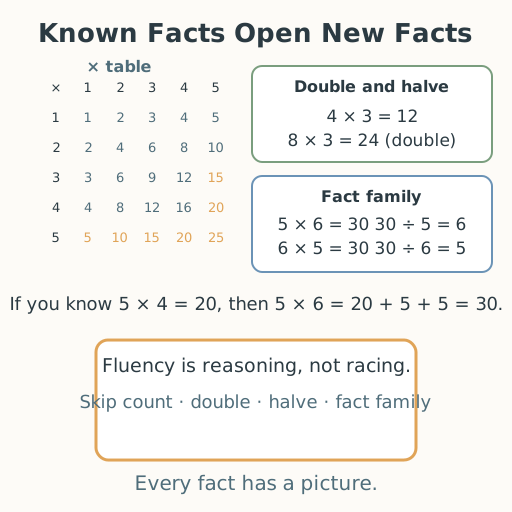
Lesson 5 — Multiplying & Dividing within 100
Summary
Learners fill a multiplication table to 10 × 10, find the facts they already know by skip counting, and use known facts — doubling, halving, and fact families — to reach every product and quotient within 100. Fluency grows from strategy and pattern, never from racing.
Objectives
- Multiply and divide within 100 and explain the meaning of each operation using objects, drawings, and known facts. (D05.S1.03.02)
Connection
A cook needs six tables of eight chairs; a farmer wants four rows of seven trees; a seamstress cuts three strips for each of nine cloths. No one counts every object one at a time — people use known facts and build new ones from them: if you know 4 × 5 is 20, then 4 × 6 is just one more four. The multiplication table is not a page to memorize by fear; it is a map of patterns that many cultures built the same way, by skip counting and doubling. Today you make the map your own.
Materials
- About 100 small objects or square tiles
- A multiplication table (blank or filled) to 10 × 10
- Paper or slate and a drawing tool
Preparation
- Give each learner or pair about 100 objects and a multiplication table.
- Clear space to build arrays and count aloud.
- Plan a quick example of using a known fact (5 × 4 = 20) to find a new one (5 × 6 = 30).
Facilitator note
This lesson is written to the learner (“you”). It builds on the meaning lessons (3 and 4) and turns to fluency within 100 — the new skill is using known facts and strategies (doubling, halving, skip counting, fact families) rather than memorizing in isolation. Teach with a worked example (philosophy §13): show that 5 × 4 = 20, so 5 × 6 is 20 plus two more fives; then show the fact family (5 × 6 = 30, 6 × 5 = 30, 30 ÷ 5 = 6, 30 ÷ 6 = 5). Fluency is not speed: a child who reasons to a fact is fluent; a child who races but cannot explain is not. No ranking, no timed tests — “not yet” is information, never a verdict (philosophy §8). The multiplication table is a human invention shared across traditions; it is one tool, not a test of worth. Count in the home language. For learners who are Deaf or hard of hearing, count with sign and point to the table; for learners who are blind or low-vision, build arrays in rows of cups and read facts by touch. Learners with limited movement direct a partner. Mastery arrives at its own pace.
Procedure
- Gather — facts you already know (5 min). You know how to count by twos, fives, and tens. That means you already know the 2s, 5s, and 10s facts. Say them: 5, 10, 15, 20, 25 … up to 100.
- Worked example — build from a known fact (8 min). Watch and help: build 5 rows of 4. Count by fives: 5, 10, 15, 20 — so 5 × 4 = 20. Now build 5 rows of 6. You know 5 × 4 = 20, so add two more fives: 20, 25, 30. 5 × 6 = 30. The known fact did the hard work.
- Fact families (8 min). From one fact, make four: 5 × 6 = 30, 6 × 5 = 30, 30 ÷ 5 = 6, 30 ÷ 6 = 5. Say them as one family. One fact you remember gives you four.
- Guided practice — fill the table (15 min). Fill in your multiplication table. Use skip counting for the rows you know, doubling and halving for the rest (double 4 × 3 = 12 to get 8 × 3 = 24; halve it to get 2 × 3 = 6). Mark the facts you already knew.
- Check with a friend (8 min). Compare tables with a friend. Do you agree? Where you differ, build the array together, kindly, and count again.
- Close (6 min). Remember: you never have to memorize a lonely fact. Known facts, doubling, halving, and fact families are your tools — and every fact has a picture.
Differentiation
- Support: Work only on the 2s, 5s, and 10s today; add other rows another day.
- Support (blind/low-vision): Use cups in rows to build facts and read them by touch, not sight.
- Extension: Use the distributive strategy — 7 × 6 = (5 × 6) + (2 × 6) = 30 + 12 = 42 — and explain why it works with an array.
Assessment
- Formative (observation): Can the learner use a known fact or strategy (skip counting, doubling, halving, a fact family) to find a product or quotient within 100 and explain it?
- Self: Can the learner name one fact they learned today and the strategy they used?
Home connection
At home, pick one multiplication fact and find its whole family (two multiplication and two division sentences), then show a grown-up how you built it from a fact you already knew.
Resources
- Van de Walle, J. A., Karp, K. S., & Bay-Williams, J. M. (2019). Elementary and Middle School Mathematics: Teaching Developmentally (10th ed.). Pearson. (Building multiplication fluency from known facts, doubling, halving, and the distributive property, rather than rote memorization.)