Lesson 06 — Heating and Cooling Change States
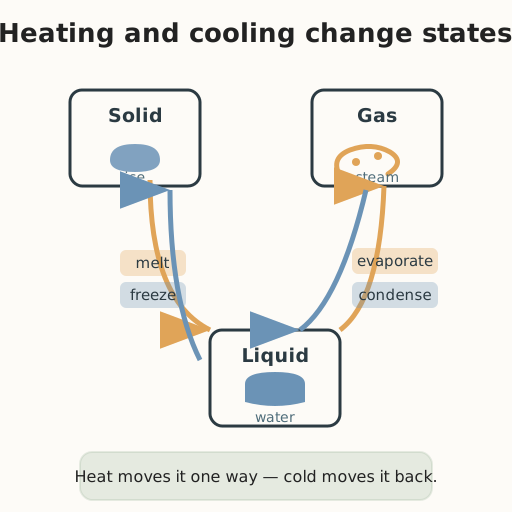
Learners discover that heating and cooling move matter between its states: heating melts a solid to a liquid and evaporates a liquid to a gas, while cooling freezes a liquid to a solid and condenses a gas back to a liquid. They watch water change before their eyes — ice melting, water evaporating, a puddle drying — and draw the change-of-state circle.
Objectives
Objectives
- D06.S3.03.01 Describe the three states of matter (solid, liquid, and gas) and how heating and cooling change them.
Essential question
How do heating and cooling move matter between solid, liquid, and gas?
Key vocabulary
Materials
Standard materials
- Ice cubes and a warm spot · per pair To watch a solid melt into a liquid
- A small cup of water and a cold place or freezer · per pair To watch a liquid freeze into a solid
- A warm, wet mark on a surface · 1 To watch a liquid evaporate (dry) into a gas over time
- Paper and crayons · per learner
Low-tech / no-cost
- Ice or snow and your own warmth Hold ice in your hand and watch it melt — body heat is heat
- A wet hand waved in the air Feel the water evaporate as your hand dries and cools
Enriched / lab & device
- A safe kettle or pan (adult use) to show steam · 1 Watch water boil into steam (gas) and condense on a cool lid back into liquid
- A change-of-state wheel · per learner A paper wheel to turn between solid, liquid, and gas with melt, freeze, evaporate, and condense on the spokes
Works in different contexts
- large-group Show melting and evaporation as a whole-group demonstration, then pairs test one change of state themselves
- self-directed A learner holds an ice cube until it melts, wets a finger and watches it dry, and draws the two changes
- outdoor-only Melt ice or snow in your hand, and watch a puddle shrink in the Sun — two changes of state right outside
- multi-age Older learners run the safe kettle demonstration while younger learners observe and name the change
- level-grouped Learners who can link two changes (melt then evaporate) trace the full water path; learners still learning match one change to its name
Lesson 6 — Heating and Cooling Change States
Summary
Water is the perfect teacher for change of state. Learners watch the same matter move between its three states: heating melts a solid into a liquid and evaporates a liquid into a gas, while cooling freezes a liquid into a solid and condenses a gas back into a liquid. They hold ice as it melts, watch a wet mark dry, and draw the circle that water travels — the same circle happening in kitchens, rivers, and skies everywhere.
Objectives
- Describe the three states of matter (solid, liquid, and gas) and how heating and cooling change them. (D06.S3.03.01)
Connection
You have seen this a hundred times: an ice cube melts into water in your warm hand; a puddle dries in the Sun; steam condenses into little drops on a cool window. That is one substance — water — moving between solid, liquid, and gas. Heat pushes it one way; cold pulls it the other. The same circle is making the rain and the snow and the clouds above your head, wherever you live.
Materials
- Ice cubes and a warm spot
- A small cup of water and a cold place or freezer
- A warm, wet mark on a surface
- Paper and crayons
Preparation
- Have ice cubes, a warm spot, and (if possible) a freezer or very cold place ready.
- Make a wet mark on a smooth surface to watch it dry over the lesson.
- If using a kettle or pan for steam, an adult operates it and keeps hands clear.
Facilitator note
This lesson is written to the learner (“you”). Anchor the four words — melt, freeze, evaporate, condense — with concrete, watched examples before the circle is drawn (concrete before abstract). Model once (worked example: “heat melts ice”), then let pairs test one change themselves. Note the four changes are reversible — matter is not created or destroyed here, just rearranged (a first seed of the conservation idea, deepened in Grade 4). Keep the global lens: the same freezing, melting, and evaporating waters a rice field, carves a river, and clouds a sky anywhere on Earth. If boiling water is shown, an adult handles the heat, and learners watch at a safe distance — no fear, just care. Distinguish the evidence (what we watched happen) from the words we use to name it; the names are tools.
Procedure
- Gather and remember (5 min). Last lesson you met the three states: solid, liquid, gas. Today: what makes matter change from one to another? The answer is heat and cold.
- Heat melts and evaporates (15 min). Hold an ice cube and watch it melt — a solid becomes a liquid. Watch a wet mark slowly dry in the warm air — the liquid evaporates into a gas you cannot see. Say the two heat words: melt, evaporate.
- Cold freezes and condenses (10 min). Put a small cup of water somewhere cold and predict what will happen: it will freeze into a solid. If you have steam or a cold window, watch a gas condense back into liquid drops. Say the two cold words: freeze, condense.
- Draw the circle (15 min). Draw water in its three states — ice, water, steam — in a circle. Draw arrows with the right words: heating goes melt → evaporate; cooling goes freeze ← condense.
- Close (5 min). Heat and cold are the hands that move matter between its states. The ice in your cup, the drying puddle, and the clouds in the sky are all the same water, changing.
Differentiation
- Support: Match two changes (ice melts, water freezes) to their names with a partner.
- Support (non-speaking): Point to the ice melting or the mark drying; a partner says the word.
- Support (blind/low-vision): Feel ice melt in your hand and feel the cool of your wet hand drying; name each change by telling.
- Support (motor): Direct a partner to hold the ice and wet the mark while you watch and name each change of state.
- Extension: Trace one water drop’s full journey through all four changes and tell where each might happen in the world.
Assessment
- Formative (observation): Can the learner name at least two changes of state and say whether heat or cold causes each?
- Artifact (portfolio): The labeled change-of-state circle drawing.
Home connection
At home, watch a change of state with a grown-up: an ice cube melting in a cup, a wet cloth drying on a line, or breath fogging a cold window. Name the change together.
Resources
- BBC Bitesize (KS2 Science), “Changing states” — melting, freezing, evaporating, and condensing, and how heating and cooling cause them. https://www.bbc.co.uk/bitesize/topics/zgwc96f/articles/zwj9r2p