Lesson 07 — Push and Pull — Forces and Motion
Learners discover that a force is a push or a pull, and that forces change motion: they start things moving, stop them, speed them up, slow them down, and turn them. They push and pull a toy and a partner and describe each change in their own words, feeling the force that moves their world.
Objectives
Objectives
- D06.S3.03.02 Explain that a push or pull (force) changes an object's motion, and describe friction.
Essential question
How does a push or a pull change an object's motion?
Key vocabulary
Materials
Standard materials
- A toy car or ball · per pair To push, pull, start, stop, and change direction
- A soft rope or cloth · per pair For a gentle tug-of-war pull
- Paper and crayons · per learner
Low-tech / no-cost
- Your own body and a partner Push a friend's hands, pull a partner's hands — forces you can feel
- A found object (a stone, a stick, a seed) Push it, pull it, and describe how its motion changes
Enriched / lab & device
- A small ramp or track · 1 To feel pushes change speed and direction on a track
- A "forces around me" hunt sheet · per learner A sheet to tally pushes and pulls seen around the room, school, or home
Works in different contexts
- large-group Take turns demonstrating a push and a pull to the group, then pairs test forces on a toy and describe the motion change
- self-directed A learner pushes and pulls a found object and writes or draws what each force made it do
- outdoor-only Push a stone, pull a branch, throw a seed into the wind — and describe how each force changed its motion
- multi-age Older learners name the motion changes (start, stop, speed up, slow down, turn) while younger ones push and pull
- level-grouped Learners who can describe direction changes too; learners still learning report just "it started" or "it stopped"
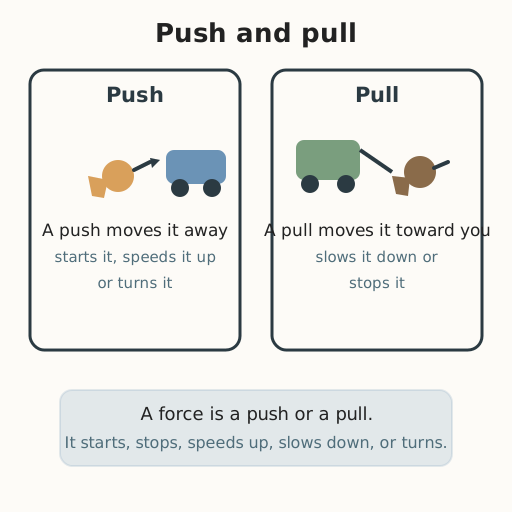
Lesson 7 — Push and Pull: Forces and Motion
Summary
A force is a push or a pull, and a force changes motion. Learners push and pull a toy car, a found object, and each other’s hands, and name the five ways a force changes motion: it can start, stop, speed up, slow down, or turn (change direction). They feel the invisible hand — force — that moves their world.
Objectives
- Explain that a push or pull (force) changes an object’s motion, and describe friction. (D06.S3.03.02)
Connection
Kick a ball and it rolls — that is a push. Open a drawer and it slides toward you — that is a pull. A force is any push or pull, and a force always does one of five things: it makes something start, stop, speed up, slow down, or turn. You use forces all day, everywhere — carrying water, rolling a tire, throwing a seed, pulling a fish from a line. The same force moves a bicycle in any city and a cart in any village.
Materials
- A toy car or ball
- A soft rope or cloth
- Paper and crayons
Preparation
- Have a toy car or ball and a soft rope ready per pair.
- Clear a safe space for pushing, pulling, and a gentle tug-of-war.
Facilitator note
This lesson is written to the learner (“you”). The idea is simple and physical, so let learners do it — but teach the five motion changes explicitly first with a worked example (push the car: “it started and sped up; now I stop it”), then let pairs explore (guided practice). Frame force as neutral and useful — forces are not violent; the same push that throws a ball also holds a door open gently. Keep it safe and cooperative: the tug-of-war is gentle and even, and learners feel both the push and the pull rather than competing. This lesson sets up Lesson 8 on friction — for now, hold the question “why does the car eventually stop on its own?” open, and let it be answered tomorrow. Include every body: forces can be felt and described by any learner, seated or standing.
Procedure
- Gather and remember (5 min). What makes things move? Try to move a toy car without touching it. It will not move. A force — a push or a pull — is what changes its motion.
- Meet the five changes (10 min). Watch the worked example: push the car — it starts and speeds up; catch it — it stops; pull it gently back — it slows down; nudge it from the side — it turns. Say the five: start, stop, speed up, slow down, turn.
- Push and pull (15 min). With a partner, push the car, pull it, turn it, stop it. Push your partner’s hands, pull them gently with the rope. Each time, say what the force did: “My push started it.” “My pull stopped it.”
- Draw a force (10 min). Draw one push and one pull from your day, and write or draw what each force changed.
- Close (5 min). A force is a push or a pull, and it changes motion. You are a force user — you push and pull your world into motion all day long.
Differentiation
- Support: Push and pull a toy with a partner and say just “started” or “stopped.”
- Support (non-speaking): Act out the push or pull; a partner says the motion change.
- Support (blind/low-vision): Feel a partner’s push and pull on your hands and name what each one did to your own motion.
- Support (motor): Direct a partner to push and pull the toy while you name each motion change — start, stop, speed up, slow down, or turn.
- Extension: Find one force that does three of the five changes at once (a rolling ball that starts, turns, and speeds up) and describe it.
Assessment
- Formative (observation): Can the learner push and pull an object and say what each force changed (start, stop, speed up, slow down, or turn)?
- Self: The learner checks their drawing: “Did I show what my force changed?”
Home connection
At home, find one push and one pull you do every day — closing a door, drawing a pail of water, pushing a broom. Tell a grown-up what each force changes.
Resources
- BBC Bitesize (KS2), “What is a force?” — pushes and pulls and how forces change motion. https://www.bbc.co.uk/bitesize/topics/zvr3nrd/articles/zywcrdm