Lesson 09 — Day, Night, and the Seasons
Learners discover why we have day and night and the seasons: Earth spins (rotates) once a day, so one side faces the Sun (day) while the other is dark (night), and Earth travels (orbits) the Sun once a year with a tilt, making the seasons. They model it with a ball and a light, see that day for one place is night for another, and hold the big story of the Sun and Earth as a story told from evidence, alongside other ways people have told it.
Objectives
Objectives
- D06.S4.03.01 Explain how Earth's rotation causes day and night and how its orbit causes the seasons.
Essential question
How does Earth's turning make day and night, and how does its orbit make the seasons?
Key vocabulary
Materials
Standard materials
- A ball to be the Earth and a lamp or bright spot to be the Sun · 1 set To model day and night as the ball turns
- A marked stick or pencil through the ball · 1 To show Earth's tilt as it orbits
- Paper and crayons · per learner
Low-tech / no-cost
- A ball or round fruit and a partner's light or a shadow Turn the ball — the lit side is day, the dark side is night
- Voice and body One learner is the Sun, another spins as the Earth, another walks the orbit around the Sun
Enriched / lab & device
- A small globe and a flashlight · 1 set To see day, night, and the tilt that makes seasons
- A day-length chart from two places on Earth · 1 To compare daylight hours in different seasons and places
Works in different contexts
- large-group Model day and night with one learner as the Sun and the group as the spinning Earth, then pairs model it with a ball and a light
- self-directed A learner turns a ball beside a light, notices the lit and dark halves, and draws day, night, and the orbit
- outdoor-only Use the real Sun and your own shadow — turn around to feel your body's day side and night side, and notice the shadow's length by season
- multi-age Older learners label the orbit and tilt while younger learners spin and point to day and night
- level-grouped Learners who can explain the tilt-and-seasons link do so; learners still learning describe just day and night from the turning
Lesson 9 — Day, Night, and the Seasons
Summary
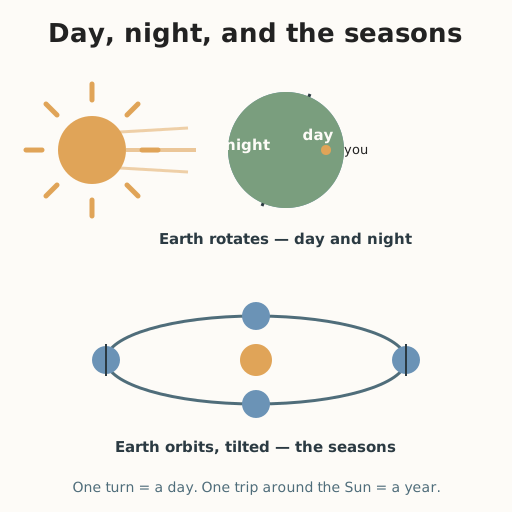
Why is it light when you wake and dark when you sleep? Earth spins — rotates — once each day, so the side facing the Sun has day and the side turned away has night. And Earth travels — orbits — the Sun once each year, tilted a little as it goes, and that tilt makes the seasons. Learners model it with a ball and a light, and discover that when it is day for you, it is night for someone on the other side of the world.
Objectives
- Explain how Earth’s rotation causes day and night and how its orbit causes the seasons. (D06.S4.03.01)
Connection
Every morning the Sun seems to rise, and every evening it seems to set. It is not the Sun moving — it is you, riding a spinning Earth. One whole turn is a day: the side facing the Sun is in daylight, and the side turned away is in night. And as Earth slowly orbits the Sun over a whole year, tipped a little to one side, the Sunlight falls higher or lower, and the world warms into summer and cools into winter. Right now, on the other side of the planet, someone is sleeping in the night while you are awake in the day.
Materials
- A ball to be the Earth and a lamp or bright spot to be the Sun
- A marked stick or pencil through the ball
- Paper and crayons
Preparation
- Set up the lamp (or use a sunny window) as the “Sun” and have the ball ready.
- Mark a dot on the ball as “you,” so learners can watch it move into light and dark.
Facilitator note
This lesson is written to the learner (“you”). Model day and night concretely first — turn the ball and point to the lit and dark halves — then name rotate and orbit (concrete before abstract). Be careful with a common misconception: learners may think the Sun moves around us; gently correct with the spinning-ball model, saying “the Sun seems to move because we turn.” For seasons, the tilt is the key idea at this level — keep it simple and honest, not exhaustive. Hold the big story with care (§11): the spinning Earth and orbiting seasons are what scientists tell from evidence gathered over centuries; other cultures have told the story of the Sun and Earth in their own beautiful ways, and both can be honored — science is one way of knowing, not the only one. Keep the global lens: day length and seasons differ with latitude — near the equator the seasons barely change, and far north or south the days grow very long or short. No fear — this is the steady, reliable rhythm of our home.
Procedure
- Gather and remember (5 min). Where does the Sun go at night? It does not go anywhere — the Earth is doing the moving. Today you will see how.
- Day and night (15 min). Turn the ball slowly beside the light. The side facing the Sun is in day; the side turned away is in night. Earth makes one full rotation — one turn — every day. Find the dot that is “you” and watch it move from light into dark and back. Say it: Earth rotates; that is day and night.
- The seasons (15 min). Now walk the ball in a big circle around the Sun — that is Earth’s orbit, one full trip each year. Earth is tilted a little as it goes. When your part of Earth is tipped toward the Sun, the Sun sits higher and you get summer; tipped away, the Sun sits lower and you get winter. That tilt, not how close Earth is, makes the seasons.
- Draw it (10 min). Draw the spinning Earth with day on one side and night on the other, and draw the tilted orbit with the four seasons.
- Close (5 min). Earth spins and orbits, tilted as it goes — and that is why you have morning and night, summer and winter. A steady, spinning home, carrying you through light and dark. Scientists tell this story from evidence they gathered over many years. People all over the world have also told the story of the Sun and Earth in their own beautiful ways, and both can be honored side by side.
Differentiation
- Support: Turn the ball with a partner and point to the lit side (day) and dark side (night).
- Support (non-speaking): Point to the day side and night side of the ball; a partner says the words.
- Support (blind/low-vision): Feel the warm lamp (Sun) on your face, then turn away to feel the “night side” of your own body, and describe the difference.
- Support (motor): Direct a partner to turn the ball and walk the orbit while you point out day, night, and the tilt.
- Extension: Explain why it is summer in one hemisphere while it is winter in the other, using the tilt.
Assessment
- Formative (observation): Can the learner explain (or model) that Earth’s turning makes day and night and that its tilted orbit makes the seasons?
- Artifact (portfolio): The labeled day-night-and-seasons drawing.
Home connection
At home, notice when the Sun rises and sets over the week, or watch the daylight get longer or shorter through the season. Tell a grown-up what Earth is doing while you watch.
Resources
- NASA Space Place, “What Causes the Seasons?” and “Why Do We Have Day and Night?” — Earth’s rotation and tilted orbit, explained for children. https://spaceplace.nasa.gov/seasons/en/