Lesson 01 — Patterns in Art
Learners find patterns in the world around them, then make an artwork that uses a repeating shape, line, or color. They discover that a pattern is something that comes back the same way, and that repeating shapes and lines are a language every culture has used to decorate cloth, homes, and baskets.
Objectives
Objectives
- D07.S1.03.01 Use a simple pattern or repetition of shape, line, or color in an artwork.
Essential question
How do I use a repeating shape, line, or color to make a pattern in my artwork?
Key vocabulary
Materials
Standard materials
- Paper and drawing tools · per learner Crayons, colored pencils, or markers to make a pattern
- A few pattern examples to notice · 1 set A woven cloth, a leaf, a shell, a tile, or a printed border with repeating shapes
Low-tech / no-cost
- Sticks, stones, leaves, and sand or dirt Press and repeat natural shapes to make a pattern on the ground
- A finger or twig as a drawing tool Draw a repeating line or shape in sand, mud, or dust
Enriched / lab & device
- A stamp or stencil set · 1 set per learner or pair Cut shapes from a sponge, leaf, or potato to repeat a print
- Fabric or woven samples from more than one culture · 1 set To notice how repeating patterns live in real cloth and baskets everywhere
Works in different contexts
- large-group Show one big pattern on a chart — "triangle, triangle, circle, triangle, triangle, circle" — and repeat it aloud together before learners make their own
- multi-age Younger learners repeat one shape; older learners alternate two or three shapes in a row; pair them to compare patterns
- self-directed A learner finds a pattern around them, repeats it with one shape, line, or color in their own artwork, and checks that the repeat stays the same
- level-grouped Some learners repeat a single shape or line; others alternate two or three elements; match the challenge to the learner
- outdoor-only Gather leaves, stones, and shells and press them in a repeated row in sand, or draw a repeating line in the dirt with a stick
Lesson 1 — Patterns in Art
Summary
Learners find patterns all around them — in cloth, leaves, shells, and tiles — and then make an artwork that uses a repeating shape, line, or color. They discover that a pattern is something that comes back the same way, and that repeating shapes and lines are a language people everywhere have used to decorate cloth, homes, and baskets.
Objectives
- Use a simple pattern or repetition of shape, line, or color in an artwork. (D07.S1.03.01)
Connection
Look around you — the weave of a cloth, the ribs of a leaf, the tiles on a floor, the border of a blanket or a basket. A pattern is the same shape, line, or color coming back again and again. People everywhere have repeated shapes and lines to make things beautiful: woven cloth in one part of the world, painted borders in another, carved shells and beads in a third. Today you will make a pattern of your own.
Materials
- Paper and drawing tools (crayons, colored pencils, or markers)
- A few pattern examples to notice (a cloth, a leaf, a shell, a tile, a printed border)
Preparation
- Gather a few real objects that show repeating patterns for learners to look at and touch.
- Have paper and drawing tools ready for each learner.
Facilitator note
This lesson is written to the learner (“you”) so it works in a classroom and for a self-directed learner. Making a repeating pattern is a skill, so model one aloud and on the board first — “triangle, triangle, circle; triangle, triangle, circle” — before learners try their own (Kirschner, Sweller & Clark, 2006). A pattern is a repeat, not a perfect drawing; if the repeat stays the same, it is a pattern. A learner who is blind or has low vision makes a pattern by touch and placement: they arrange repeated objects (two stones, one leaf; two stones, one leaf) in a row, or press a repeated shape into clay, and a partner names the sequence. A learner with limited fine motor repeats with a big sponge stamp, a cut-out stencil, or by directing a partner who places the shapes. A learner who does not speak points to the elements and shows the repeat. Every pattern belongs.
Procedure
- Gather (5 min). Look at the objects in front of you. Do you see the same shape, line, or color coming back again and again? That is a pattern. A pattern is a repeat.
- Find patterns (10 min). Look around the room and out the window. Where do you see a repeat — a row of bricks, a stripe in a cloth, the ribs of a leaf? Touch the examples and trace the repeat with a finger.
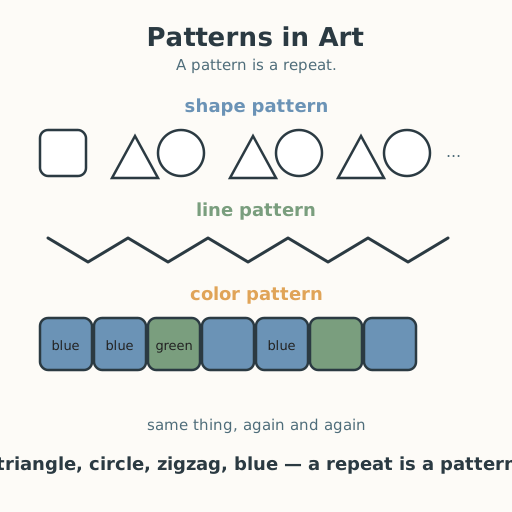
- Choose your repeat (10 min). Pick one thing to repeat in your artwork: a shape (a circle, a triangle), a line (a zigzag, a wave), or a color (blue, blue, green). Say or point to what you will repeat.
- Make your pattern (15 min). Draw, stamp, or press your repeat across the page — the same shape, line, or color coming back the same way. You may alternate two things (triangle, circle, triangle, circle) or keep one. Your pattern is yours; no one has made exactly this repeat before.
- Share and close (5 min). Show a friend or grown-up your pattern. Point to the part that repeats. Remember: a pattern is something that comes back the same — and repeating shapes and lines are how people everywhere have made things beautiful.
Differentiation
- Support: Offer one clear repeat (“draw a circle, then another circle, then another”) and let the learner keep that one pattern going.
- Support (blind/low-vision): Make a pattern by touch — repeated objects in a row or a pressed shape in clay — with a partner naming the sequence.
- Support (fine motor): Repeat with a big sponge stamp, a cut-out stencil, or by directing a partner who places the shapes.
- Support (non-speaking): Point to the repeated element and show the repeat with a finger.
- Extension: Invite learners to alternate two or three elements (triangle, circle, square) and to name what comes next in the sequence.
Assessment
- Formative (observation): Does the learner use a repeated shape, line, or color in an artwork, and point to the part that repeats?
- Artifact (portfolio): The learner’s patterned artwork, kept in the portfolio (or a photo of it).
Resources
- No external resources required; the claims in this lesson are about the learner’s own making and about the shared human practice of repeating pattern, which learners observe directly.
Home connection
At home, find a pattern with a grown-up — the weave of a cloth, the stripes of a blanket, the leaves of a plant. Then make your own small pattern together and point to the part that repeats.