Lesson 02 — Mood in a Picture
Learners name the mood of an artwork and point to what in the picture creates it — the color, the line, the shape. Then they make a small picture with a chosen mood. They discover that pictures speak a language of feeling, and that the same feeling can be shown in pictures from many places.
Objectives
Objectives
- D07.S1.03.02 Describe the mood of an artwork and point to what in the picture creates it.
Essential question
How do I describe the mood of an artwork and point to what in the picture creates it?
Key vocabulary
Materials
Standard materials
- A few artworks to look at · 1 set Two or three pictures with clearly different moods (a calm scene, an exciting scene, a stormy scene)
- Paper and drawing tools · per learner To make a small picture with a chosen mood
Low-tech / no-cost
- The world as the gallery Notice the mood of a sky, a wall, a shadow, or a face — no supplies needed
- A stick or finger to draw in sand or dirt Draw a small picture with a chosen mood on the ground
Enriched / lab & device
- Pictures of artworks from more than one culture · 1 set A calm print, an energetic painting, a stormy scene — to notice mood across traditions
- A "mood word" card set · 1 set Cards with words like calm, wild, lonely, joyful to point to when naming a mood
Works in different contexts
- large-group Show one artwork to the whole group and ask "what mood?" then "point to what makes it that way"; gather several ideas before moving on
- multi-age Older learners name the mood and the picture clues; younger learners point to the part of the picture that gives the feeling
- self-directed A learner looks at an artwork, names its mood, points to the part that creates it, then makes their own small picture with a chosen mood and checks it
- level-grouped Some learners name one mood and one clue; others name a mood and two or three clues (color, line, shape); match the challenge
- outdoor-only Read the mood of the sky, the trees, or the light, and point to what makes it feel that way, then draw a mood in the dirt
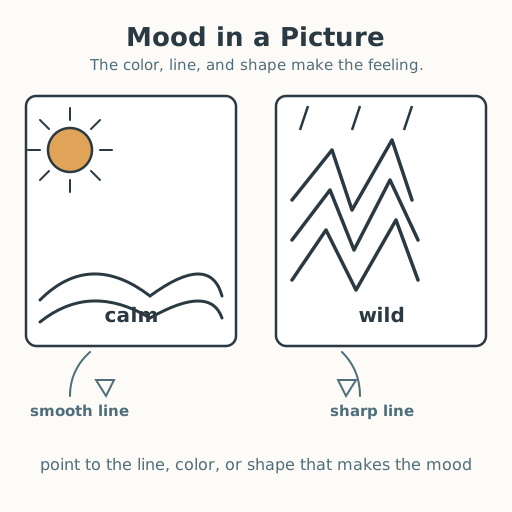
Lesson 2 — Mood in a Picture
Summary
Learners name the mood of an artwork and point to what in the picture creates it — the color, the line, the shape. Then they make a small picture with a chosen mood. They discover that pictures speak a language of feeling, and that the same feeling can be shown in pictures made far away and long ago.
Objectives
- Describe the mood of an artwork and point to what in the picture creates it. (D07.S1.03.02)
Connection
A picture can make you feel something before you say a single word — a soft blue sunset feels calm, a jagged dark storm feels wild, a bright crowded market feels excited. The feeling a picture gives you is its mood, and it does not come from nowhere: the color, line, and shape in the picture make it. Today you will look at pictures, name their mood, and point to what makes them feel that way.
Materials
- A few artworks to look at (a calm scene, an exciting scene, a stormy scene)
- Paper and drawing tools
Preparation
- Choose two or three pictures with clearly different moods to look at together.
- Have paper and drawing tools ready for each learner.
Facilitator note
This lesson is written to the learner (“you”) so it works in a classroom and for a self-directed learner. Naming mood and pointing to evidence is a skill, so model it once — “this picture feels calm; the smooth line and light color make it calm” — before learners try on their own (Kirschner, Sweller & Clark, 2006). There is no single “right” mood; two learners may feel two things about one picture, and both can be true — ask “what in the picture makes you feel that?” rather than “is that the correct mood?” A learner who is blind or has low vision reads mood through a spoken description of the color, line, and shape, and through touch (raised-line or textured versions); they name the mood and point to the described clue. A learner who does not speak points to a mood word card or to the part of the picture. Mood is a feeling, and everyone’s feeling is welcome.
Procedure
- Gather (5 min). Look at the first picture. What feeling rises up in you — calm, wild, joyful, lonely, excited? That feeling is the picture’s mood.
- Name the mood (10 min). Say the mood word, or point to a mood word card. There is no wrong answer: if the picture feels calm to you, that is real.
- Point to the clue (15 min). Now look again. What in the picture makes you feel that way? Point to it and name it — the color (dark and heavy, light and soft), the line (smooth and curved, sharp and jagged), or the shape (round and gentle, spiky and sudden). That is your evidence.
- Make a mood (10 min). Draw a small picture with a mood you choose — calm, wild, excited, quiet. Use color, line, and shape to make it feel that way.
- Share and close (5 min). Show your picture. Tell (or point to) its mood, and point to what in it creates the feeling. Remember: pictures speak a language of feeling, and the clues are in the color, line, and shape.
Differentiation
- Support: Offer two clear choices (“does this feel calm or wild?”) and one clue to point to (“point to the dark color”).
- Support (blind/low-vision): Name the mood from a spoken or tactile description and point to the described clue; a partner can describe the color and line.
- Support (non-speaking): Point to a mood word card and to the part of the picture that gives the feeling.
- Extension: Invite learners to name a mood and two or three clues, and to compare two pictures with different moods (“this one is calm because the line is smooth; this one is wild because the line is sharp”).
Assessment
- Formative (observation): Does the learner name a mood and point to a color, line, or shape that creates it?
- Artifact (portfolio): The learner’s mood picture, kept in the portfolio (or a photo of it).
Resources
- No external resources required; the claims in this lesson are about the learner’s own looking and feeling, which they practice directly.
Home connection
With a grown-up, look at a picture in a book or on a wall and name its mood. Then each of you points to the part of the picture that makes you feel that way, and see if you agree.